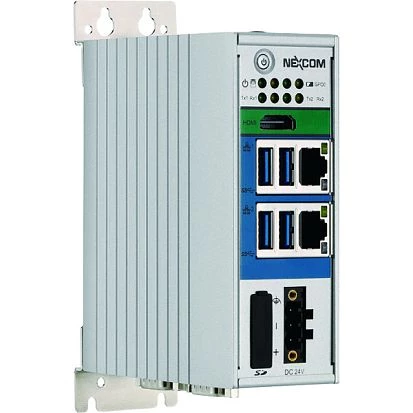
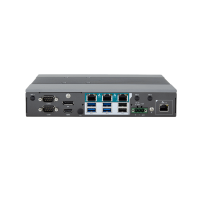
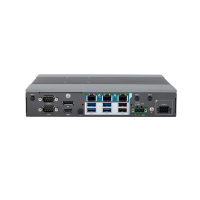
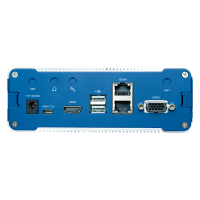
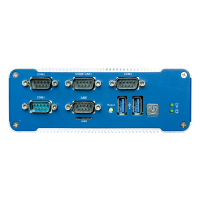
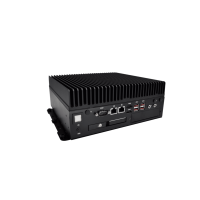
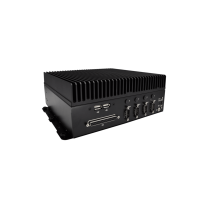
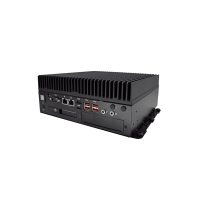
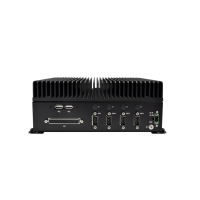
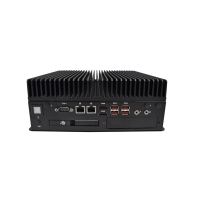
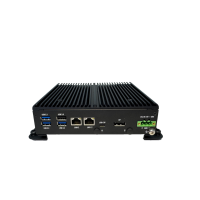
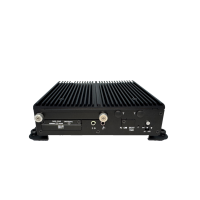
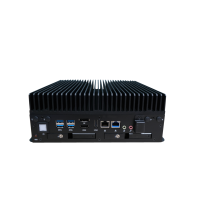
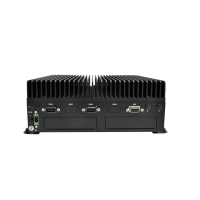
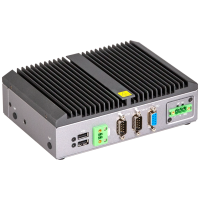
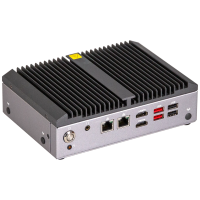
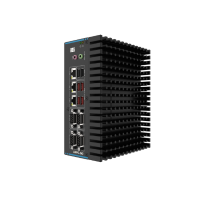
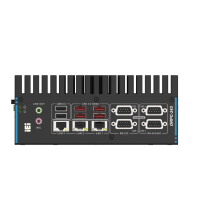
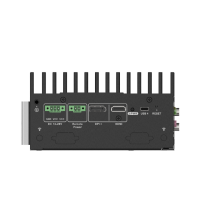
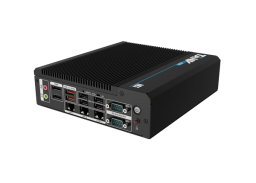
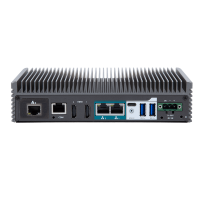
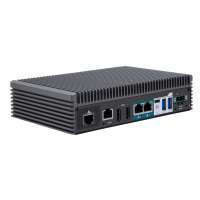
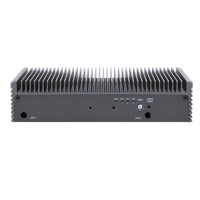
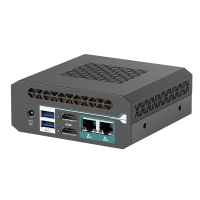
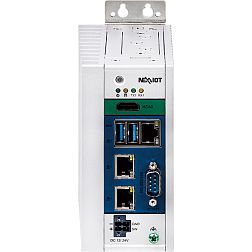
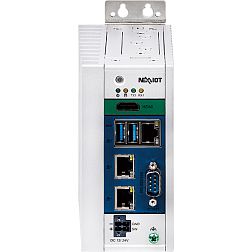
NIFE-105
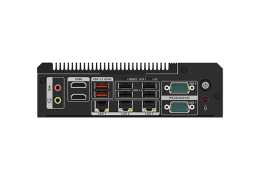
The dual Intel I210-IT NICs enable OT/IT network separation: one port operates as an EtherCAT master interface for real-time fieldbus communication with servo drives, distributed I/O modules and motion controllers when running a SoftPLC software stack such as Beckhoff TwinCAT 3 or CODESYS; the second port maintains standard Gigabit Ethernet connectivity for SCADA communication, remote management and data transfer to IT systems. Windows 10 Enterprise provides the runtime environment for SoftPLC applications, HMI software and industrial middleware, whilst the two mini-PCIe slots accept optional Wi-Fi, 3.5G or 4G/LTE modules for wireless connectivity in installations where fixed Ethernet cabling is unavailable.
Key Features
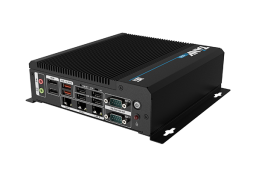
- Intel Atom x5-E3930 Dual Core 1.8 GHz — Fanless from −20 °C to +70 °C: The x5-E3930 processor's low TDP combined with NEXCOM's passive thermal design enables fully fanless operation across an industrial temperature range covering cold storage environments, outdoor gateway cabinets and high-ambient machine rooms without fan maintenance; the dual-core architecture provides sufficient processing headroom to run a SoftPLC control application, EtherCAT master stack and local data logging tasks concurrently on Windows 10 Enterprise without performance contention between real-time and non-real-time processes
- Dual Intel I210-IT GbE with EtherCAT, WoL, Teaming and PXE: Two Intel I210-IT controllers provide independent Gigabit Ethernet ports supporting EtherCAT master operation for real-time fieldbus communication with IEC 61158-compatible servo drives, distributed I/O and motion control hardware when used with a compatible SoftPLC software stack; Wake-on-LAN enables remote power-on for scheduled maintenance tasks; teaming supports active/passive NIC redundancy for network availability; PXE boot supports network-based OS deployment across multi-node installations
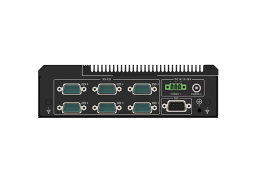
- 2× RS-232/422/485 DB9 with 2,500 V Isolation — Plus 2× Internal RS-232 Headers: COM1 and COM2 (external DB9 connectors) support RS-232, RS-422 and RS-485 with auto flow control and 2,500 V galvanic isolation, breaking ground loops between the NIFE-105 and field devices on separate earth potentials without requiring external serial isolators; two additional RS-232 COM ports (COM3 and COM4) are available as internal TX/RX/RTS/CTS pin headers (J3) for connection to internal serial peripherals within the enclosure
- 4× GPO + 4× GPI — TTL 5 V Discrete I/O via Internal Header: Four general-purpose output channels (GPO0–GPO3) and four general-purpose input channels (GPI0–GPI3) are provided via the internal J2 pin header at TTL 5 V logic levels, enabling direct connection to digital sensors, relay outputs, indicator lamps and machine status signals for discrete event monitoring and control without a separate digital I/O expansion card; the internal header location keeps signal wiring within an enclosed chassis
- 2× Full-Size mini-PCIe for Wireless and Storage Expansion — Plus Internal SATA and SD Card: Two full-size mini-PCIe sockets (USB + PCIe signal) accept optional Wi-Fi (802.11 a/b/g/n/ac), 3.5G and 4G/LTE wireless modules; a dedicated SIM card socket routes cellular connectivity to the appropriate slot; an mSATA SSD can be installed in place of a wireless module for expanded solid-state storage; an internal SATA signal connector (CN3) with power header (J1) provides an additional path for a 2.5" SATA SSD; an external SD card slot provides removable media access for data export and firmware management
- +24 V DC AT/ATX Power, Remote Switch Header, 46.2 × 100 × 120 mm Form Factor: A 3-pin terminal block accepts +24 VDC ±20% from standard industrial power supplies; AT/ATX power mode is switch-selectable — AT mode powers on automatically with supply voltage for auto-restart applications; ATX mode requires a power button signal for managed start-up; a remote switch/S3 internal header (JP1) enables panel-mounted power control; the 46.2 × 100 × 120 mm chassis installs within compact controller cabinets without consuming a DIN-rail section
- Windows 10 Enterprise, 4× USB 3.0, HDMI Display and Internal USB 2.0 Header: Windows 10 Enterprise 64-bit provides the platform for SoftPLC runtimes, SCADA HMI software and industrial middleware including real-time extension frameworks required for deterministic EtherCAT execution; four USB 3.0 Type-A ports (900 mA each) connect USB-to-fieldbus adapters, industrial cameras and USB storage devices; one HDMI port drives a local monitor for HMI or configuration access; an internal USB 2.0 header (500 mA) accommodates a security dongle or internal USB module
Configuration and Expansion Options
| Expansion Type | Interface Used | Notes |
|---|---|---|
| Wi-Fi 802.11 a/b/g/n/ac | mini-PCIe CN1 or CN2 | Optional Wi-Fi module; both sockets carry USB + PCIe signal |
| 3.5G / 4G LTE cellular | mini-PCIe CN1 (default) + SIM slot | SIM card power routed to CN1 by default; CN2 selectable via SW1 |
| mSATA SSD | mini-PCIe CN1 or CN2 | Additional solid-state storage beyond the onboard 16 GB eMMC |
| 2.5" SATA SSD / HDD | Internal CN3 (signal) + J1 (power) | Mass storage expansion independent of mini-PCIe slots |
| SD card | External SD slot | Removable media for data logging files, firmware images and OS backups |
| 24 V / 60 W AC/DC power adapter | — | Optional external adapter (P/N: 7400060054X00); not supplied with base unit |
Application Use Cases
EtherCAT SoftPLC Controller for Machine Automation
Deployed as the controller in a servo motor and distributed I/O system, the NIFE-105 runs a SoftPLC software stack — Beckhoff TwinCAT 3, CODESYS or equivalent — on Windows 10 Enterprise, using one Intel I210-IT NIC as an EtherCAT master interface to communicate with servo drives, digital I/O terminals, analogue I/O modules and safety controllers on a real-time EtherCAT network. The palm-size chassis mounts within the machine's existing control cabinet, consolidating the fieldbus master, Modbus RTU gateway and HMI server functions into a single platform connected to the engineering network through the second I210-IT NIC — reducing the panel component count versus a separate PLC, serial gateway and industrial PC.
M2M Gateway and Industrial IoT Edge Node
In machine-to-machine communication deployments, the NIFE-105 aggregates data from multiple field devices: Modbus RTU instruments on COM1/COM2 (RS-485 with 2,500 V isolation), EtherCAT devices on LAN1 and USB field devices on the four USB 3.0 ports. An optional 4G/LTE mini-PCIe module combined with the integrated SIM slot provides cellular backhaul to a cloud IoT platform, enabling remote monitoring, OTA configuration updates and alarm notifications from installations without fixed Ethernet infrastructure. The 16 GB eMMC and optional SATA SSD store edge analytics data locally for resilience against connectivity interruptions.
Serial Protocol Gateway and Modbus Data Concentrator
With COM1 and COM2 providing isolated RS-232/422/485 with auto flow control and COM3/COM4 available as internal RS-232 headers, the NIFE-105 supports up to four simultaneous serial device connections at different baud rates and protocols. Running protocol conversion software on Windows 10 Enterprise, it aggregates Modbus RTU data from energy meters, motor drives, temperature controllers and flow meters into a Modbus TCP or OPC UA endpoint accessible over Gigabit Ethernet by upstream SCADA or MES systems — functioning as a protocol gateway and data concentrator with no additional gateway hardware required in the panel.
Compact Embedded Controller for Space-Constrained Installations
The 46.2 × 100 × 120 mm form factor makes the NIFE-105 suitable for integration into machine frames, robot controllers and specialised equipment where a standard DIN-rail controller chassis occupies too much panel space. The +24 VDC ±20% input connects directly to the machine's existing 24 V DC bus; AT mode enables automatic power-on with machine start without a dedicated power controller; the GPIO header (4 in, 4 out) connects to machine digital I/O signals for status monitoring, interlock control and alarm indication directly from the controller chassis without an external I/O expansion unit.
Remote Monitoring Node with Wireless Backhaul
For remote utility monitoring, substation control and pipeline telemetry applications, the NIFE-105 with an optional 4G/LTE mini-PCIe module provides a self-contained monitoring and communication node: RS-485 on COM2 connects to Modbus RTU instruments; the GPIO inputs monitor alarm contacts and digital status signals; the onboard eMMC and optional SD card store local data for offline resilience; and the LTE module provides cellular backhaul to the control centre over a VPN connection. The −20 °C to +70 °C operating range accommodates outdoor enclosure ambient temperatures without supplementary cabinet heating at remote sites.
Why Choose the NIFE-105
EtherCAT SoftPLC in a 46 × 100 × 120 mm Chassis
The combination of two Intel I210-IT NICs — supporting EtherCAT master operation under TwinCAT 3 or CODESYS — with Windows 10 Enterprise and a palm-size form factor addresses a specific integration challenge: deploying a real-time fieldbus master in installations where panel space is severely constrained. Traditional EtherCAT controller platforms — DIN-rail bus couplers, rack-mount industrial PCs, embedded control modules — typically require substantially more panel real estate. The NIFE-105 provides EtherCAT master capability and a full Windows 10 SoftPLC runtime within a chassis that can be mounted inside a controller cabinet door or within the machine body itself, without reserving a DIN-rail rail section or a separate equipment rack bay.
2,500 V Isolated Serial Ports — Without an External Isolator
Galvanic isolation on RS-232/422/485 COM ports is a specification frequently absent from compact industrial PCs at this form factor — it is typically found in larger rack-mount serial interface cards or dedicated serial isolator units purchased separately. The NIFE-105 includes 2,500 V isolation as standard on both external DB9 COM ports, providing ground loop protection for RS-485 networks that connect instruments, drives and controllers powered from different supply circuits. This eliminates the need for external DIN-rail serial isolators or fibre-optic RS-485 repeaters between the NIFE-105 and its serial field devices, reducing wiring cost and cabinet component count in installations with mixed-supply serial networks.
Dual mini-PCIe Flexibility — One SKU for Wired and Wireless Deployments
Two independent mini-PCIe sockets allow the NIFE-105 to be configured for different deployment scenarios from the same base hardware: one slot carries a Wi-Fi module whilst the other provides cellular LTE; storage-intensive deployments add an mSATA SSD to one slot whilst retaining a wireless interface in the other; the independent internal SATA connector provides a further storage path alongside both mini-PCIe modules simultaneously. A single procurement SKU therefore covers both wireless-connected field nodes and wired-only installations with expanded local storage — simplifying spares inventory management for projects deploying the NIFE-105 across multiple sites or machine variants.
Frequently Asked Questions
Does the NIFE-105 support EtherCAT?
Yes. The NIFE-105 uses dual Intel I210-IT Gigabit Ethernet controllers, which support EtherCAT master operation when used with a compatible SoftPLC software stack such as Beckhoff TwinCAT 3, CODESYS with EtherCAT master functionality, or open-source EtherCAT master implementations. One I210-IT NIC is dedicated to the EtherCAT fieldbus network; the second maintains standard Gigabit Ethernet connectivity for IT/OT network communication, SCADA access and remote management.
How many serial COM ports does the NIFE-105 provide?
The NIFE-105 provides four serial COM ports in total: COM1 and COM2 are external DB9 connectors supporting RS-232, RS-422 and RS-485 with auto flow control and 2,500 V galvanic isolation; COM3 and COM4 are internal RS-232 pin headers (TX/RX/RTS/CTS) available via the J3 internal header for connecting internal serial peripherals within the chassis enclosure. All four COM ports are independently addressable for simultaneous multi-device serial communication.
What expansion options are available for the NIFE-105?
The NIFE-105 includes two full-size mini-PCIe sockets (USB + PCIe signal) accepting optional Wi-Fi, 3.5G, 4G/LTE and mSATA modules, with a dedicated SIM card socket for cellular modules. An internal SATA signal connector (CN3) with power header (J1) provides an additional path for a 2.5" SATA SSD independently of the mini-PCIe slots. An external SD card slot accepts standard SD cards for removable storage. The onboard 16 GB eMMC provides base storage for the OS and application software.
What power input does the NIFE-105 require?
The NIFE-105 accepts +24 VDC ±20% via a 3-pin terminal block connector. AT and ATX power modes are switch-selectable: AT mode powers on automatically when supply voltage is applied, suitable for automation equipment that starts with the machine; ATX mode requires a power button signal for managed start-up. A remote switch/S3 internal header enables panel-mounted power control. An optional 24 V / 60 W AC/DC power adapter is available separately (P/N: 7400060054X00).
What operating system does the NIFE-105 support?
The NIFE-105 is officially supported with Windows 10 Enterprise 64-bit, which provides the runtime environment for SoftPLC applications, SCADA HMI software and industrial middleware. The Windows 10 platform supports real-time extension frameworks required for deterministic SoftPLC execution, including Beckhoff TwinCAT 3's kernel-mode real-time extension and CODESYS runtime, which operate as Windows services with elevated hardware timer interrupt priority for fieldbus cycle time determinism.








Get a Quote