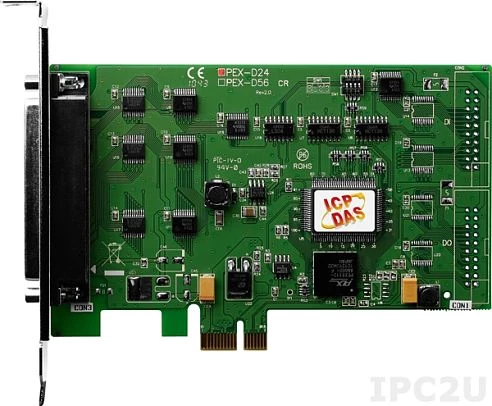
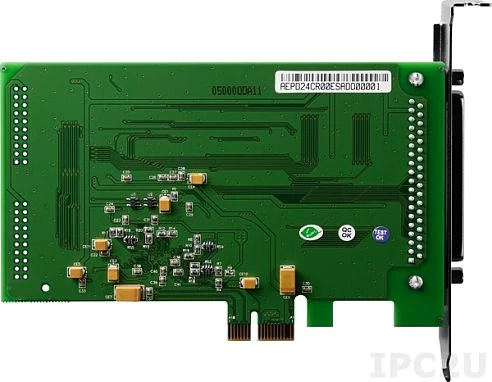
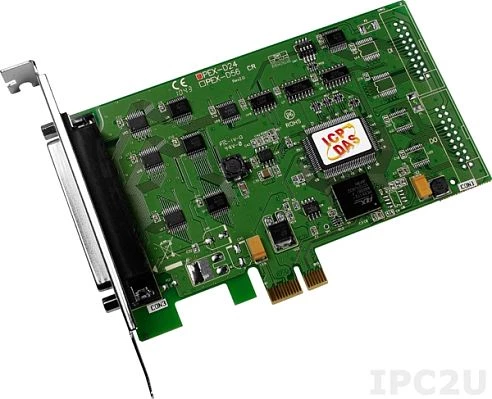
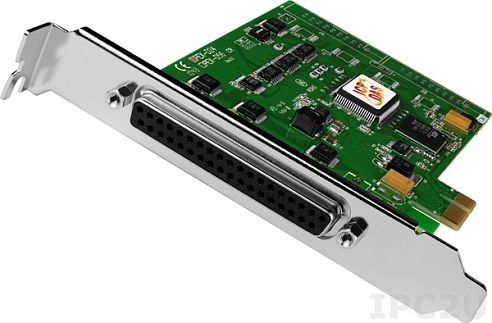
PEX-D24

ICP DAS
SKU: 05841600
PCI Express 24DI/O
Price on request
Available
Available

The PEX-D24 is a direct software and driver-compatible replacement for the ICP DAS PIO-D24 and PIO-D24U series PCI and Universal PCI cards, enabling system integrators to migrate existing automation applications to PCIe platforms without rewriting drivers, modifying software logic or replacing cabling. A 4-bit Card ID SMD switch identifies each card individually in multi-card installations, and four programmable interrupt sources allow interrupt-driven I/O routines to be implemented alongside polled applications without additional hardware.

Key Features

  • 24 Bidirectional 5V/TTL Digital I/O Channels — Three 8-Bit Ports: All 24 channels are individually configurable as digital inputs or digital outputs under software control; input threshold is 2.0 V minimum for logic ON and 0.8 V maximum for logic OFF; output sink current is 64 mA at 0.8 V and source current is 32 mA at 2.0 V — capable of directly driving optocoupler inputs, relay coil drivers, and TTL logic without external buffers in the majority of industrial wiring configurations
  • 8255 PPI Mode 0 Emulation — Direct Software Migration from PIO-D24: The PEX-D24 emulates two Intel 8255 Programmable Peripheral Interface ports in Mode 0, the same register-level interface used by the legacy PIO-D24 and PIO-D24U cards; existing applications written for those cards — including programmes using ICP DAS DLL libraries, LabVIEW drivers or direct register access — run on the PEX-D24 without modification, eliminating software redevelopment cost during PC chassis upgrades from PCI to PCIe platforms
  • 500 kHz Response Speed (~2 μs) on All Channels: Buffered TTL I/O on all 24 channels supports switching frequencies up to 500 kHz, enabling the PEX-D24 to be used in high-frequency pulse counting, encoder feedback reading, stepper motor step/direction control and time-critical relay sequencing applications where response latency below 2 μs is required
  • Four Interrupt Sources — Interrupt-Driven I/O Capability: Four independent interrupt sources are available for hardware event notification without continuous polling, reducing CPU overhead in high-channel-count acquisition systems and enabling the host application to respond to edge-triggered external events such as limit switches, proximity sensors and emergency stop signals with deterministic latency
  • 4-Bit Card ID SMD Switch — Up to 16 Cards per System: An onboard 4-bit DIP switch assigns a unique Card ID from 0 to 15 to each installed PEX-D24, allowing software to enumerate and address up to 16 cards in a single host PC — expanding total digital I/O capacity to 384 channels (16 × 24) in a single chassis without address conflicts or external multiplexing hardware
  • DB37 Connector with Extensive ICP DAS Accessories Ecosystem: The single female DB37 connector is compatible with ICP DAS CA-series shielded cables, DB-series screw-terminal daughter boards and DN-series DIN-rail terminal boards, providing immediate access to field wiring termination without custom cable fabrication; standard accessories cover cable lengths from 30 cm to several metres and support both individual screw-terminal and IDC-connector wiring styles
  • Compact PCIe x1 Card — Low Power, Wide OS Support: The PEX-D24 occupies a single PCIe x1 slot at 86 × 134 × 22 mm and draws only 650 mA at +3.3 V with zero current from the +12 V rail, making it compatible with industrial embedded PCs and compact chassis with limited power headroom; the card is supported by ICP DAS Windows driver packages and SDK libraries, and the 8255 register-level interface supports custom driver development under Linux

Application Use Cases

Machine Control and Relay Interfacing

The PEX-D24 controls industrial relay modules, solenoid valve drivers and motor contactor coils directly from PC-based control applications. With sink current of 64 mA per output channel, the card drives standard optocoupler relay module inputs — ICP DAS RLY-series and compatible third-party relay boards — without intermediate transistor buffers. The 500 kHz switching speed supports relay sequencing tasks including conveyor indexing, actuator control and safety interlock switching from a host industrial PC running SCADA or custom HMI software.

PCI-to-PCIe Platform Migration

Industrial PCs based on legacy PCI backplane architectures are progressively being replaced by PCIe-based systems as motherboard manufacturers phase out PCI slots from desktop and embedded platforms. The PEX-D24 is engineered specifically for this transition: it replicates the hardware register interface of the PIO-D24 and PIO-D24U cards at the software level, so existing automation software, DLL-based motion sequences and LabVIEW VIs compiled for those cards execute on the PEX-D24 without modification, reducing system re-qualification effort and extending the operational life of validated control applications.

Automated Test Equipment (ATE)

In automated test and measurement systems, the PEX-D24 controls digital stimulus lines, reads pass/fail signals from device-under-test logic outputs and triggers measurement instruments via interrupt-driven sequencing. The four interrupt sources enable event-driven test execution — for example, starting a measurement on a rising edge from a synchronisation signal — whilst the 500 kHz response speed supports test routines that cycle digital outputs at speeds typical of functional test patterns for logic boards, embedded controllers and relay assemblies.

Multi-Card High-Channel-Count DIO Systems

Applications requiring more than 24 digital channels — machine tool I/O panels, production line signal marshalling, large-format relay logic systems — expand capacity by installing multiple PEX-D24 cards in the same PC. The 4-bit Card ID switch assigns a unique address to each card and ICP DAS driver libraries enumerate all installed cards automatically at initialisation, presenting a unified I/O address space without manual base-address configuration. Up to 16 PEX-D24 cards provide 384 bidirectional TTL channels from a single host chassis.

Signal Monitoring and Digital Data Acquisition

As a 24-channel digital input reader, the PEX-D24 monitors the state of limit switches, proximity sensors, optical barriers, BCD-encoded position indicators and logic-level signals from PLCs and field instruments. The 5V/TTL input thresholds are compatible with the output logic of most industrial sensor families, and the interrupt-driven input mode allows the host application to log signal state changes with edge timestamps without consuming CPU resources in a continuous polling loop — suitable for audit-trail logging, process event recording and fault detection in manufacturing systems.

Why Choose the PEX-D24

Zero Software Changes When Migrating from PIO-D24 or PIO-D24U
The most significant cost in a platform migration is rarely the hardware itself — it is re-validating the software stack. The PEX-D24 eliminates this cost entirely by emulating the 8255 PPI register interface at the hardware level, so the driver model, DLL function calls and register addresses used by PIO-D24 applications remain valid on the PCIe card. For system integrators maintaining validated automation applications in regulated industries, this means a PCIe chassis upgrade can proceed without triggering software re-qualification — the existing software evidence package remains applicable to the replacement platform.

Interrupt-Driven I/O and 500 kHz Response for Real-Time Applications
Polled digital I/O is adequate for slow-moving process control, but applications with sub-millisecond event response requirements — emergency stop detection, encoder edge counting, synchronisation pulse capture — need hardware interrupt capability. The PEX-D24 provides four independent interrupt sources that deliver hardware-level event notification to the host application without relying on the polling interval of a software timer. Combined with the 500 kHz switching speed on all 24 channels, this makes the PEX-D24 suitable for motion control, pulse timing and event-driven test sequences that a polled DIO card cannot reliably support.

Proven ICP DAS Ecosystem — Cables, Terminal Boards and SDK
ICP DAS has supplied compatible accessories for the D24 product family across PCI, Universal PCI and now PCIe generations. CA-series shielded flat cables, DB-series screw-terminal daughter boards and DN-series DIN-rail terminal boards all connect to the PEX-D24's DB37 port without modification, so existing field wiring harnesses and terminal assemblies from PIO-D24 installations are physically reusable on the replacement system. The ICP DAS SDK includes Windows DLL libraries, LabVIEW drivers and code examples for C, C++, Visual Basic and Delphi, covering the majority of industrial HMI and SCADA development environments in use across European manufacturing sites.

Frequently Asked Questions

Is the PEX-D24 software-compatible with the PIO-D24 and PIO-D24U?
Yes. The PEX-D24 emulates the Intel 8255 PPI Mode 0 register interface used by the PIO-D24 and PIO-D24U. Applications that use ICP DAS DLL libraries, LabVIEW drivers or direct register access to the 8255 interface on those cards will run on the PEX-D24 without modification to the application software or driver configuration.

How many digital I/O channels does the PEX-D24 provide?
The PEX-D24 provides 24 bidirectional 5V/TTL digital I/O channels, organised as three 8-bit ports (Port A, Port B and Port C) via a single female DB37 connector. All 24 channels are individually readable as digital inputs or writable as digital outputs under software control.

How many PEX-D24 cards can be installed in a single PC?
Up to 16 PEX-D24 cards can be installed in a single host PC, providing a maximum of 384 bidirectional digital I/O channels. Each card is assigned a unique address using the onboard 4-bit Card ID SMD switch (values 0–15), and the ICP DAS driver software enumerates all installed cards automatically without manual base-address configuration.

What is the maximum switching speed of the PEX-D24's digital I/O channels?
The PEX-D24 supports a maximum switching speed of 500 kHz (approximately 2 μs response time) on all 24 channels. This response speed applies to both digital input reading and digital output switching, making the card suitable for pulse counting, step/direction motor control and other time-critical DIO applications.

What connector and accessories are compatible with the PEX-D24?
The PEX-D24 uses a female DB37 connector. Compatible ICP DAS accessories include CA-series shielded flat cables (in various lengths), DB-series screw-terminal daughter boards for individual channel wiring and DN-series DIN-rail terminal boards for panel-mount field wiring installations. All accessories in the D24 accessory family are interchangeable with those used on the predecessor PIO-D24 and PIO-D24U cards.
The PEX-D24 is a direct software and driver-compatible replacement for the ICP DAS PIO-D24 and PIO-D24U series PCI and Universal PCI cards, enabling system integrators to migrate existing automation applications to PCIe platforms without rewriting drivers, modifying software logic or replacing cabling. A 4-bit Card ID SMD switch identifies each card individually in multi-card installations, and four programmable interrupt sources allow interrupt-driven I/O routines to be implemented alongside polled applications without additional hardware.

Key Features

  • 24 Bidirectional 5V/TTL Digital I/O Channels — Three 8-Bit Ports: All 24 channels are individually configurable as digital inputs or digital outputs under software control; input threshold is 2.0 V minimum for logic ON and 0.8 V maximum for logic OFF; output sink current is 64 mA at 0.8 V and source current is 32 mA at 2.0 V — capable of directly driving optocoupler inputs, relay coil drivers, and TTL logic without external buffers in the majority of industrial wiring configurations
  • 8255 PPI Mode 0 Emulation — Direct Software Migration from PIO-D24: The PEX-D24 emulates two Intel 8255 Programmable Peripheral Interface ports in Mode 0, the same register-level interface used by the legacy PIO-D24 and PIO-D24U cards; existing applications written for those cards — including programmes using ICP DAS DLL libraries, LabVIEW drivers or direct register access — run on the PEX-D24 without modification, eliminating software redevelopment cost during PC chassis upgrades from PCI to PCIe platforms
  • 500 kHz Response Speed (~2 μs) on All Channels: Buffered TTL I/O on all 24 channels supports switching frequencies up to 500 kHz, enabling the PEX-D24 to be used in high-frequency pulse counting, encoder feedback reading, stepper motor step/direction control and time-critical relay sequencing applications where response latency below 2 μs is required
  • Four Interrupt Sources — Interrupt-Driven I/O Capability: Four independent interrupt sources are available for hardware event notification without continuous polling, reducing CPU overhead in high-channel-count acquisition systems and enabling the host application to respond to edge-triggered external events such as limit switches, proximity sensors and emergency stop signals with deterministic latency
  • 4-Bit Card ID SMD Switch — Up to 16 Cards per System: An onboard 4-bit DIP switch assigns a unique Card ID from 0 to 15 to each installed PEX-D24, allowing software to enumerate and address up to 16 cards in a single host PC — expanding total digital I/O capacity to 384 channels (16 × 24) in a single chassis without address conflicts or external multiplexing hardware
  • DB37 Connector with Extensive ICP DAS Accessories Ecosystem: The single female DB37 connector is compatible with ICP DAS CA-series shielded cables, DB-series screw-terminal daughter boards and DN-series DIN-rail terminal boards, providing immediate access to field wiring termination without custom cable fabrication; standard accessories cover cable lengths from 30 cm to several metres and support both individual screw-terminal and IDC-connector wiring styles
  • Compact PCIe x1 Card — Low Power, Wide OS Support: The PEX-D24 occupies a single PCIe x1 slot at 86 × 134 × 22 mm and draws only 650 mA at +3.3 V with zero current from the +12 V rail, making it compatible with industrial embedded PCs and compact chassis with limited power headroom; the card is supported by ICP DAS Windows driver packages and SDK libraries, and the 8255 register-level interface supports custom driver development under Linux

Application Use Cases

Machine Control and Relay Interfacing

The PEX-D24 controls industrial relay modules, solenoid valve drivers and motor contactor coils directly from PC-based control applications. With sink current of 64 mA per output channel, the card drives standard optocoupler relay module inputs — ICP DAS RLY-series and compatible third-party relay boards — without intermediate transistor buffers. The 500 kHz switching speed supports relay sequencing tasks including conveyor indexing, actuator control and safety interlock switching from a host industrial PC running SCADA or custom HMI software.

PCI-to-PCIe Platform Migration

Industrial PCs based on legacy PCI backplane architectures are progressively being replaced by PCIe-based systems as motherboard manufacturers phase out PCI slots from desktop and embedded platforms. The PEX-D24 is engineered specifically for this transition: it replicates the hardware register interface of the PIO-D24 and PIO-D24U cards at the software level, so existing automation software, DLL-based motion sequences and LabVIEW VIs compiled for those cards execute on the PEX-D24 without modification, reducing system re-qualification effort and extending the operational life of validated control applications.

Automated Test Equipment (ATE)

In automated test and measurement systems, the PEX-D24 controls digital stimulus lines, reads pass/fail signals from device-under-test logic outputs and triggers measurement instruments via interrupt-driven sequencing. The four interrupt sources enable event-driven test execution — for example, starting a measurement on a rising edge from a synchronisation signal — whilst the 500 kHz response speed supports test routines that cycle digital outputs at speeds typical of functional test patterns for logic boards, embedded controllers and relay assemblies.

Multi-Card High-Channel-Count DIO Systems

Applications requiring more than 24 digital channels — machine tool I/O panels, production line signal marshalling, large-format relay logic systems — expand capacity by installing multiple PEX-D24 cards in the same PC. The 4-bit Card ID switch assigns a unique address to each card and ICP DAS driver libraries enumerate all installed cards automatically at initialisation, presenting a unified I/O address space without manual base-address configuration. Up to 16 PEX-D24 cards provide 384 bidirectional TTL channels from a single host chassis.

Signal Monitoring and Digital Data Acquisition

As a 24-channel digital input reader, the PEX-D24 monitors the state of limit switches, proximity sensors, optical barriers, BCD-encoded position indicators and logic-level signals from PLCs and field instruments. The 5V/TTL input thresholds are compatible with the output logic of most industrial sensor families, and the interrupt-driven input mode allows the host application to log signal state changes with edge timestamps without consuming CPU resources in a continuous polling loop — suitable for audit-trail logging, process event recording and fault detection in manufacturing systems.

Why Choose the PEX-D24

Zero Software Changes When Migrating from PIO-D24 or PIO-D24U
The most significant cost in a platform migration is rarely the hardware itself — it is re-validating the software stack. The PEX-D24 eliminates this cost entirely by emulating the 8255 PPI register interface at the hardware level, so the driver model, DLL function calls and register addresses used by PIO-D24 applications remain valid on the PCIe card. For system integrators maintaining validated automation applications in regulated industries, this means a PCIe chassis upgrade can proceed without triggering software re-qualification — the existing software evidence package remains applicable to the replacement platform.

Interrupt-Driven I/O and 500 kHz Response for Real-Time Applications
Polled digital I/O is adequate for slow-moving process control, but applications with sub-millisecond event response requirements — emergency stop detection, encoder edge counting, synchronisation pulse capture — need hardware interrupt capability. The PEX-D24 provides four independent interrupt sources that deliver hardware-level event notification to the host application without relying on the polling interval of a software timer. Combined with the 500 kHz switching speed on all 24 channels, this makes the PEX-D24 suitable for motion control, pulse timing and event-driven test sequences that a polled DIO card cannot reliably support.

Proven ICP DAS Ecosystem — Cables, Terminal Boards and SDK
ICP DAS has supplied compatible accessories for the D24 product family across PCI, Universal PCI and now PCIe generations. CA-series shielded flat cables, DB-series screw-terminal daughter boards and DN-series DIN-rail terminal boards all connect to the PEX-D24's DB37 port without modification, so existing field wiring harnesses and terminal assemblies from PIO-D24 installations are physically reusable on the replacement system. The ICP DAS SDK includes Windows DLL libraries, LabVIEW drivers and code examples for C, C++, Visual Basic and Delphi, covering the majority of industrial HMI and SCADA development environments in use across European manufacturing sites.

Frequently Asked Questions

Is the PEX-D24 software-compatible with the PIO-D24 and PIO-D24U?
Yes. The PEX-D24 emulates the Intel 8255 PPI Mode 0 register interface used by the PIO-D24 and PIO-D24U. Applications that use ICP DAS DLL libraries, LabVIEW drivers or direct register access to the 8255 interface on those cards will run on the PEX-D24 without modification to the application software or driver configuration.

How many digital I/O channels does the PEX-D24 provide?
The PEX-D24 provides 24 bidirectional 5V/TTL digital I/O channels, organised as three 8-bit ports (Port A, Port B and Port C) via a single female DB37 connector. All 24 channels are individually readable as digital inputs or writable as digital outputs under software control.

How many PEX-D24 cards can be installed in a single PC?
Up to 16 PEX-D24 cards can be installed in a single host PC, providing a maximum of 384 bidirectional digital I/O channels. Each card is assigned a unique address using the onboard 4-bit Card ID SMD switch (values 0–15), and the ICP DAS driver software enumerates all installed cards automatically without manual base-address configuration.

What is the maximum switching speed of the PEX-D24's digital I/O channels?
The PEX-D24 supports a maximum switching speed of 500 kHz (approximately 2 μs response time) on all 24 channels. This response speed applies to both digital input reading and digital output switching, making the card suitable for pulse counting, step/direction motor control and other time-critical DIO applications.

What connector and accessories are compatible with the PEX-D24?
The PEX-D24 uses a female DB37 connector. Compatible ICP DAS accessories include CA-series shielded flat cables (in various lengths), DB-series screw-terminal daughter boards for individual channel wiring and DN-series DIN-rail terminal boards for panel-mount field wiring installations. All accessories in the D24 accessory family are interchangeable with those used on the predecessor PIO-D24 and PIO-D24U cards.

System Architecture
System Bus
PCI-Express x1
Digital Input-Output
Channels of DIO
24
Digital Input
Total channels of digital input
24
Level of Logic "0"
0~0.8 V
Level of Logic "1"
2~5 V
Digital Output
Total channels of digital output
24
Output voltage
0~5 V
Max. load current
64 mA
Connectors
Connectors
DB37 Female
Software
Operating System Compatibility
Linux kernel 2.6, Windows XP, Windows 7, Windows Vista
Development Software
LabVIEW, BCB, Delphi, VC, VB
Operating Conditions
Operating Temperature
0..60 °C
Dimensions
Net Weight
0.12 kg
Gross Weight
0.21 kg
System Architecture
System Bus
PCI-Express x1
Digital Input-Output
Channels of DIO
24
Digital Input
Total channels of digital input
24
Level of Logic "0"
0~0.8 V
Level of Logic "1"
2~5 V
Digital Output
Total channels of digital output
24
Output voltage
0~5 V
Max. load current
64 mA
Connectors
Connectors
DB37 Female
Software
Operating System Compatibility
Linux kernel 2.6, Windows XP, Windows 7, Windows Vista
Development Software
LabVIEW, BCB, Delphi, VC, VB
Operating Conditions
Operating Temperature
0..60 °C
Dimensions
Net Weight
0.12 kg
Gross Weight
0.21 kg
System Architecture
System Bus
PCI-Express x1
Digital Input-Output
Channels of DIO
24
Digital Input
Total channels of digital input
24
Level of Logic "0"
0~0.8 V
Level of Logic "1"
2~5 V
Digital Output
Total channels of digital output
24
Output voltage
0~5 V
Max. load current
64 mA
Connectors
Connectors
DB37 Female
Software
Operating System Compatibility
Linux kernel 2.6, Windows XP, Windows 7, Windows Vista
Development Software
LabVIEW, BCB, Delphi, VC, VB
Operating Conditions
Operating Temperature
0..60 °C
Dimensions
Net Weight
0.12 kg
Gross Weight
0.21 kg
System Architecture
System Bus
PCI-Express x1
Digital Input-Output
Channels of DIO
24
Digital Input
Total channels of digital input
24
Level of Logic "0"
0~0.8 V
Level of Logic "1"
2~5 V
Digital Output
Total channels of digital output
24
Output voltage
0~5 V
Max. load current
64 mA
Connectors
Connectors
DB37 Female
Software
Operating System Compatibility
Linux kernel 2.6, Windows XP, Windows 7, Windows Vista
Development Software
LabVIEW, BCB, Delphi, VC, VB
Operating Conditions
Operating Temperature
0..60 °C
Dimensions
Net Weight
0.12 kg
Gross Weight
0.21 kg
PEX-P16R16I
ICP DAS PEX-P16R16I PCI Express x1 add-on card, 16x Isolated DI, 16x Relay Output
PEX-D48
ICP DAS PEX-D48 PCI Express 48DI/O & 1 Counter/Timer Card
PEX-P16POR16i
ICP DAS PEX-P16POR16i PCI Express X 1 Isolated 16DI, 16 Relay Board

Get a Quote