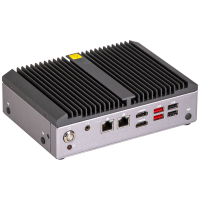
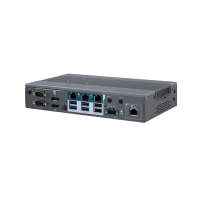
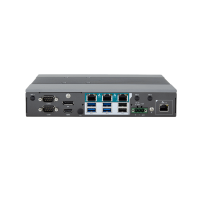
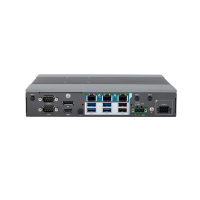
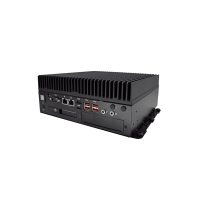
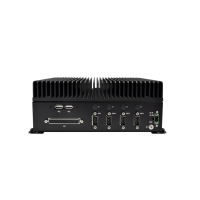
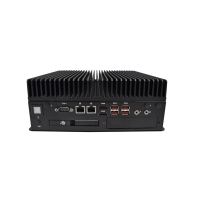
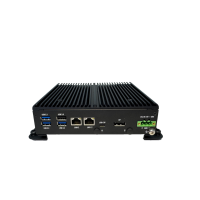
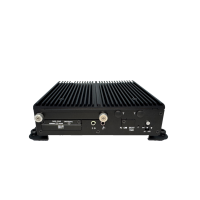
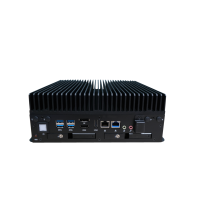
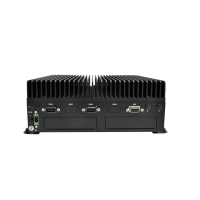
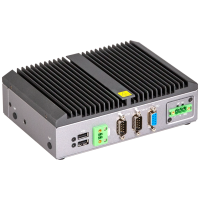
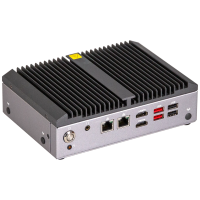
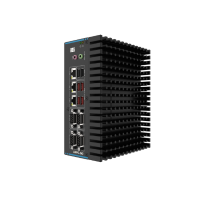
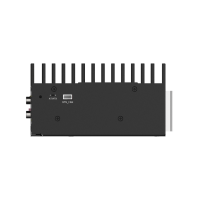
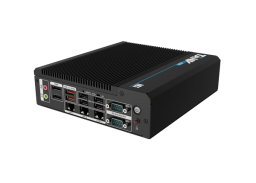
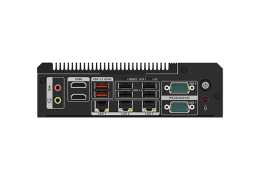
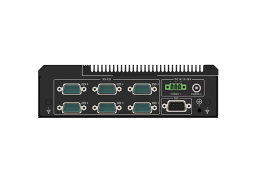
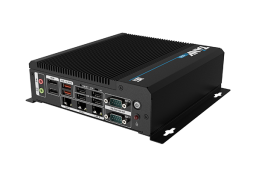
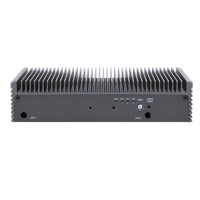
NISE-3900E
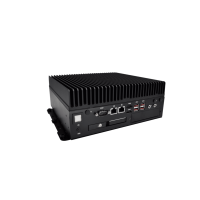
The socketed LGA processor design sets the NISE-3900E apart from soldered-CPU fanless systems: processors can be specified at procurement to match the compute demand of each application — from the 4-core Intel Core i3-9100TE for gateway and control tasks to the 8-core Intel Core i7-9700TE for compute-intensive machine vision, soft PLC and edge analytics workloads — and replaced in the field without exchanging the entire system board. The external M.2 socket (SATA 3.0 / PCIe x4) provides accessible storage expansion, an internal M.2 Key B slot supports optional 4G/LTE, and a SIM card socket and Mini-PCIe slot complete the wireless connectivity options for remote-site deployments.
Key Features
- Up to 8-Core Intel Core i7-9700TE — Socketed LGA, 64 GB DDR4: The NISE-3900E accepts 8th and 9th Generation Intel Core i7, i5 and i3 LGA processors across the 35 W embedded TE/T series, with the i7-9700TE delivering 8 cores at 1.8 GHz base clock and 12 MB cache for demanding parallel workloads; two DDR4 2400/2666 SO-DIMM sockets support up to 64 GB for large-dataset edge analytics, in-memory historian applications and multi-virtual-machine deployments; the LGA socket allows processor specification at order time and field upgrade without board replacement
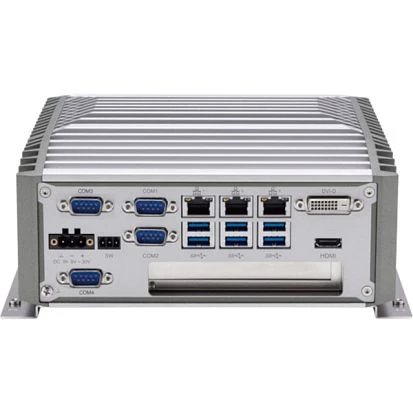
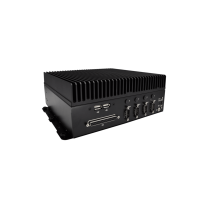
- PCIe x4 Expansion Slot — GPU, AI Inference, Frame Grabber or Fieldbus: A full PCIe x4 expansion slot allows the NISE-3900E to be equipped with a wide range of standard half-length PCIe cards — discrete GPU for GPGPU compute or hardware video encode/decode, AI inference accelerators (Intel Movidius, NVIDIA Tesla, Hailo), multi-channel machine vision frame grabbers, PROFINET/EtherCAT master cards or additional network interface cards — extending the platform beyond built-in I/O without external hubs or USB adapters; the expansion slot is the principal differentiator of the NISE-3900E versus fanless box-PCs limited to integrated I/O only
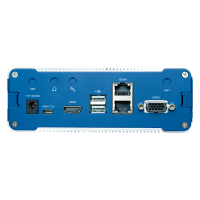
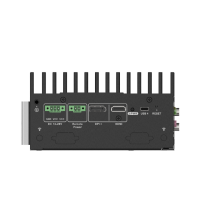
- Triple Independent Display — DVI-D, DisplayPort and HDMI: Three simultaneous independent display outputs drive up to three monitors concurrently from the Intel UHD 630 integrated graphics: a primary SCADA process overview screen, a secondary alarm and trend screen, and a third engineering or supervisor station display; DVI-D covers legacy panel monitors common in industrial installations; DisplayPort and HDMI cover modern displays and high-resolution panels up to 4K (DP); all three outputs are active simultaneously without additional graphics hardware
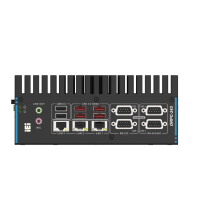
- Three Intel GbE LAN — Dual I210-IT (EtherCAT-Capable) and I219-LM: Two Intel I210-IT controllers provide EtherCAT real-time fieldbus master capability alongside standard GbE functions including Wake-on-LAN, network teaming and PXE boot; the third port uses Intel I219-LM for management or IT network separation; this three-NIC architecture supports OT/IT network segregation — isolating the EtherCAT control network from the enterprise IT network from the remote management network — on the same platform without an additional NIC card
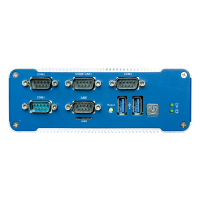
- Four COM Ports — RS-232/422/485 and RS-232: COM1 and COM2 support RS-232, RS-422 and RS-485 with automatic flow control, covering the full range of industrial serial standards for PLC communication, instrument interfaces and Modbus RTU; COM3 and COM4 provide RS-232 for serial devices including barcode scanners, receipt printers and RS-232-only equipment; all four ports are presented on rear-panel DB9 connectors for direct field wiring without adapters
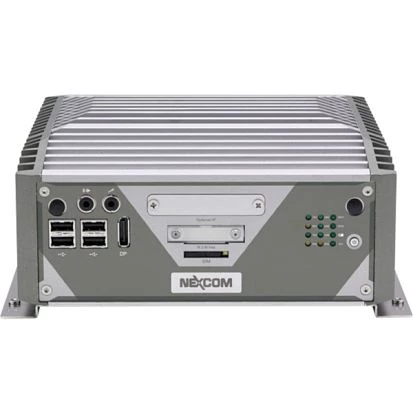
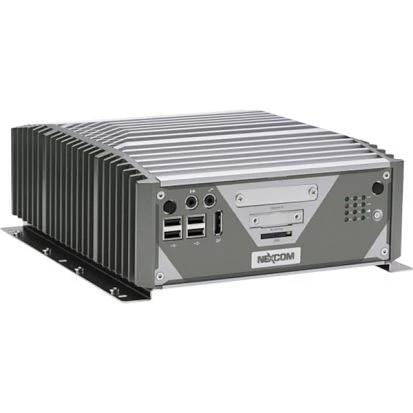
- External M.2 Socket and Internal 4G/LTE Slot: The external M.2 socket (SATA 3.0 / PCIe x4) provides accessible storage expansion for NVMe SSDs without opening the chassis; the internal M.2 Key B slot accepts an optional 4G/LTE module paired with the dedicated SIM card socket for cellular backhaul at remote installations; the Mini-PCIe socket accommodates Wi-Fi or 3.5G modules as an alternative wireless option; combined with the three-NIC wired LAN, the NISE-3900E covers every connectivity scenario from multi-port wired SCADA nodes to fully wireless remote terminal units
- DC 9–30 V, ATX Mode, CE/FCC Certified, −5 °C to +55 °C: Wide-range DC 9–30 V input operates from 12 V or 24 V industrial supply rails; ATX power mode enables software-controlled remote power-on and power-off from a supervisory system; operating range of −5 °C to +55 °C covers the majority of indoor industrial and transportation environments; CE (EN61000-6-2 / EN61000-6-4), FCC Class A and UKCA certification confirms compliance for European, US and UK markets; storage temperature −20 °C to +80 °C supports cold-chain and transport environments
Application Use Cases
Machine Vision and Industrial AI Inference
The NISE-3900E with Intel Core i7-9700TE and a PCIe x4 AI inference card — Intel Movidius Myriad X, NVIDIA Tesla or Hailo-8 — forms a complete machine vision inference platform: the 8-core processor handles image pre-processing, defect classification logic, PLC communication and result logging concurrently, whilst the inference accelerator card runs the neural network at hardware speeds without competing for processor resources. The external M.2 slot provides fast NVMe SSD storage for image buffer and model files, and dual display output drives a process monitoring screen and an inspection result visualisation screen simultaneously from a single fanless unit on the production line.
Soft PLC and Multi-Axis EtherCAT Motion Control
Running a real-time EtherCAT master alongside a Windows-based or Linux-based soft PLC demands the core count to isolate the time-critical control loop from background OS tasks. The 8-core i7-9700TE provides sufficient cores to dedicate a physical core to the EtherCAT master scan task, reducing jitter to sub-100 µs cycle consistency achievable with RTSS or PREEMPT_RT patched Linux. Two Intel I210-IT ports connect to the EtherCAT ring; the third GbE connects to the IT supervisory network; four COM ports interface with legacy serial encoders, safety relays and operator panels — all from a single fanless platform without the network card and serial card additions typically required on standard industrial PCs.
Triple-Display SCADA Operator Workstation
Process control rooms and factory operator stations increasingly require three monitors: a primary process overview, a secondary P&ID and trend screen, and a third alarm or historian query display. The NISE-3900E drives all three simultaneously from integrated Intel UHD 630 graphics via DVI-D, DisplayPort and HDMI — without a discrete graphics card occupying the PCIe x4 slot, which remains available for fieldbus or acquisition hardware. The fanless design eliminates fan noise from the operator environment, and three Intel GbE ports allow simultaneous connection to the control network, the IT network and the historian server on separate interfaces without VLAN configuration on a managed switch.
Industrial Edge Server and Multi-Protocol Gateway
In Industry 4.0 connectivity architectures, a single node must collect data from multiple legacy protocols (Modbus RTU via COM ports, EtherCAT via I210-IT NICs, PROFINET via PCIe card), aggregate and normalise it, and forward selected datasets to a cloud historian, an MES and a local SCADA simultaneously. The NISE-3900E with an i5-9500TE or i7-9700TE, 32–64 GB DDR4 and a PCIe NIC or fieldbus card provides the compute, memory and I/O to run all of these concurrently: a Modbus TCP/RTU gateway, an OPC UA server, a cloud IoT agent and a local database writer — without offloading any function to an external device.
Railway and Transportation Onboard Computing
Rolling stock, trackside cabinets and bus intelligent transport system controllers require CE-certified embedded PCs with wide DC voltage input, solid vibration resistance and fanless reliability. The NISE-3900E's DC 9–30 V input covers both 12 V (light vehicles) and 24 V (heavy vehicles and rail) onboard power, and the fanless passive-cooled design eliminates the primary failure mode of fan-equipped PCs in high-vibration mobile environments. The external M.2 socket allows SSD replacement or capacity expansion without opening the chassis — valuable for maintenance in confined onboard equipment bays where removing a system board is impractical.
Why Choose the NISE-3900E
An 8-Core Fanless Platform — LGA Socket Means Future-Proof Processor Flexibility
Most fanless industrial PCs use soldered processors: the compute level is fixed at manufacture and cannot be changed as application requirements evolve. The NISE-3900E uses a socketed LGA processor, allowing the system integrator to specify an i3-9100TE for a cost-optimised gateway deployment today and upgrade the same chassis to an i7-9700TE if the application grows to include machine vision or edge analytics — without replacing the system board, memory, storage or cabling. For organisations managing multi-year automation programmes where compute requirements are difficult to predict at initial specification, this flexibility reduces the risk of premature hardware obsolescence and defers the cost of a full platform replacement.
PCIe x4 Expansion in a Fanless Chassis — A Rare Combination
The addition of a PCIe x4 slot to an industrial fanless box-PC is uncommon: passive thermal management typically limits the total power envelope to the CPU and memory, leaving no headroom for expansion card power consumption. NEXCOM's thermal design on the NISE-3900E accommodates a half-length PCIe card alongside the embedded TE-series processor's 35 W TDP, making it possible to add a GPU, an AI accelerator, a machine vision frame grabber or a PROFINET/PROFIBUS master card without transitioning to a rack-mount or fan-cooled chassis. For applications that specifically require PCIe expansion hardware but must remain fanless for noise, dust or maintenance reasons, the NISE-3900E addresses a design requirement that few competing platforms can satisfy.
OT/IT Network Segregation Built In — Three GbE Ports Without a NIC Card
Network segregation between operational technology and information technology networks is a fundamental requirement of IEC 62443 and NAMUR OPC UA security architectures. Implementing it on a two-NIC embedded PC requires either VLAN configuration on an external managed switch or a PCIe NIC card consuming the only expansion slot. The NISE-3900E provides three GbE ports as standard — two EtherCAT-capable Intel I210-IT ports for the OT side and one Intel I219-LM for IT connectivity — allowing the SCADA engineer to physically separate the EtherCAT control segment, the SCADA Ethernet segment and the IT management network on three independent interfaces without consuming the PCIe x4 slot or configuring VLANs on external infrastructure.
Frequently Asked Questions
What processor options are available for the NISE-3900E?
The NISE-3900E supports 8th and 9th Generation Intel Core i7, i5 and i3 processors in an LGA socket. 9th Gen options include the Core i7-9700TE (8-core, 1.8 GHz, 12 MB cache), Core i5-9500TE (6-core, 2.2 GHz, 9 MB cache) and Core i3-9100TE (4-core, 2.2 GHz, 6 MB cache). 8th Gen variants including the i7-8700T, i5-8500T and i3-8100T are also supported. The socketed LGA design allows the processor to be replaced in the field without replacing the system board.
Does the NISE-3900E support EtherCAT?
Yes. Two of the three Gigabit Ethernet ports use the Intel I210-IT controller, which supports EtherCAT real-time fieldbus master operation alongside standard functions including Wake-on-LAN, network teaming and PXE boot. The 8-core i7-9700TE provides sufficient processor cores to isolate the EtherCAT master scan task on a dedicated core, enabling sub-millisecond cycle consistency alongside concurrent HMI and gateway application threads.
What can the PCIe x4 expansion slot be used for?
The PCIe x4 slot accepts standard half-length PCIe expansion cards including: discrete GPU or GPGPU cards for hardware video processing and neural network inference; AI accelerator cards (Intel Movidius, NVIDIA, Hailo); machine vision frame grabbers for multi-camera image acquisition; additional Gigabit or 10 Gigabit network interface cards; PROFINET, PROFIBUS or CANopen master cards for additional fieldbus connectivity; and PCIe SSD cards for high-speed storage expansion.
How many monitors can the NISE-3900E drive simultaneously?
The NISE-3900E supports three simultaneous independent displays via the DVI-D, DisplayPort and HDMI outputs — all driven by the integrated Intel UHD 630 graphics without a discrete graphics card. DisplayPort supports resolutions up to 4K. All three outputs are active concurrently, enabling triple-monitor operator workstation configurations for SCADA process overview, trend analysis and alarm management screens from a single fanless unit.
What is the power input range and are there OS restrictions?
The NISE-3900E accepts DC 9–30 V wide-range input with ATX power mode for software-controlled remote power management; an optional power adapter is available. Supported operating systems are Windows 10 64-bit and Linux (Kernel 4.9). The unit is CE (EN61000-6-2 / EN61000-6-4), FCC Class A and UKCA certified, covering CE marking requirements for the European and UK markets and FCC compliance for US deployments.
Get a Quote