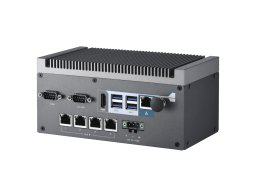
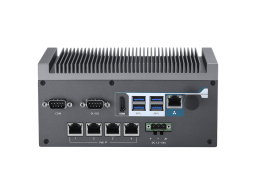
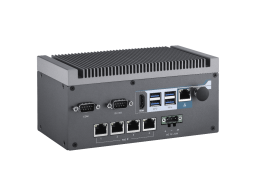
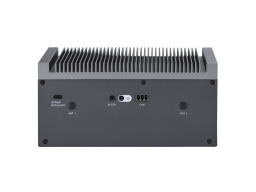
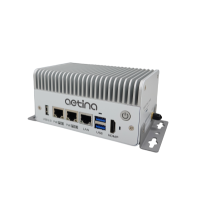
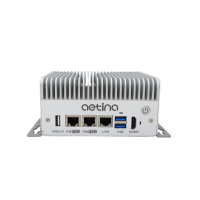
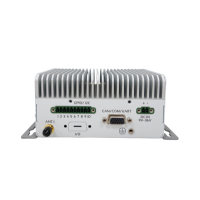
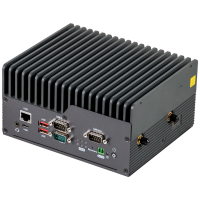
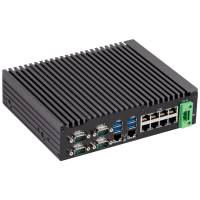
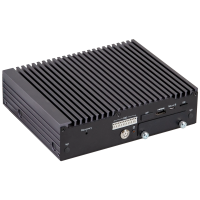
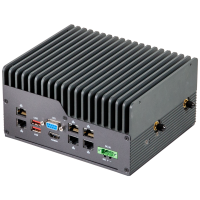
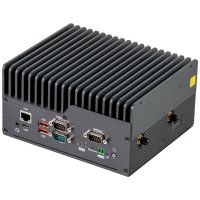
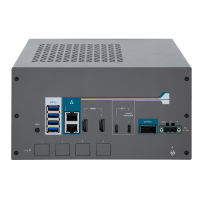
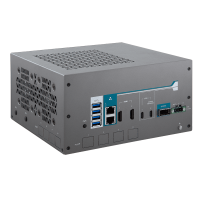
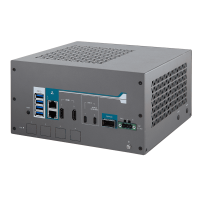
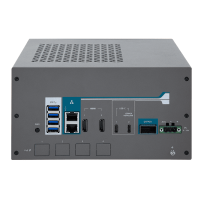
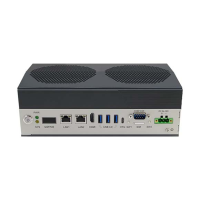
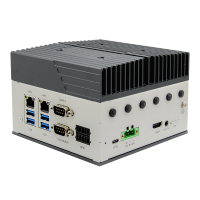
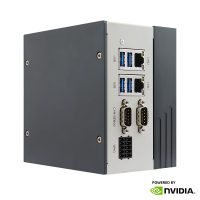
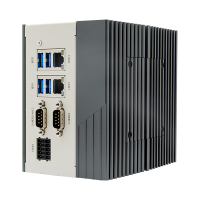
Coeus-4001T
The Coeus-4001T is a compact industrial Box PC built on the NVIDIA® Jetson Thor™ T5000 system-on-module, integrating a 14-core Arm® Neoverse™-V3AE CPU at 2.6 GHz with a 2,560-core NVIDIA Blackwell™ GPU featuring 96 Tensor Cores and delivering up to 2,070 TFLOPS (FP4). With 128 GB of LPDDR5X memory running at 273 GB/s bandwidth, the Coeus-4001T is specifically engineered to run large, complex AI models — including natural language processing, 3D scene perception and multi-sensor fusion pipelines — as a standalone edge inference node without cloud dependency.
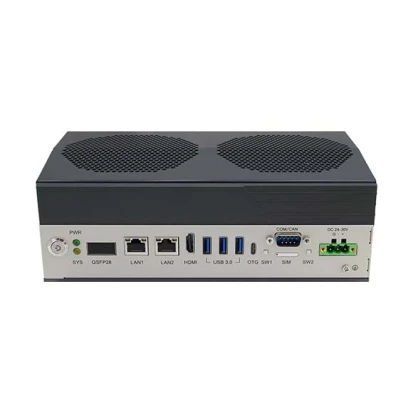
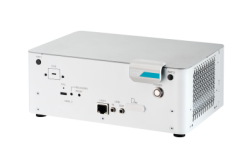
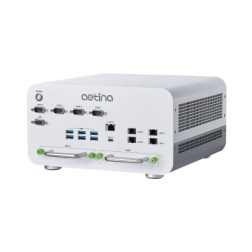
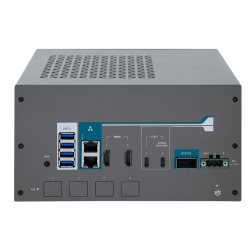
Weighing just 2.25 kg in a 75.8 × 137 × 268 mm chassis, the Coeus-4001T combines datacenter-class AI compute density with an industrial connectivity profile that sets it apart from general-purpose AI appliances. A 100 GbE QSFP28 port expandable to 4×25G optical, dual 2.5 GbE LAN, dual PCIe x4 expansion slots and an integrated 24–30 V DC PSU make it a practical choice for demanding AI inference, high-throughput data processing and intelligent edge computing deployments across industrial automation, smart manufacturing and AI-driven network infrastructure.
Key Features
- NVIDIA Jetson Thor T5000 — 2,070 TFLOPS (FP4): 14-core Arm Neoverse-V3AE CPU at 2.6 GHz with 1 MB L2 and 16 MB L3 cache; 2,560-core Blackwell GPU with 96 Tensor Cores; 128 GB LPDDR5X at 273 GB/s — memory bandwidth large enough to sustain high-throughput inference across LLMs, point-cloud models and multi-modal neural networks simultaneously
- 100 GbE QSFP28 High-Speed Networking: Single QSFP28 port expandable to 4×25G optical transceiver modules, plus dual 2.5 GbE RJ45 (Intel I225) for management and LAN traffic — equipping the Coeus-4001T for AI data pipeline roles at the network edge where bandwidth is a bottleneck, not just compute
- Dual PCIe x4 Expansion: Two PCIe x4 slots enable addition of capture cards, NPU accelerators, FPGA coprocessors or additional networking adapters — extending the base platform for application-specific signal acquisition or compute offload without external chassis
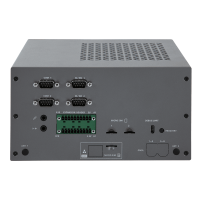
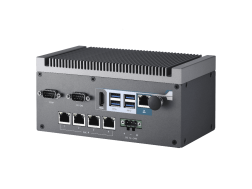
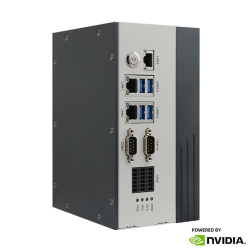
- Industrial Serial and Bus I/O: 2× RS-232/422/485 COM ports with DB9 connectors, 2× CAN bus (optional), 1× SIM socket and M.2 Key-B for 4G/5G LTE — covering PLC communication, sensor bus integration and cellular uplink in a single unit
- Compact Industrial Form Factor with Integrated PSU: 75.8 × 137 × 268 mm chassis at 2.25 kg net weight; DC 24–30 V input with integrated power supply eliminates external power bricks; wall mount and DIN rail installation options for control cabinet and field deployment
- Wireless and Cellular Ready: M.2 E-Key (Wi-Fi module), M.2 B-Key (4G/5G LTE), M.2 M-Key (NVMe SSD) and SIM socket pre-provisioned for wireless connectivity without hardware modification
Application Use Cases
Large AI Model Inference at the Edge
The Coeus-4001T is explicitly designed for workloads that demand both high compute throughput and high memory bandwidth — conditions that define large transformer models, multi-modal AI systems and 3D perception networks. At 273 GB/s LPDDR5X bandwidth, the platform sustains inference on models that exceed the capacity of conventional embedded AI boards, enabling engineers to run natural language processing, visual question answering and LiDAR-camera fusion pipelines locally without routing sensitive data to a cloud inference endpoint.
Industrial Automation and AI-Driven Process Control
In manufacturing environments, the Coeus-4001T connects to PLCs and motion controllers over RS-232/422/485 and CAN bus, while the dual PCIe x4 slots accommodate machine vision frame grabbers or additional I/O cards. The integrated PSU accepts 24–30 V DC directly from standard industrial rail power supplies, and wall or DIN rail mounting places the unit inside existing control cabinets without additional enclosures or power conditioning hardware.
High-Throughput AI Data Pipelines and Network Edge
The 100 GbE QSFP28 port makes the Coeus-4001T unusual among edge AI Box PCs — it can ingest and process network traffic at line rates that approach small-cell server class, enabling real-time deep packet inspection, network anomaly detection and AI-assisted traffic classification at the aggregation layer of industrial and enterprise networks. The 4×25G optical breakout capability accommodates distributed sensor networks where uplink bandwidth would otherwise require a rackmount appliance.
Smart Manufacturing and Quality Inspection
Three USB 3.0 ports support USB3 Vision cameras for automated optical inspection, and the dual PCIe x4 slots enable GigE Vision frame grabbers for multi-camera inspection cells. The Blackwell GPU with 96 Tensor Cores runs defect detection and classification models locally at the inspection station, eliminating the round-trip latency of cloud inference and allowing inline rejection decisions within cycle-time constraints on high-speed production lines.
Multi-Sensor Fusion for Robotics and Autonomous Systems
For robotics integrators, the combination of 2,070 TFLOPS compute, 273 GB/s memory bandwidth, CAN bus, serial ports and cellular connectivity addresses the full data pipeline from sensor acquisition to actuator command — running sensor fusion, path planning and localisation models on a single compact board. The 5G-capable M.2 B-Key slot connects mobile robotic platforms to fleet management and cloud model update infrastructure without a separate communications module.
Why Choose the Coeus-4001T
The Highest AI Compute Density in Its Weight Class
At 2.25 kg and 75.8 × 137 × 268 mm, the Coeus-4001T is among the most compact platforms available for the NVIDIA Jetson Thor T5000 module. Delivering 2,070 TFLOPS (FP4) and 273 GB/s memory bandwidth in this form factor means engineers no longer need to choose between compute performance and physical integration constraints. The unit mounts on a DIN rail inside a standard control cabinet or on a wall in a field enclosure — applying server-class AI inferencing exactly where the data originates, not in a distant rack.
Designed for the AI Models That Actually Matter
Most edge AI computers are optimised for computer vision workloads running on relatively small convolutional networks. The Coeus-4001T was designed from the outset for the next generation of industrial AI: large transformer models for natural language understanding, 3D point-cloud networks for spatial perception and multi-sensor fusion architectures that combine camera, LiDAR, radar and IMU data streams. The 128 GB LPDDR5X pool and 273 GB/s bandwidth sustain these workloads at throughput levels that smaller unified-memory platforms cannot match.
100 GbE Networking Without a Rackmount Appliance
The QSFP28 port is a specification that typically appears in rackmount servers and network appliances, not in 2 kg box PCs. For applications at the boundary of the operational technology and information technology networks — AI-driven SCADA gateways, intelligent network taps, edge inference nodes in high-bandwidth sensor networks — the Coeus-4001T eliminates the need for a separate network appliance alongside the AI compute node. One qualified platform, one installation, one power connection.
Frequently Asked Questions
What processor and GPU does the Coeus-4001T use?
The Coeus-4001T is powered by the NVIDIA Jetson Thor T5000 system-on-module, which integrates a 14-core Arm Neoverse-V3AE 64-bit CPU running at 2.6 GHz, a 2,560-core NVIDIA Blackwell GPU with 96 Tensor Cores, and 128 GB of LPDDR5X unified memory delivering 273 GB/s of memory bandwidth.
What is the AI performance of the Coeus-4001T?
The Coeus-4001T delivers up to 2,070 TFLOPS (FP4) via the NVIDIA Jetson Thor T5000 module. This throughput, combined with 273 GB/s memory bandwidth, supports large AI model inference including transformer networks for natural language processing, 3D perception models and multi-sensor fusion pipelines as standalone edge workloads.
What networking interfaces does the Coeus-4001T provide?
The Coeus-4001T includes one QSFP28 port supporting up to 100 GbE (expandable to 4×25G optical modules) and two 2.5 GbE RJ45 ports (Intel I225). Additionally, an M.2 E-Key socket supports Wi-Fi modules and an M.2 B-Key socket supports 4G/5G LTE modules, backed by a SIM card slot.
What expansion options are available on the Coeus-4001T?
The Coeus-4001T provides two PCIe x4 expansion slots for capture cards, FPGA coprocessors or additional networking adapters. Storage expansion is via an M.2 M-Key slot for NVMe SSD. Wireless expansion uses dedicated M.2 E-Key (Wi-Fi) and M.2 B-Key (4G/5G) sockets. A USB-C OTG port is also provided for device management.
What are the power and mounting requirements for the Coeus-4001T?
The Coeus-4001T accepts DC 24–30 V input via an integrated power supply — compatible with standard 24 V industrial rail power. The unit supports wall mount and DIN rail installation. It measures 75.8 × 137 × 268 mm and weighs 2.25 kg, making it suitable for installation inside standard control cabinets without additional enclosures.
Get a Quote