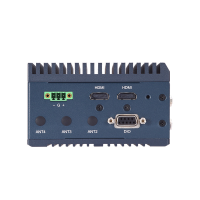
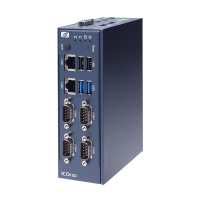
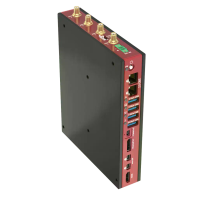
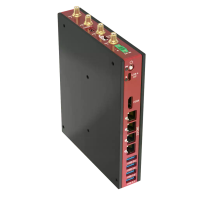
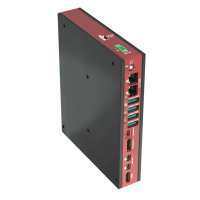
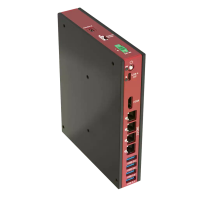
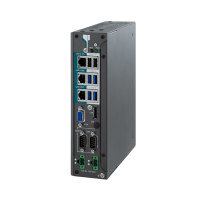
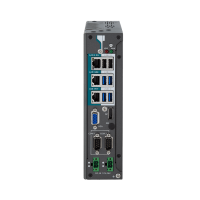
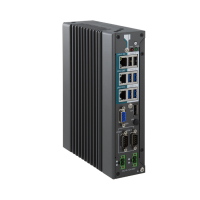
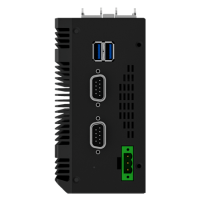
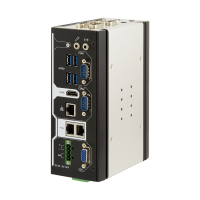
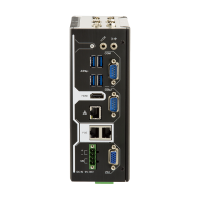
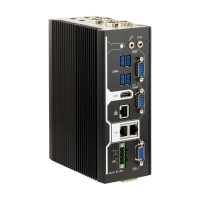
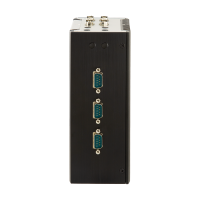
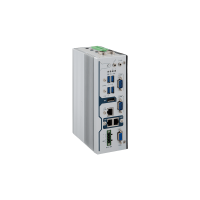
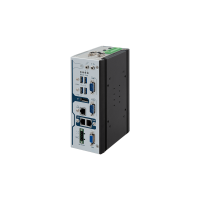
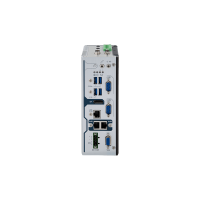
BEDROCK-PC-V3X60
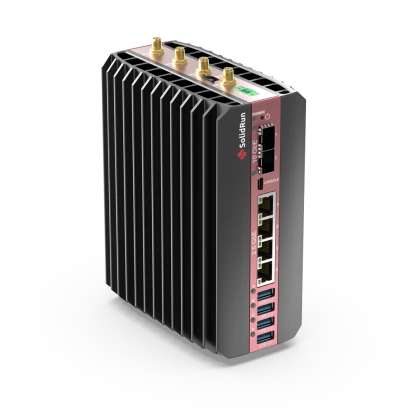
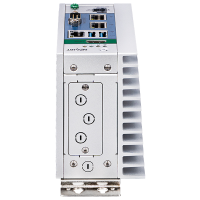
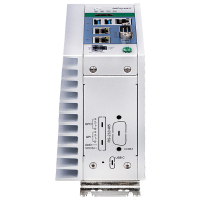
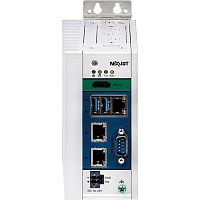
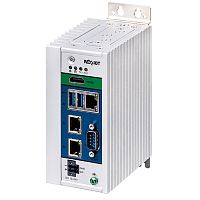
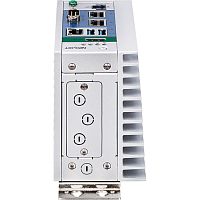
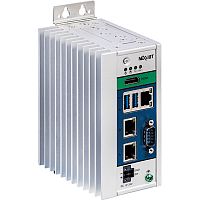
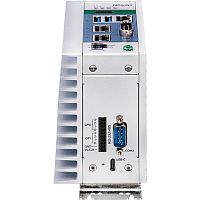
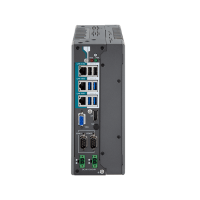
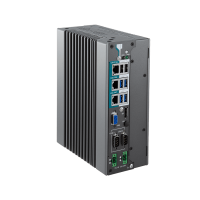
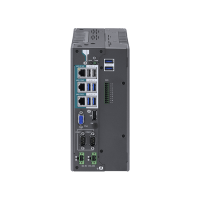
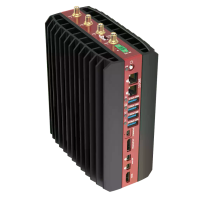
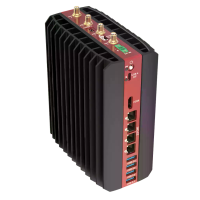
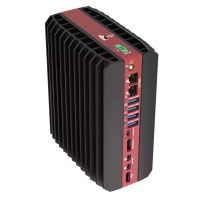
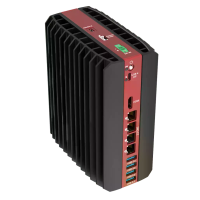
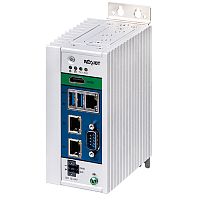
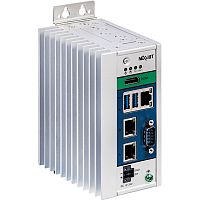
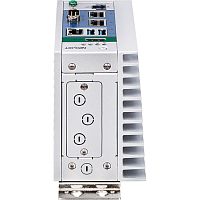
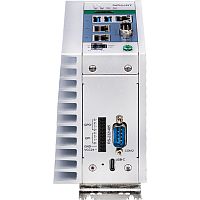
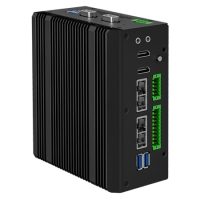
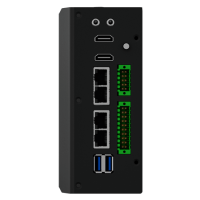
The BEDROCK-PC-V3X60's network specification is exceptional for a DIN-rail form factor: two 10 Gigabit SFP+ ports supporting both fibre and direct-attach copper transceivers sit alongside four 2.5 Gigabit Ethernet ports on Intel I226 controllers, delivering six independent network interfaces from a 1.5-litre chassis. Optional Wi-Fi 6E with Bluetooth 5.3 and an M.2 slot for Quectel 4G/5G cellular modem modules cover wireless backhaul requirements, and a DC 12–60 V input on a Phoenix terminal connector operates from solar, battery, vehicle, industrial 24 V and rack 48 V power supplies without a converter.
Key Features
- AMD Ryzen Embedded V3000 — 8C/16T Zen 3+, 6 nm, up to 3.8 GHz: The AMD Ryzen Embedded V3000 series brings desktop-class x86 compute to the DIN-rail form factor: 8 cores with simultaneous multithreading at up to 3.8 GHz on TSMC 6 nm deliver the processing capacity for concurrent virtualisation, real-time control, containerised edge applications and AI inference tasks that would require a full rack server in previous embedded generations; AMD Virtualization (AMD-V) and AMD-Vi IOMMU are supported for VM-based network function deployment
- Two 10 GbE SFP+ Ports — Fibre and Copper Transceiver Support: The two native 10 Gigabit SFP+ ports accept standard SFP+ transceivers covering 10GBASE-SR (multi-mode fibre, short range), 10GBASE-LR (single-mode fibre, up to 10 km), 10GBASE-CR direct-attach copper cables and 1000BASE-SX/LX downgraded GbE modules — a single hardware platform covers both fibre backbone connections and short copper interconnects without an additional media converter; at full 10 Gbps line rate on both ports simultaneously, the BEDROCK-PC-V3X60 processes 20 Gbps of network throughput from a fanless 73 mm wide chassis
- Four Intel I226 2.5 GbE Ports — Reliable Network Segmentation: Four 2.5 Gigabit Ethernet ports on Intel I226 controllers provide additional network segment capacity for OT/IT separation, management network isolation, LAN-side distribution and multi-homed routing configurations; combined with the two SFP+ ports, the BEDROCK-PC-V3X60 provides six independent network interfaces — sufficient to implement a fully segmented firewall, router, or SDN switch without PCIe expansion cards
- Triple NVMe PCIe Gen4 x4 Storage — Parallel High-Speed I/O: Three M.2 2280 slots each connected via PCIe Gen4 x4 provide sequential read/write performance exceeding 7 GB/s per drive; three drives in RAID 0 exceed 20 GB/s aggregate read throughput for network packet capture, log storage and distributed database applications; the primary slot optionally includes power-loss protection circuitry for journal consistency in the event of sudden power disconnection — critical for storage systems in industrial environments without UPS
- DDR5 with ECC — Data Integrity for Mission-Critical Deployments: Two SODIMM slots support DDR5-4800 in non-ECC or ECC configuration, with capacity up to 96 GB; ECC (Error-Correcting Code) memory detects and corrects single-bit memory errors in-flight, preventing silent data corruption in applications where memory integrity is essential — network firewalls processing millions of packet-forwarding decisions per second, embedded databases serving industrial historian queries and virtualised PLCs executing deterministic control loops all benefit from ECC protection against cosmic ray and electrical noise-induced bit flips
- Liquid Metal TIM and Heatpipes — 60 W Passive Cooling in 1.5 L: Dissipating 60 W in a 1.5-litre fanless chassis requires engineering beyond a simple heatsink block; the BEDROCK-PC-V3X60 uses liquid metal thermal interface material (significantly lower thermal resistance than standard TIM paste) between the processor die and the copper heatpipe assembly, which conducts heat laterally across the chassis walls and dissipates it through the aluminium surface; the result is sustained full-TDP processor performance without thermal throttling and without a fan, even in elevated-ambient environments
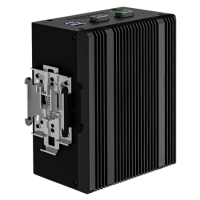
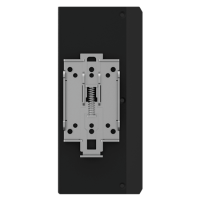
- Dual SPI Flash BIOS, IP40, −40 °C to +85 °C, DIN-Rail with Locking Lever: Dual SPI Flash stores two independent BIOS images — if the primary firmware becomes corrupted during an update or power loss event, the secondary image restores system boot capability automatically; IP40 dust ingress resistance protects internal components in industrial environments; the −40 °C to +85 °C operating range covers arctic outdoor cabinet, desert solar installation and industrial furnace-adjacent enclosure temperatures; DIN-rail mounting uses a lever-based locking mechanism to prevent vibration-induced loosening in mobile and high-vibration fixed installations
Application Use Cases
High-Throughput Fanless Network Security Appliance
Running pfSense, OPNsense or a custom Linux-based firewall and IDS/IPS stack, the BEDROCK-PC-V3X60 processes network traffic at full 10 Gbps line rate on the SFP+ ports whilst simultaneously running deep packet inspection, VPN termination and intrusion detection on the AMD Ryzen Embedded V3000's 8 cores. The six-NIC architecture — two SFP+ for WAN/backbone and four 2.5 GbE for LAN segments — provides enough interfaces to implement multi-zone firewall segmentation (WAN, LAN, OT, management, DMZ) without PCIe expansion. The fanless ventless chassis eliminates air-handling attack vectors, simplifies TEMPEST-sensitive deployments and removes the filter maintenance cycle from the operational budget of network operations teams.
Industrial Edge Server with Virtualisation
The 8-core AMD Ryzen Embedded V3000 with AMD-V virtualisation and up to 96 GB ECC DDR5 supports a KVM, Proxmox or VMware ESXi hypervisor running multiple isolated virtual machines concurrently on a DIN-rail node: a real-time Linux VM for soft-PLC control, a Windows VM for SCADA HMI, a containerised OPC UA server and a network monitoring agent can each occupy isolated virtual machines without cross-contaminating their execution environments. Triple NVMe PCIe Gen4 storage provides the IOPS and bandwidth to sustain multiple concurrent VM disk images without throughput contention, and ECC memory prevents silent data corruption in the hypervisor memory management layer.
5G Multi-Access Edge Computing (MEC) Node
Telecommunications operators and private 5G network operators deploying Multi-Access Edge Computing at base station sites require compute hardware that operates in outdoor cabinet temperatures, runs on 48 V DC telecom power, and provides the network interfaces to interconnect the 5G user-plane with local application servers. The BEDROCK-PC-V3X60 satisfies all three requirements: −40 °C to +85 °C operation covers outdoor European and Middle Eastern cabinet conditions; DC 12–60 V accepts 48 V telecom rectifier outputs directly; the Quectel 5G M.2 modem option provides the cellular air-interface connection; and the dual 10 GbE SFP+ ports connect to the 5G fronthaul and backhaul fibre infrastructure at the base station site.
Network Packet Capture and Traffic Analysis
Security operations centres and network performance engineers deploying passive traffic monitoring at high-traffic aggregation points need fanless hardware that can sustain wire-speed capture on 10 GbE links without dropping packets. The BEDROCK-PC-V3X60's two SFP+ ports connect to SPAN or TAP mirror feeds; the 8-core processor provides the cycles to run ntopng, Zeek, Suricata or custom DPDK-based capture applications at line rate; and three NVMe PCIe Gen4 drives in a striped configuration write captured traffic to disk at aggregate speeds that prevent ring buffer overflow during traffic spikes. Power-loss protection on the primary NVMe drive preserves capture files and index integrity in the event of unexpected power loss at the monitoring site.
Utility and Energy Infrastructure Automation
Substation automation, renewable energy inverter monitoring and smart grid edge controllers operate in outdoor electrical enclosures where the −40 °C to +85 °C temperature range is a safety requirement, not a marketing claim. The BEDROCK-PC-V3X60's DC 12–60 V input connects directly to substation battery-backed DC buses (48 V or 24 V) without an intermediate AC/DC converter; the IP40 dust-resistant chassis withstands the particulate environment of outdoor switchgear rooms; ECC memory ensures that IEC 61850 GOOSE message processing and protection relay logic execute without silent computation errors; and the AMI Aptio V BIOS with dual SPI Flash survives firmware corruption from electrical surge events that are common in high-voltage proximity installations.
Why Choose the BEDROCK-PC-V3X60
Six Network Ports — Including Dual 10 GbE SFP+ — in a 73 mm Fanless DIN-Rail Chassis
Delivering dual 10 Gigabit fibre-capable network interfaces from a passive-cooled DIN-rail device is the BEDROCK-PC-V3X60's most distinctive engineering achievement. Most DIN-rail embedded PCs top out at multiple 1 GbE or at most 2.5 GbE copper ports; sourcing dual 10 GbE capability in a fanless DIN-rail form factor has historically required either an x86 server with active cooling or a dedicated network switch. The BEDROCK-PC-V3X60 places programmable x86 compute — 8 cores, up to 96 GB DDR5 ECC, triple NVMe Gen4 — alongside two 10 GbE SFP+ ports and four 2.5 GbE copper ports in a single chassis, removing the need to co-locate a separate server and network appliance in the same DIN-rail panel.
60 W Passive Dissipation via Liquid Metal and Heatpipes — No Compromises on Performance
Fanless embedded PCs frequently throttle the processor TDP to fit within the passive dissipation capacity of a small aluminium block, delivering only a fraction of the processor's rated performance in sustained workloads. The BEDROCK-PC-V3X60 takes the opposite approach: the chassis is engineered to dissipate a full 60 W passively, and the processor runs at its full AMD Ryzen Embedded V3000 TDP without throttling. Liquid metal TIM and copper heatpipes sustain this dissipation across the entire −40 °C to +85 °C ambient range — meaning the same CPU benchmark score at +85 °C as at +25 °C. For applications where predictable and consistent compute throughput is a system requirement — real-time control, packet forwarding at line rate, synchronised data acquisition — this thermal consistency matters.
Dual BIOS, ECC Memory and Power-Loss-Protected NVMe — Designed for Unattended Long-Lifecycle Deployments
Field-deployed embedded PCs in substations, remote telecommunications sites and critical infrastructure installations may go unattended for years between planned maintenance visits. Every design decision on the BEDROCK-PC-V3X60 reflects this operational reality: dual SPI Flash BIOS recovers from firmware corruption without human intervention; ECC DDR5 corrects memory bit errors silently before they manifest as application crashes; power-loss-protected NVMe storage preserves data integrity through unexpected power disconnections without relying on a UPS; and the AMI Aptio V BIOS with serial console redirection allows out-of-band management and recovery via a serial connection without a display attached. A hardware platform that self-recovers from the most common field failure modes reduces the operational cost of remote deployments over a multi-year service life.
Frequently Asked Questions
What processor does the BEDROCK-PC-V3X60 use?
The BEDROCK-PC-V3X60 is powered by the AMD Ryzen Embedded V3000 Series — an 8-core, 16-thread processor based on the Zen 3+ architecture manufactured on a 6 nm TSMC process, with a maximum burst frequency of up to 3.8 GHz. The V3X60 chassis supports sustained operation at up to 60 W processor TDP through its passive liquid metal and heatpipe cooling system, allowing the processor to run at full rated performance without thermal throttling.
What types of transceivers do the 10 GbE SFP+ ports support?
The two SFP+ ports on the BEDROCK-PC-V3X60 accept standard SFP+ transceivers including 10GBASE-SR (multi-mode fibre, up to 300 m), 10GBASE-LR (single-mode fibre, up to 10 km), 10GBASE-ER (single-mode fibre, up to 40 km), direct-attach copper (DAC) cables and active optical cables (AOC). Standard 1000BASE-SX and 1000BASE-LX GbE SFP modules are also supported for lower-speed fibre uplink connections. Third-party SFP+ modules with standard MSA compliance are accepted.
Does the BEDROCK-PC-V3X60 support ECC memory?
Yes. Both SODIMM memory slots support DDR5-4800 in ECC (Error-Correcting Code) configuration with a total capacity of up to 96 GB. ECC detects and corrects single-bit memory errors in real time, preventing silent data corruption in applications requiring high memory integrity — including network firewalls, virtualisation hypervisors, embedded databases and industrial control systems. Non-ECC DDR5 modules are also compatible for deployments where ECC is not required.
What is the difference between the BEDROCK-PC-V3X30 and BEDROCK-PC-V3X60?
The V3X60 and V3X30 share the same processor platform, networking, storage and I/O specification. The difference is thermal capacity and chassis width: the V3X60 chassis (73 mm wide, 1.5 L volume) dissipates up to 60 W passively, allowing the processor to run at full TDP for sustained workloads. The V3X30 chassis (45 mm wide, 0.9 L volume) dissipates up to 30 W, requiring the processor to operate at a reduced cTDP setting. Choose the V3X60 for maximum compute performance and sustained high-throughput workloads; choose the V3X30 where DIN-rail panel width is constrained.
What power supply inputs are compatible with the BEDROCK-PC-V3X60?
The BEDROCK-PC-V3X60 accepts DC 12–60 V on a Phoenix terminal block connector, covering 12 V regulated adapters, 24 V industrial DC buses, 48 V telecom rectifier outputs and solar/battery systems in this voltage range. No AC/DC converter is required for 24 V or 48 V industrial and telecommunications power infrastructure. An optional 4G/5G modem (Quectel) and Wi-Fi 6E module (Intel AX210) are powered internally without additional external power connections.
Get a Quote