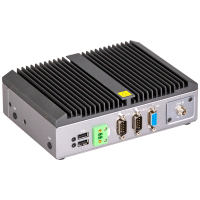
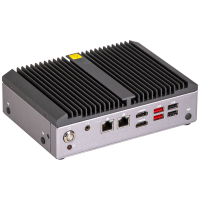
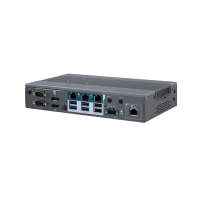
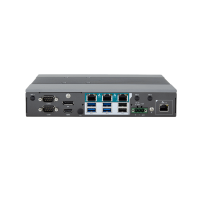
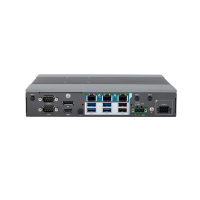
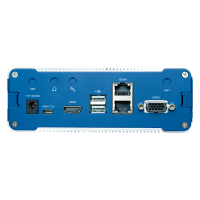
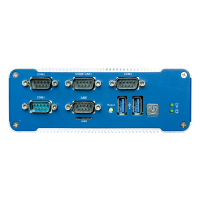
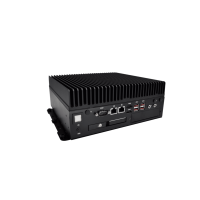
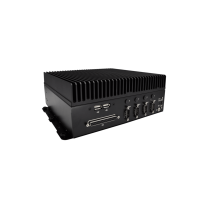
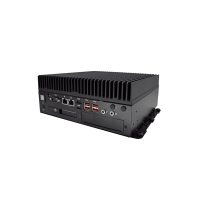
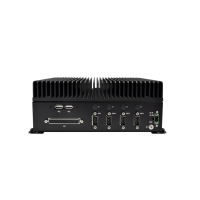
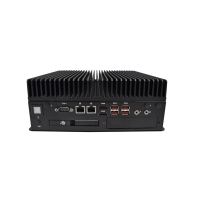
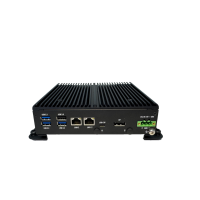
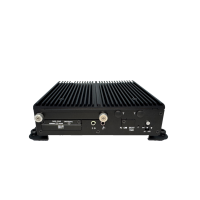
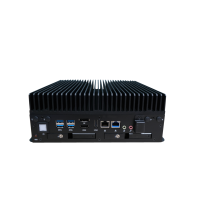
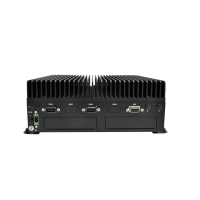
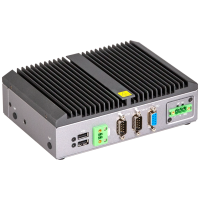
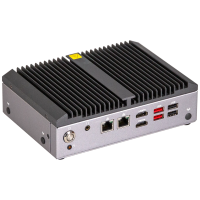
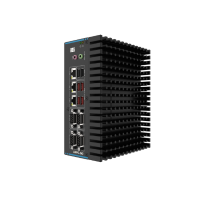
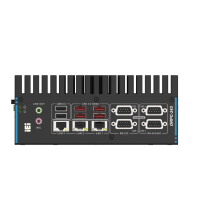
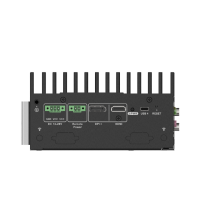
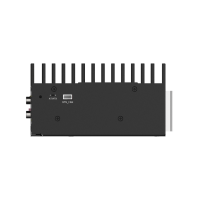
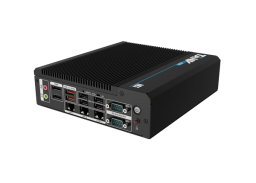
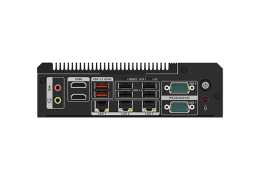
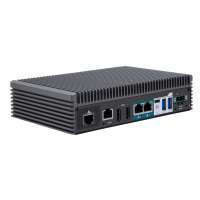
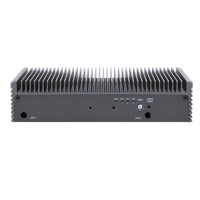
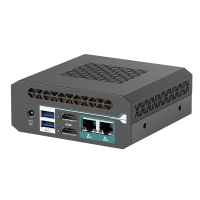
NISE-109-E02
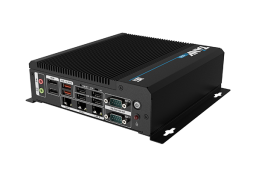
Sharing the same chassis and connectivity architecture as the NISE-109-E01, the E02 variant upgrades the processor from the dual-core Intel Atom x6211E to the quad-core Intel Celeron J6412, providing additional processing headroom for compute-intensive operator interfaces, concurrent multi-protocol gateway tasks and local edge data processing in environments where ambient temperature remains within −10 °C to +60 °C. DC 9–30 V input with ATX mode, TPM 2.0 hardware security, a Mini-PCIe slot for optional wireless modules and M.2 plus 2.5" SATA III storage complete the platform.
Key Features
- Intel Celeron J6412 Quad-Core 2.0 GHz — Fanless Operation to +60 °C: Four processor cores at 2.0 GHz deliver significantly higher compute throughput than dual-core Atom-class processors, supporting concurrent SCADA visualisation, protocol gateway tasks, local database operations and edge analytics within the same passive thermal envelope; the Elkhart Lake platform provides integrated Intel UHD graphics with hardware video decode for smooth multi-display operation without a discrete graphics card; fanless operation eliminates fan failure, filter maintenance and particulate ingress in industrial environments
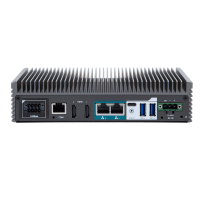
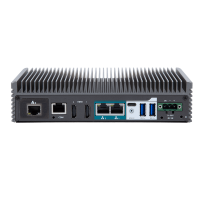
- Dual Intel I210-IT GbE with WoL, PXE and EtherCAT: Two independent Intel I210-IT Gigabit Ethernet controllers provide network teaming, Wake-on-LAN, PXE boot and EtherCAT real-time fieldbus master capability from the same platform; EtherCAT support on both LAN ports allows the NISE-109-E02 to serve as an IEC 61158-compliant EtherCAT master for servo drives and distributed I/O nodes whilst simultaneously maintaining an IT Ethernet connection for SCADA network communication — without a separate motion controller or PCIe EtherCAT card
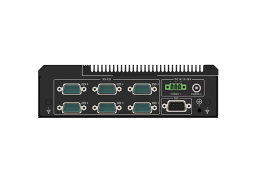
- Four COM Ports — RS-232 and RS-232/422/485: Two fixed RS-232 ports and two software-configurable RS-232/422/485 ports allow simultaneous serial communication with multiple PLCs, drives, field instruments and legacy equipment across the full range of industrial serial standards; all four ports are independently accessible, eliminating the need for USB-to-serial adapters or external serial hubs in multi-device gateway configurations
- Dual Independent Display — HDMI and DisplayPort: HDMI 1.4 and DisplayPort 1.4 outputs drive two independent monitors simultaneously from the integrated Celeron J6412 graphics; the additional compute capacity of the quad-core processor compared to the dual-core E01 variant supports more demanding graphics workloads — including multiple SCADA process overview screens, high-resolution process video, or a split operator station and supervisor screen configuration — without frame-rate degradation
- Flexible Storage — 2.5" SATA III and M.2 Key B+M 2242: A full-size 2.5" SATA III bay accepts industrial SSD or HDD for OS, application and historian storage; the M.2 2242 Key B+M socket provides a secondary SATA or PCIe x1 SSD path; combined capacity covers local data logging, multi-application installation and edge database requirements without external storage devices
- Mini-PCIe Expansion for Wi-Fi, 3G/4G and GPIO: The onboard Mini-PCIe slot accepts optional Wi-Fi (802.11 a/b/g/n/ac), 3.5G and 4G/LTE wireless modules for cellular or Wi-Fi backhaul in deployments without fixed Ethernet infrastructure; an optional GPIO expansion module adds discrete input/output channels for direct sensor, relay and indicator integration without an external I/O controller
- TPM 2.0, Wide DC Input and ATX Power Mode: Hardware TPM 2.0 supports encrypted storage, secure boot and hardware-rooted identity for industrial cybersecurity compliance; DC 9–30 V input operates from both 12 V and 24 V industrial supply rails; ATX mode supports software-controlled remote power-on and power-off from a supervisory system or watchdog controller
Application Use Cases
Compute-Intensive SCADA HMI and Operator Workstation
The quad-core Celeron J6412 at 2.0 GHz provides the processing headroom that complex SCADA interfaces demand: simultaneously rendering multiple animated process overview screens, executing real-time data acquisition from serial and Ethernet field devices, running alarm management logic and writing to a local historian database. The NISE-109-E02 handles these concurrent workloads at a throughput level that the dual-core Atom x6211E in the E01 variant cannot sustain at full SCADA project scale, making it the appropriate choice for operator station applications where interface complexity or channel count is high. Dual display output supports a primary process overview screen and a secondary trend/alarm screen from a single unit.
Industrial IoT Gateway with Local Edge Analytics
In deployments where raw sensor and machine data must be pre-processed, filtered, aggregated or analysed locally before transmission to a cloud or enterprise MES system, the NISE-109-E02 provides the compute capacity to run edge analytics frameworks — Node-RED, Python inference pipelines, OPC UA data aggregation — alongside the four COM port and dual GbE connectivity that gateway applications require. The quad-core processor allows the analytics workload and the communication gateway workload to be isolated across CPU cores without mutual performance interference, maintaining deterministic protocol handling on the serial ports whilst executing compute-intensive data transformation tasks concurrently.
EtherCAT Master with Concurrent HMI Logic
Real-time EtherCAT master applications running on a Windows or Linux soft PLC stack require processor cycles reserved for the cyclic EtherCAT scan task at microsecond granularity. On a dual-core processor, scheduling the EtherCAT master thread alongside an HMI or SCADA process creates contention that can introduce jitter into the control cycle. The four cores of the Celeron J6412 allow the EtherCAT master task, the HMI application and the network communication services to be allocated to dedicated cores, reducing cross-task interference and enabling the NISE-109-E02 to serve as a combined EtherCAT master and operator terminal without compromising real-time cycle consistency.
Building Automation Controller and BMS Integration Node
Building management systems installed in data centres, hospitals and commercial facilities operate in climate-controlled environments well within the −10 °C to +60 °C range of the NISE-109-E02. The four COM ports handle simultaneous BACnet/MSTP, Modbus RTU and legacy RS-232 device communication; dual GbE connects to BACnet/IP and IP management networks; and the fanless chassis suits installation in ceiling voids, electrical rooms and service corridors where noise and dust ingress from a fan-cooled unit would be unacceptable. The quad-core processor supports concurrent execution of multiple BMS protocol stacks, local trend logging and a graphical facility management interface without resource contention.
Retail and Hospitality Embedded PC
Point-of-sale back-end systems, self-service kiosk controllers and digital signage players in retail and hospitality environments benefit from the NISE-109-E02's quad-core performance, dual display output and fanless silent operation. Four cores at 2.0 GHz handle concurrent customer-facing application rendering, back-office connectivity and peripheral management without the frame-rate drops or UI latency that can occur on low-power dual-core processors under multi-application load. The compact 185 × 131 × 54 mm chassis installs in counter, cabinet and display enclosures where rack-mount hardware is impractical, and six USB ports connect all required peripherals — receipt printers, scanners, cash drawers and customer displays — without a USB hub.
Why Choose the NISE-109-E02
Quad-Core Performance in the Same Fanless Chassis as the NISE-109-E01
The NISE-109-E02 and NISE-109-E01 are mechanically and electrically identical: same 185 × 131 × 54 mm chassis, same connectivity complement, same DC 9–30 V power input, same storage options. The sole specification difference is the processor: the E02 upgrades from the dual-core Atom x6211E at 1.3 GHz to the quad-core Celeron J6412 at 2.0 GHz, doubling the core count and increasing clock speed by 54 %. For system integrators who have qualified the NISE-109 platform mechanically and electrically, this means the E02 can be substituted at procurement time to meet higher compute requirements without any change to mounting, cabling, power supply or cabinet design — the platform qualification transfers directly.
Celeron J6412 — The Right Processor for Multi-Application Industrial Workloads
Industrial embedded PCs are rarely single-application platforms. A SCADA gateway typically runs a protocol driver, a historian client, a tag database service and an operator interface simultaneously. On the dual-core Atom x6211E, these four workloads compete for two processor cores; on the quad-core Celeron J6412 of the NISE-109-E02, each major workload can occupy a dedicated core with headroom remaining for OS services and background tasks. This core-per-task architecture reduces the likelihood of CPU saturation events — UI freezes, communication timeouts, delayed historian writes — that are difficult to diagnose and frequently misattributed to software or network issues rather than the underlying processor constraint.
EtherCAT, Four COM Ports and Wireless Expansion on a Single Certified Platform
Industrial automation projects require connectivity diversity that consumer mini-PCs and single-board computers do not provide: serial RS-485 for legacy PLCs, EtherCAT for modern distributed I/O, optional 4G/LTE for remote-site backhaul and TPM 2.0 for operational technology cybersecurity compliance. The NISE-109-E02 combines all of these in a single CE/FCC-certified platform without requiring add-on cards, USB adapters or custom enclosures. For procurement teams specifying equipment for multi-site programmes, sourcing a single hardware model that covers the majority of connectivity scenarios — with wireless configured per site via the Mini-PCIe slot — simplifies vendor management, spare parts inventory and field replacement logistics.
Frequently Asked Questions
What processor does the NISE-109-E02 use, and how does it differ from the E01?
The NISE-109-E02 uses the Intel Celeron J6412 quad-core processor at 2.0 GHz with an operating temperature range of −10 °C to +60 °C. The NISE-109-E01 uses the Intel Atom x6211E dual-core processor at 1.3 GHz with a wider operating range of −20 °C to +70 °C. All other hardware specifications — chassis, connectivity, storage, power input and certifications — are identical between the two variants.
Does the NISE-109-E02 support EtherCAT?
Yes. Both Gigabit Ethernet ports use the Intel I210-IT controller, which supports EtherCAT real-time fieldbus master operation alongside standard functions including Wake-on-LAN, network teaming and PXE boot. The quad-core Celeron J6412 provides additional processor cores compared to the dual-core E01 variant, enabling the EtherCAT master task to be assigned to a dedicated core alongside concurrent HMI and gateway application threads.
How many serial COM ports does the NISE-109-E02 provide?
The NISE-109-E02 provides four COM ports: two fixed RS-232 ports and two software-configurable RS-232/422/485 ports. All four are independently accessible, allowing simultaneous serial communication with multiple PLCs, drives, field instruments and legacy equipment without a serial hub or USB-to-serial converter.
What wireless options are available for the NISE-109-E02?
Wireless connectivity is added via the onboard Mini-PCIe expansion slot, which accepts optional Wi-Fi (802.11 a/b/g/n/ac), 3.5G and 4G/LTE modules. An optional GPIO expansion module is also compatible with the Mini-PCIe slot for discrete input/output capability. The standard unit ships without a wireless module; the module is selected and fitted to match the connectivity requirements of each deployment site.
When should I choose the NISE-109-E02 over the NISE-109-E01?
Choose the NISE-109-E02 when the application requires higher compute throughput — for example, multi-application SCADA workloads, concurrent EtherCAT master and HMI tasks, or local edge analytics — and the installation environment remains within −10 °C to +60 °C. Choose the NISE-109-E01 when the extended operating temperature range of −20 °C to +70 °C is required for outdoor cabinets, vehicle-mounted installations or high-ambient factory environments, and the lower compute demand of a dual-core processor is sufficient for the application.
Get a Quote