Edge computing and Edge AI are often discussed together in industrial automation. Both move computing resources closer to machines, production equipment and data sources, but they serve different purposes.
Edge computing processes data close to the source. Edge AI adds AI inference to this processing layer.
For machine builders, system integrators and manufacturers, this distinction matters. Data acquisition, machine communication and preprocessing do not automatically require AI acceleration. Machine vision, multiple camera streams and demanding AI models can place substantially higher demands on the hardware.
The key question is therefore not whether Edge Computing or Edge AI is better. It is:
What does the system actually need to do?
What Is Edge Computing?
Edge computing means processing data close to where it is generated. In an industrial environment, this can be directly at a machine, production cell or production line.
- machine and sensor data acquisition
- data preprocessing
- communication with machines and controllers
- protocol conversion
- data storage
- condition monitoring
- gateway functions
- connectivity to higher-level systems
Instead of transferring all raw data to a central server or the cloud, relevant information can be processed directly at the edge and only selected data forwarded.
Many of these tasks do not require dedicated AI hardware. A properly configured Embedded Computer or industrial PC may be sufficient.
What Is Edge AI?
Edge AI runs trained AI models directly on an edge device or industrial computer close to the data source.
- machine vision
- automated optical inspection
- object detection
- anomaly detection
- predictive maintenance
- robotics
- AI-based process monitoring
AI inference takes place at the edge without inherently requiring a permanent cloud connection. Central servers or cloud infrastructure can still be used for model training, management or long-term data analysis.
Edge AI does not automatically require a high-performance GPU. The necessary compute resources depend on the model, data volume, latency and required processing rate.
Edge Computing vs. Edge AI
| Criteria | Edge Computing | Edge AI |
|---|---|---|
| Processing close to the data source | Yes | Yes |
| AI model required | No | Yes |
| Typical data | Machine, sensor and process data | Image, video, sensor and process data |
| Typical tasks | Data acquisition, monitoring, communication, gateway functions | Machine vision, inspection, anomaly detection, predictive maintenance, robotics |
| CPU | Often sufficient | Depends on workload |
| GPU, NPU or AI accelerator | Usually not required | Depends on workload |
| Permanent cloud connection | No | No |
Edge AI does not replace Edge Computing. It adds AI inference to edge processing.
Does Edge AI Always Need a GPU? No.
Smaller AI models may run on a CPU or a processor with an integrated NPU. Dedicated AI accelerators and platforms such as NVIDIA Jetson provide further options for compact Edge AI systems. More demanding machine vision workloads, multiple camera streams or highly parallel processing may require a more powerful GPU.
An Edge AI project should therefore not start with:
Which GPU do I need?
First define what the system needs to process, the amount of data involved and the required processing speed.
IPC2U offers Edge AI Computing Platforms across different performance and architecture classes.
Four Questions to Ask Before Selecting the Hardware
1. What Data Needs to Be Processed?
Sensor and machine data place different demands on the hardware than high-resolution images or video streams.
A conventional industrial PC may be sufficient for machine communication, data acquisition and preprocessing. Machine vision and AI inference can require considerably more compute performance depending on model complexity, data volume and processing rate.
2. How Demanding Is the AI Workload?
Running a single anomaly detection model is different from processing several camera streams simultaneously.
- AI model
- data volume
- inference speed
- number of parallel workloads
These parameters determine whether CPU resources are sufficient or additional AI acceleration is required.
3. What Needs to Be Connected?
For industrial machine vision and Edge AI, compute performance is only part of the system design. Image and sensor data must also reach the processor at the required rate.
- number of cameras
- resolution and frame rate
- Ethernet requirements
- USB interfaces
- additional sensors
- communication with machines and controllers
A powerful GPU does not solve the problem if the required I/O is missing.
4. Will the System Need to Expand?
For a clearly defined workload, a compact platform with integrated compute resources may be sufficient.
If additional cameras, network interfaces, storage or another GPU may be required later, expansion options become more important. PCIe resources, installation space, power supply and thermal design should therefore be considered from the beginning.
Which Platform Fits Which Use Case?
| Use Case | Possible Platform |
|---|---|
| Machine communication and gateway | Embedded computer or industrial PC |
| Data acquisition and monitoring | CPU-based industrial PC |
| Light AI inference | CPU, NPU or AI accelerator |
| Compact Edge AI | NVIDIA Jetson or comparable AI platform |
| Industrial machine vision | Jetson system or GPU-accelerated industrial PC |
| High GPU performance in a compact form factor | Industrial PC with MXM GPU |
| Multiple cameras and demanding AI workloads | High-performance industrial PC with GPU |
| High expansion requirements | Modular industrial PC |
This provides a starting point rather than a fixed sizing rule. I/O, compute performance, form factor, expansion and operating conditions need to be considered together.
Does Edge AI Always Require a New Industrial PC?
Not necessarily.
Depending on the installed hardware, AI acceleration may be added to an existing industrial PC. If suitable M.2 or PCIe interfaces are available, an AI accelerator or GPU can be an option.
A free slot alone, however, is not sufficient. Power supply, thermal management, CPU performance, installation space and the required AI performance also need to be considered.
For some projects, upgrading an existing system is technically and economically appropriate. In others, a new computing platform provides the better basis.
Three Hardware Architectures for Different Requirements
Industrial Edge AI hardware ranges from compact embedded platforms to expandable industrial PCs. Three different architectures illustrate the options.
Compact Edge AI with NVIDIA Jetson
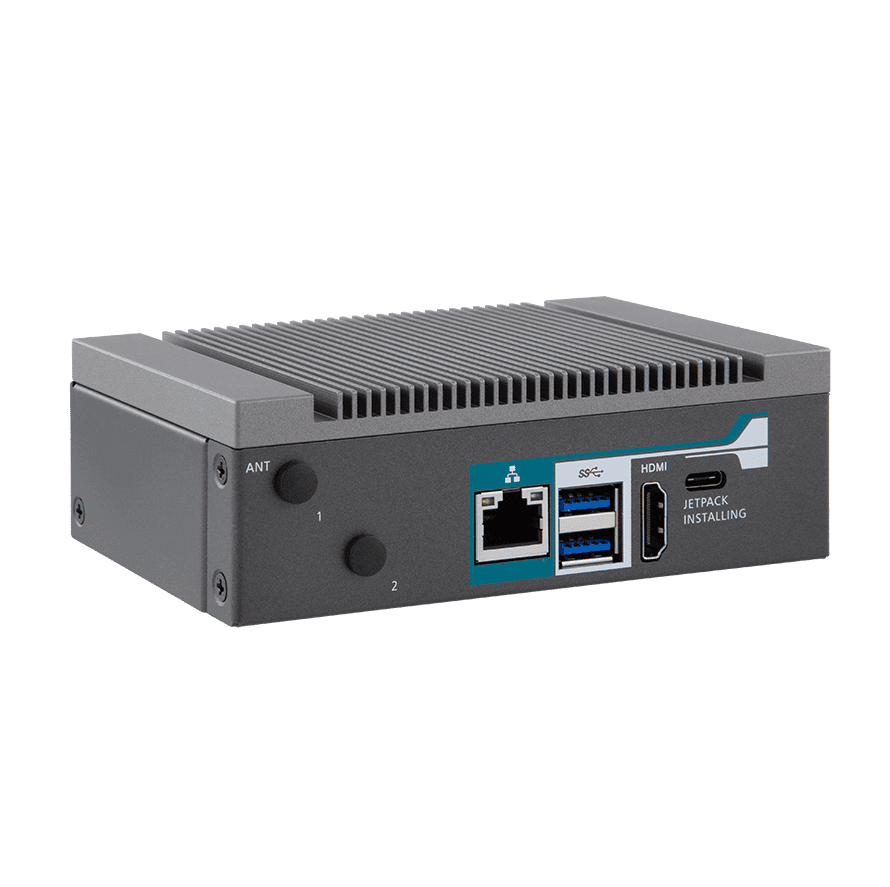
For AI inference with limited installation space, NVIDIA Jetson combines CPU and GPU resources within a compact platform.
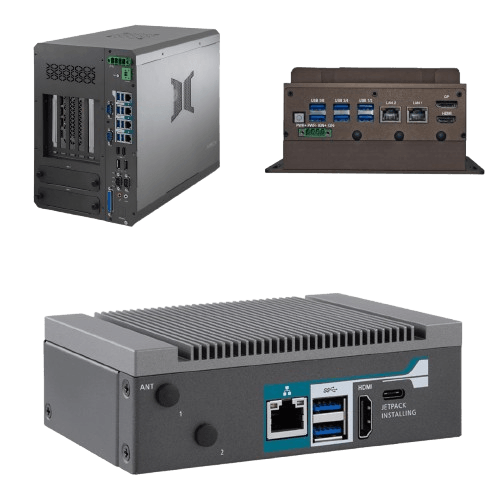
The AEC-2000-8GB is a fanless Edge AI computer based on NVIDIA Jetson Orin Nano. It combines integrated AI acceleration with Ethernet, USB and additional I/O for industrial system integration.
This approach is suitable when compact dimensions and integrated AI acceleration are more important than extensive PCIe expansion.
Compact x86 Edge AI with MXM GPU
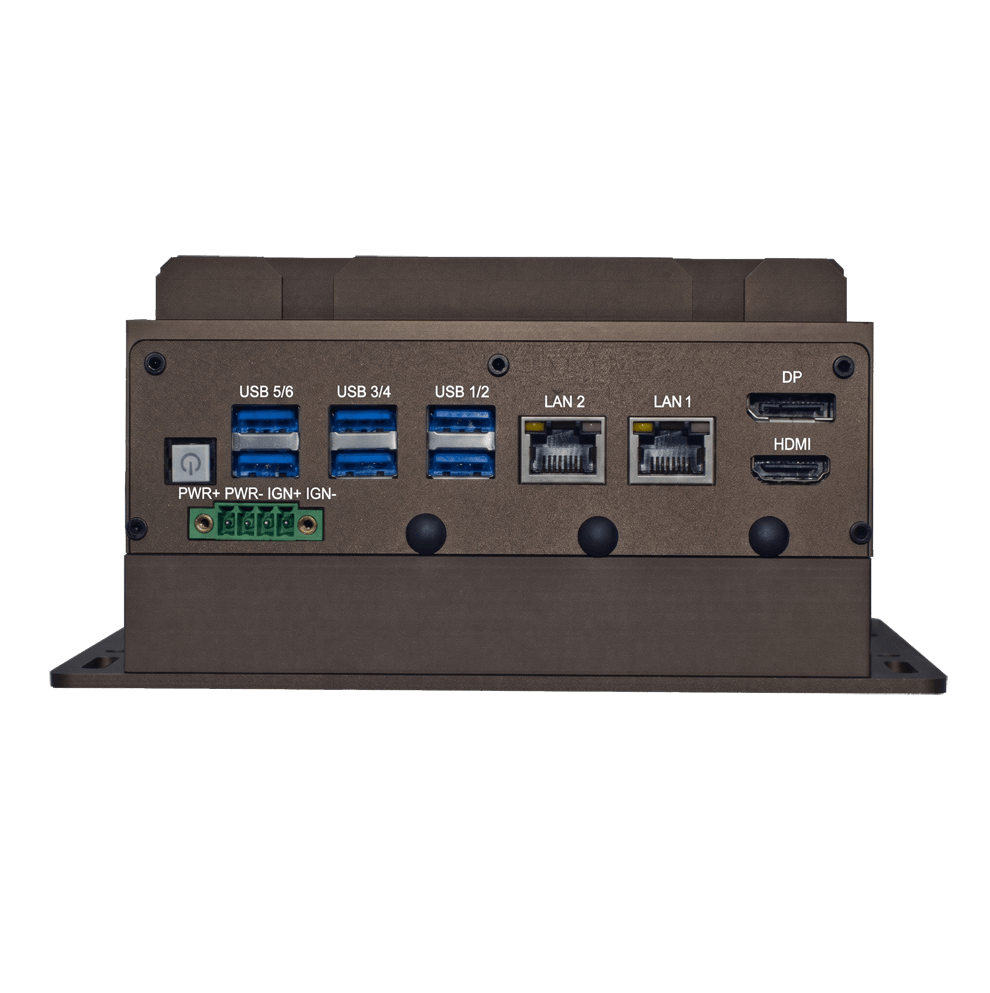
Some applications require an x86 platform together with dedicated NVIDIA GPU performance in a compact system.
The ENBIK RVS-T1M combines Intel Core processors with NVIDIA MXM GPU options and provides LAN, serial and USB interfaces for machine and peripheral connectivity.
The MXM architecture provides dedicated GPU acceleration without requiring a full-size graphics card.
Expandable Industrial PC for GPU and PCIe Cards
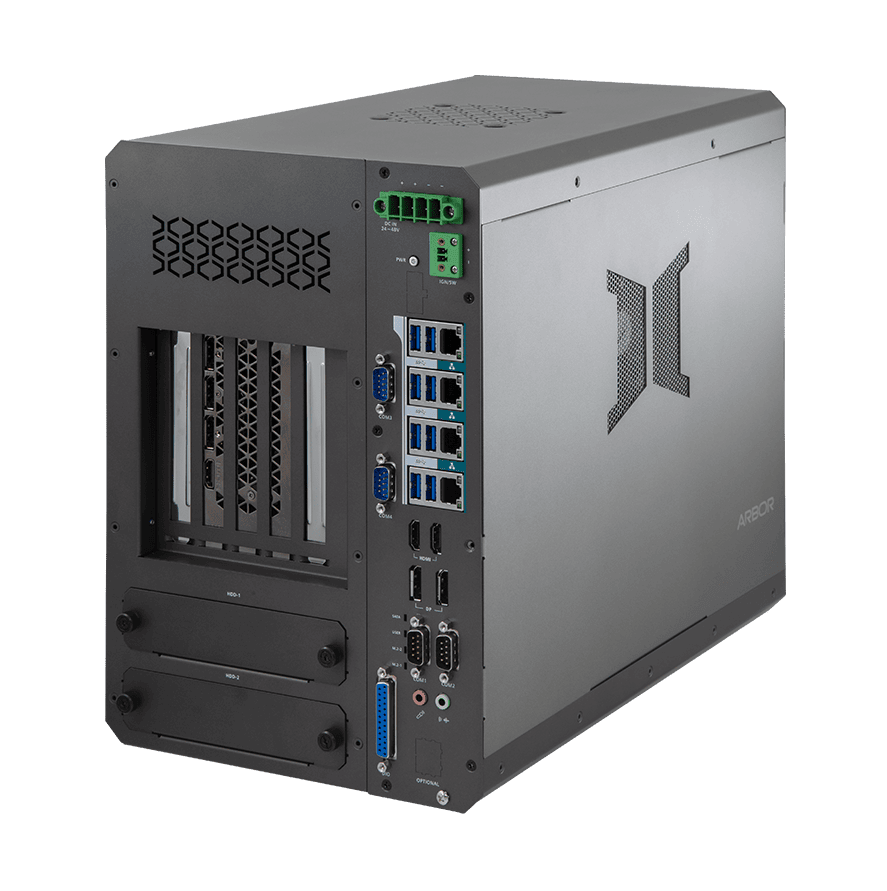
When compute performance must be combined with additional network, I/O or accelerator cards, an expandable industrial PC provides greater flexibility.
The ARBOR FPC-9309W-G5 supports Intel Core Ultra Series 2 processors, DDR5 memory and multiple PCIe slots. Network, USB, COM and additional I/O support more complex system configurations.
This architecture is relevant when GPU acceleration is only one part of the system and additional PCIe expansion, networking or storage must also be accommodated.
What Defines the Hardware Requirements?
For an initial hardware selection, a few technical parameters are usually sufficient:
- data and workloads to be processed
- AI model, if already defined
- number of cameras and sensors
- required interfaces
- processing or inference performance
- installation space, operating environment and future expansion
These parameters determine whether a conventional industrial PC is sufficient or whether the application requires an NPU, NVIDIA Jetson, MXM GPU or a more powerful discrete GPU.
Edge Computing or Edge AI?
Edge Computing and Edge AI are not competing approaches. The required hardware depends on the workload, interfaces and performance requirements.
Send us your technical requirements. We can help you select the right hardware platform for your application.