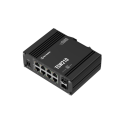
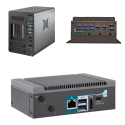
Power over Ethernet simplifies industrial network installations by carrying power and data over the same Ethernet connection. Selecting an industrial PoE switch, however, requires more than comparing the maximum power available per port.
The key parameters are endpoint power requirements, number of powered devices, total PoE budget and bandwidth requirements. Power input, operating temperature, redundancy and application-specific certifications may also determine which solution is suitable.
IPC2U offers Industrial PoE Switches and other Industrial Ethernet solutions for different network architectures and operating environments.
PoE, PoE+ and PoE++: Understanding the Power Levels
Industrial PoE installations commonly use IEEE 802.3af, IEEE 802.3at and IEEE 802.3bt.
| Standard | Type | Maximum PSE Power | Minimum Power at PD |
|---|---|---|---|
| IEEE 802.3af | Type 1 | 15.4 W | 12.95 W |
| IEEE 802.3at | Type 2 | 30 W | 25.5 W |
| IEEE 802.3bt | Type 3 | 60 W | 51 W |
| IEEE 802.3bt | Type 4 | up to approx. 100 W | 71 W |
The PSE is the equipment supplying power, typically a PoE switch or injector. The PD is the powered device. Because of cable losses, the guaranteed power available at the PD is lower than the power delivered by the PSE.
Terms such as PoE+ and PoE++ provide a convenient shorthand, but the actual IEEE standard and power specifications should be used when designing the network.
Determine Power Requirements and PoE Budget
Start with the powered devices. The maximum power requirement and required PoE standard should be established for each endpoint.
Eight devices requiring up to 25 W each, for example, result in:
8 × 25 W = 200 W
Per-port power is therefore only one part of the calculation. The switch must also provide a sufficient PoE budget for all simultaneously powered devices. A practical PoE design should also include sufficient power margin for device variations and future expansion.
The MGS-6311-8UP4X, for example, combines eight 2.5GbE PoE++ ports with four 10G SFP+ uplinks and a total PoE budget of 240 W.
Maximum power per port and total PoE budget are separate design parameters.
Consider PoE Power and Bandwidth Separately
The power required by a PD does not determine its Ethernet bandwidth requirements.
An endpoint may consume relatively little power while generating substantial network traffic. Conversely, a high-power device does not necessarily require a high data rate.
Depending on the application, Gigabit Ethernet may be sufficient, while other installations require 2.5GbE or 10GbE connectivity. With multiple endpoints, the combined traffic toward the uplink must also be considered.
Machine Vision as a Practical Example
Machine vision is a good example of why PoE power and bandwidth need to be considered separately. With multiple Ethernet cameras, the switch must provide sufficient power for the cameras while handling their combined data traffic.
Even when each camera port is adequately sized, aggregated traffic can make uplink capacity the limiting factor.
For local image processing and AI inference, IPC2U also offers Edge AI Systems.
When Is PoE++ Required?
IEEE 802.3bt is used when a powered device requires more power than IEEE 802.3af or IEEE 802.3at can provide. A higher PoE class is therefore not automatically better; it should match the requirements of the connected equipment.
Depending on the network architecture, PoE++ can be provided by switches, injectors or industrial media converters. This also allows existing copper and fiber infrastructure to be incorporated into the design without limiting the solution to a single type of network device.
Managed vs. Unmanaged Industrial PoE Switches
An unmanaged switch can be sufficient for a small, fixed network that does not require configuration or remote management.
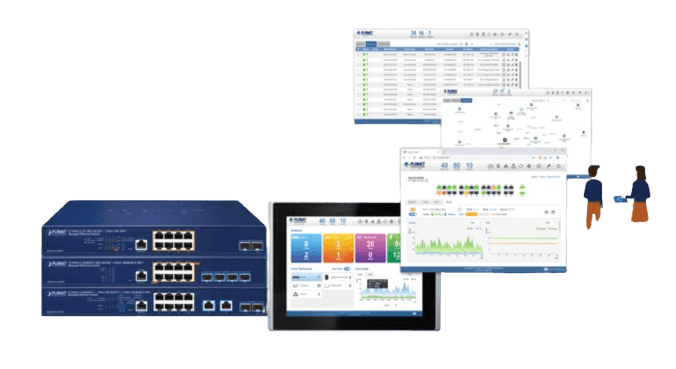
Managed switches are appropriate when the network requires segmentation, diagnostics, redundancy or security functions. Depending on the model, these may include VLANs, SNMP, RSTP, MSTP, ERPS and other management features.
For installations requiring a higher port count, the IGS-1604XSM-16PH provides 16 Gigabit PoE+ ports, four 10G SFP ports and redundant DC power input.
Management and redundancy features should always be selected according to the actual network architecture.
Environmental Requirements and Certifications
Port count, bandwidth and PoE budget are only part of industrial switch selection. Depending on the application, additional requirements may include:
- input voltage and redundant power
- operating temperature
- shock and vibration
- EMC requirements
- mounting and enclosure
- industry-specific standards
Specialized applications may require additional standards, including EN 50155 for railway applications or IEC 61850-3 and IEEE 1613 for power utility applications. Required standards and certifications should be defined early in the selection process and verified for the specific model.
Cybersecurity Requirements
The EU Cyber Resilience Act (CRA) introduces cybersecurity requirements for products with digital elements. For managed industrial switches, security features, secure update mechanisms and vulnerability management should therefore be considered as part of the selection process.
The specific security functions required depend on the network architecture and application.
Warranty and Long-Term Deployment
For long-term industrial deployments, product lifecycle and warranty terms are additional selection criteria.
Selected industrial networking products available from IPC2U include a five-year manufacturer warranty. Warranty terms should be verified for the specific product.
When Does a Fiber Uplink Make Sense?
PoE supplies endpoints over copper Ethernet, while the switch uplink can use fiber.
SFP and SFP+ interfaces are suitable for fiber backbones, longer network links and connections between network segments. They allow copper-connected PoE devices to be integrated into a wider fiber infrastructure.
Suitable configurations are available in the IPC2U Industrial Ethernet Switch portfolio.
How to Select an Industrial PoE Solution in Five Steps
1. Define the endpoints
List the number and type of powered devices.
2. Determine power requirements
Check the maximum power demand and required IEEE PoE standard for each device.
3. Calculate the PoE budget
Compare the combined power requirement of all simultaneously powered devices with the available PoE budget.
4. Determine bandwidth requirements
Consider both individual port speeds and aggregated traffic toward the uplink.
5. Define deployment requirements
Specify power input, operating temperature, management, redundancy, fiber connectivity, cybersecurity requirements and any required certifications.
Planning an Industrial PoE Network?
Send us your requirements. We can help you select the right Industrial PoE solution.