The Challenge
In large solar installations, monitoring systems, inverters, controllers and data loggers may be distributed across a wide area. These devices require reliable network connectivity for remote operation and monitoring. As the number of devices and the distances between them increase, network structure and maintenance become more demanding.
Copper Ethernet is limited to approximately 100 m per link. Longer connections between plant sections therefore require fibre or another suitable transmission technology. Network equipment installed outdoors must also be selected with regard to the temperatures and environmental conditions inside its control cabinet or protective enclosure.
The Solution
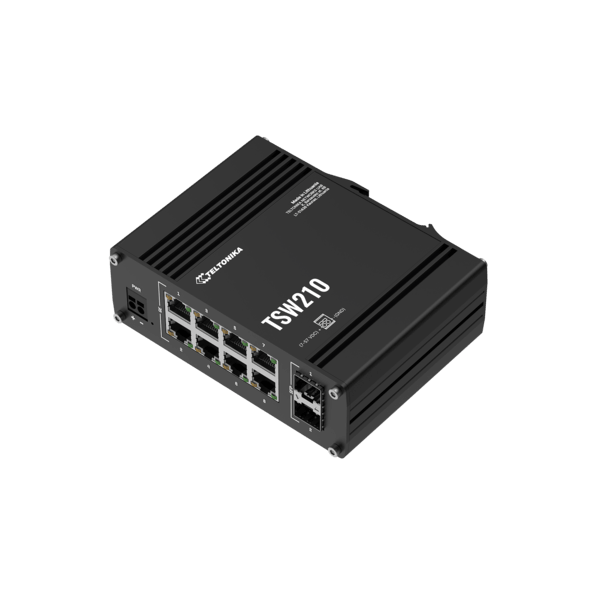
The Teltonika TSW210 provides eight Gigabit Ethernet ports for connecting local devices and two SFP ports for fibre links over longer distances. The switch requires no software configuration, which simplifies installation in applications that do not need managed network functions.
Key Specifications
| Specification | Value |
|---|---|
| Ethernet ports | 8 × RJ45, 10/100/1000 Mbps; IEEE 802.3i/u/ab/x/az; auto MDI/MDIX |
| SFP ports | 2 × Gigabit SFP |
| Switching capacity | 20 Gbps, non-blocking |
| Management | Unmanaged; no software configuration required |
| Power input | 9–57 V DC via a two-pin industrial DC power socket |
| Power consumption | 1.03 W idle, 3.71 W maximum |
| Housing / protection | Aluminium housing, IP30 |
| Operating temperature | −40 to +75 °C |
| Dimensions (W × H × D) | 132 × 44.2 × 95.1 mm |
| Mounting | DIN rail, wall or flat-surface mounting |
Due to its IP30 rating, the TSW210 must be installed in a suitable control cabinet or protective enclosure in outdoor applications. The enclosure must provide the required protection against dust, moisture, condensation and direct sunlight.
The TSW210 does not supply PoE. Cameras, access points and other powered devices require a separate PoE injector or a PoE-capable switch. As an unmanaged switch, the TSW210 does not provide VLAN configuration, managed network diagnostics or redundancy protocols. Applications requiring a redundant ring topology need an appropriate managed switch.
Key Technical Advantages
- Wide operating-temperature range. The specified range supports installation in industrial enclosures under varying ambient conditions. System designers must also consider the temperature inside the enclosure and the permitted operating-temperature range of the selected SFP modules.
- Fibre connectivity and galvanic isolation. Fibre links cover greater distances than copper Ethernet, provide galvanic isolation between plant sections and are not susceptible to electromagnetic interference along the optical transmission path.
- Local DC power supply. The 9–57 V DC input supports operation from a suitable local DC source. Manufacturer measurements show power consumption from 1.03 W at idle up to 3.71 W in the documented maximum-load test configuration.
Selecting Suitable SFP Modules
The SFP modules must be selected according to the required transmission distance, fibre type, wavelength and operating temperature. Compatibility with the TSW210 should be verified for the selected configuration. Suitable options can be found under SFP Modules and Accessories.
The Teltonika TSW210 and compatible SFP modules are available from IPC2U on request. Further product options can be found in the Industrial Ethernet Switches category.
We support the selection of suitable industrial switches, SFP modules and network components for photovoltaic installations.