Public transport operators increasingly rely on cellular connectivity to stay competitive. On-board Wi-Fi, real-time GPS tracking, dynamic routing and IoT sensors all depend on a reliable, high-throughput link to the network. This case study covers a deployment by a Middle East operator that equipped its passenger buses with the Teltonika Networks RUTX50 dual-SIM 5G router to provide on-board passenger Wi-Fi and reliable cellular connectivity.
The Challenge: On-Board Connectivity for Passengers and Fleets
Fast, dependable Internet has become a decisive factor in the public transport market. A Wi-Fi hotspot lets passengers work and browse during their journey, while real-time data transmission enables live vehicle tracking and route adjustments based on traffic or demand. The same connection also supports on-board IoT devices such as sensors for vehicle health monitoring and passenger counting.
Buses travel long distances, so coverage and reliability matter as much as raw speed. The operator needed a router that maintains service across changing network conditions and can be managed remotely across the whole fleet.
| Model | Key specifications | Best for |
|---|---|---|
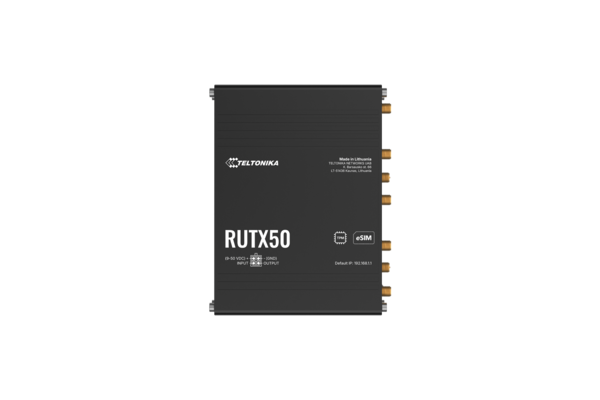
| RUTX50 | Dual-SIM 5G, up to 3.3 Gbps, 5× Gigabit Ethernet, dual-band Wi-Fi 5, LTE Cat 20 / 3G fallback, GNSS, −40…75 °C, IP30 | On-board passenger Wi-Fi hotspot and vehicle connectivity |
RUTX50 – Dual-SIM 5G Router
The RUTX50 is installed in an overhead cabinet near the driver's seat and broadcasts a 5G-backed Wi-Fi network throughout the bus. It delivers 5G Sub-6 GHz speeds of up to 3.3 Gbps download with single-digit latency. To join the hotspot, passengers enter their phone number and receive an SMS one-time password, enabling per-passenger controls such as a daily access limit and caps on upload/download bandwidth and speed. The captive login page is fully customisable and was localised to Arabic for this deployment.
Reliability comes from the router's dual-SIM design with auto-failover and backup WAN. If the first SIM's connection drops, the second takes over automatically. Backward compatibility with 4G (LTE Cat 20) and 3G keeps the bus online in areas without 5G coverage, falling back to LTE and then 3G as needed.
Beyond the hotspot, the router carries operational traffic: a driver tablet uses the Wi-Fi for route navigation and to receive updates from headquarters. A per-passenger data-usage and session-duration report is generated automatically — the database file is retrieved over Secure Copy Protocol using WinSCP, then exported from .DB to .CSV with DB Browser for further filtering. Five Gigabit Ethernet ports, dual-band 802.11ac (Wi-Fi 5) with MU-MIMO, GNSS, USB and digital I/O round out the interface set, all running on Teltonika's RutOS firmware.
| Network mode | Downlink | Uplink |
|---|---|---|
| 5G Sub-6 GHz (SA/NSA, 4×4 MIMO) | up to 3.3 Gbps | up to 900 Mbps |
| 4G LTE Cat 20 | up to 2.0 Gbps | up to 200 Mbps |
| 3G | up to 42 Mbps | up to 5.76 Mbps |
Deployment Highlights
Passenger Wi-Fi Hotspot
5G-backed Wi-Fi broadcast throughout the bus lets passengers browse and work during the journey.
RUTX50SMS OTP Authentication
Passengers log in with their phone number and an SMS one-time password, enabling per-user access and bandwidth limits.
RUTX50Localised Login Page
The captive portal is fully customisable and was localised to Arabic for this deployment.
RUTX50Driver Navigation & HQ Link
A driver tablet uses the router's Wi-Fi for route navigation and to receive updates from headquarters.
RUTX50Automated Usage Reporting
Per-passenger data and duration reports are exported via SCP (WinSCP) and converted from .DB to .CSV with DB Browser.
RUTX50Dual-SIM Auto-Failover
Two SIM slots with automatic failover and LTE Cat 20 / 3G fallback keep the connection alive across coverage gaps.
RUTX50Product in This Solution
- RUTX50 — Dual-SIM industrial 5G router, up to 3.3 Gbps, 5× Gigabit Ethernet, dual-band Wi-Fi 5, LTE Cat 20 / 3G fallback, GNSS, auto-failover.