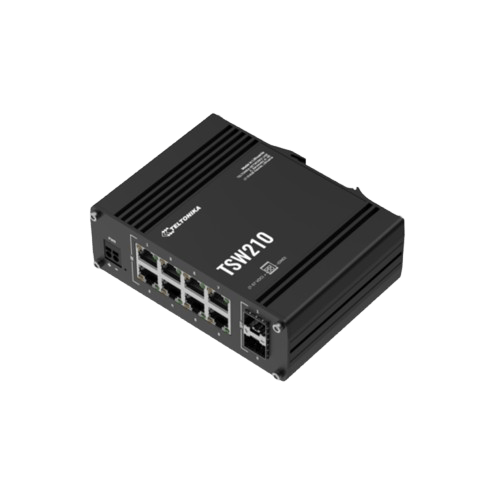
Photovoltaic installations often distribute inverters, data loggers, controllers and monitoring equipment across a large site. The Teltonika TSW210 provides eight Gigabit Ethernet ports and two SFP slots in a compact, unmanaged industrial switch, allowing nearby Ethernet devices to be connected to a fiber backbone without switch configuration.
The TSW210 operates from a 7–57 V DC supply and is specified for temperatures from −40 to +75 °C. Its aluminium housing has an IP30 rating. In outdoor photovoltaic systems, the switch therefore needs to be installed in a suitable control cabinet or enclosure.
Connecting distributed equipment in photovoltaic systems
The communication network of a solar installation does not normally connect the individual photovoltaic modules. Instead, Ethernet is used by equipment such as inverters, plant controllers, data loggers, weather monitoring systems, RTUs and service interfaces. Depending on the plant design, these devices may be located in several inverter stations or field cabinets distributed across the site.
Copper Ethernet is suitable for connections within a cabinet or between nearby devices, but standard Ethernet links over twisted-pair cabling are limited to 100 metres. Fiber can cover longer distances and provides galvanic isolation between separate plant sections. The TSW210 combines both connection types in one compact switch.
Eight Gigabit Ethernet ports and two SFP slots
The TSW210 offers eight 10/100/1000 Mbps RJ45 ports with automatic MDI/MDIX detection. Two SFP slots provide Gigabit fiber connections for longer uplinks. The achievable transmission distance depends on the selected SFP transceivers, fiber type and network topology.
As an unmanaged switch, the TSW210 starts forwarding network traffic immediately after power-up and requires no software configuration. This makes it suitable for straightforward connection points where VLANs, port-level diagnostics, redundancy protocols and remote switch management are not required.
For larger or more critical photovoltaic networks, managed switches may be needed at the backbone or central control level. Managed and unmanaged devices can therefore serve different functions within the same installation.
Installation in protected industrial enclosures
The specified operating temperature range is −40 to +75 °C. Its 7–57 V DC input supports connection to different industrial DC power supplies. According to the manufacturer, power consumption is 1.03 W when idle and 3.71 W at maximum load.
The TSW210 has an IP30 rated housing. It is therefore intended for installation in a protected control cabinet or another enclosure providing the environmental protection required at the installation site. The switch is not designed for unprotected exposure to rain, dust, condensation or direct sunlight.
The switch can be mounted on a DIN rail, wall or flat surface. According to the manufacturer documentation, an additional mounting kit is required and must be included when planning the installation.
Technical specifications
| Specification | Teltonika TSW210 |
|---|---|
| Ethernet ports | 8× RJ45, 10/100/1000 Mbps, auto MDI/MDIX |
| Fiber interfaces | 2× SFP slots for Gigabit fiber connections |
| Switch type | Unmanaged, plug and play |
| Switching capacity | 20 Gbps, non-blocking |
| Packet buffer | 128 KB |
| MAC address table | 2,000 entries |
| Jumbo frames | Up to 9,216 bytes |
| Power input | 7–57 V DC, 2-pin industrial DC socket |
| Power consumption | Approximately 1.03 W idle, 3.71 W maximum |
| PoE | Not supported |
| Housing | Aluminium, IP30, grounding capability |
| Mounting | DIN rail, wall or flat surface; additional mounting kit required |
| Dimensions | 132 × 44.2 × 95.1 mm |
| Weight | 500 g |
| Operating temperature | −40 to +75 °C |
Typical applications in solar energy systems
Local device connectivity
The eight Gigabit Ethernet ports can connect inverters, controllers, data loggers and monitoring equipment located within the same protected cabinet or station.
Fiber uplinks between plant sections
The two SFP slots can link distributed inverter stations or field cabinets to an optical backbone. Suitable SFP transceivers must be selected according to the required distance and fiber infrastructure.
Simple decentralized connection points
Because no configuration is required, the TSW210 can be used where uncomplicated commissioning and low local administration are more important than managed network functions.
Integration with industrial DC supplies
The 7–57 V DC input allows the switch to be operated with different DC supplies used in industrial control cabinets.
Important points when selecting the switch
The TSW210 does not provide Power over Ethernet. Connected devices therefore require their own power supply. It also does not offer the VLAN, monitoring, diagnostic or redundancy functions of a managed industrial switch.
These characteristics make the TSW210 a practical choice for clearly defined, unmanaged network segments. The complete topology, required availability, environmental protection, fiber distances and management functions should be evaluated before selecting switches for the overall photovoltaic installation.
Teltonika TSW210 at a glance
The Teltonika TSW210 combines eight Gigabit Ethernet ports, two SFP slots, a wide DC input and an extended operating temperature range in a compact industrial enclosure. Installed in a suitable protected cabinet, it can provide simple copper connectivity and fiber uplinks for distributed equipment in photovoltaic and other energy systems.
Industrial Ethernet switches from IPC2U
IPC2U supplies industrial networking components for photovoltaic systems, energy infrastructure and industrial automation. We support the selection of unmanaged or managed switches, suitable SFP transceivers and the required network architecture for each application.