When data is acquired simultaneously from multiple cameras, sensors or measuring instruments, counting network ports alone is not enough. All interfaces must be able to operate concurrently at the required data rate, while sufficient PCIe resources remain available for additional components.
System design becomes more demanding when four independent 2.5GbE connections are required and a dedicated NVIDIA GPU is to be installed later. The network adapter must neither occupy the GPU slot nor exhaust the system's expansion capacity.
Based on the FPC-8208-G1, IPC2U has developed an expandable Embedded PC solution for these requirements. It combines high CPU performance, four high-speed Ethernet interfaces, industrial-grade memory and storage, and a free slot for a future GPU upgrade.
The requirement: acquiring multiple data streams simultaneously
Modern cameras and sensors generate increasing volumes of data. In applications with multiple devices, the individual data streams must be acquired, buffered and processed in parallel. Typical use cases include:
- multi-camera machine vision
- optical inspection and test systems
- mobile and stationary measurement systems
- test benches and experimental setups
- scientific data acquisition
- quality control in production and laboratories
- traffic and infrastructure monitoring
- machine and equipment monitoring
Four interfaces operating at 2.5Gbps provide an aggregate gross data rate of 10Gbps. Actual usable throughput is lower and depends on factors such as the connected devices, transmission protocol, packet size and system configuration. CPU performance, PCIe connectivity, memory and storage must therefore be considered together.
Why PCIe slot allocation matters
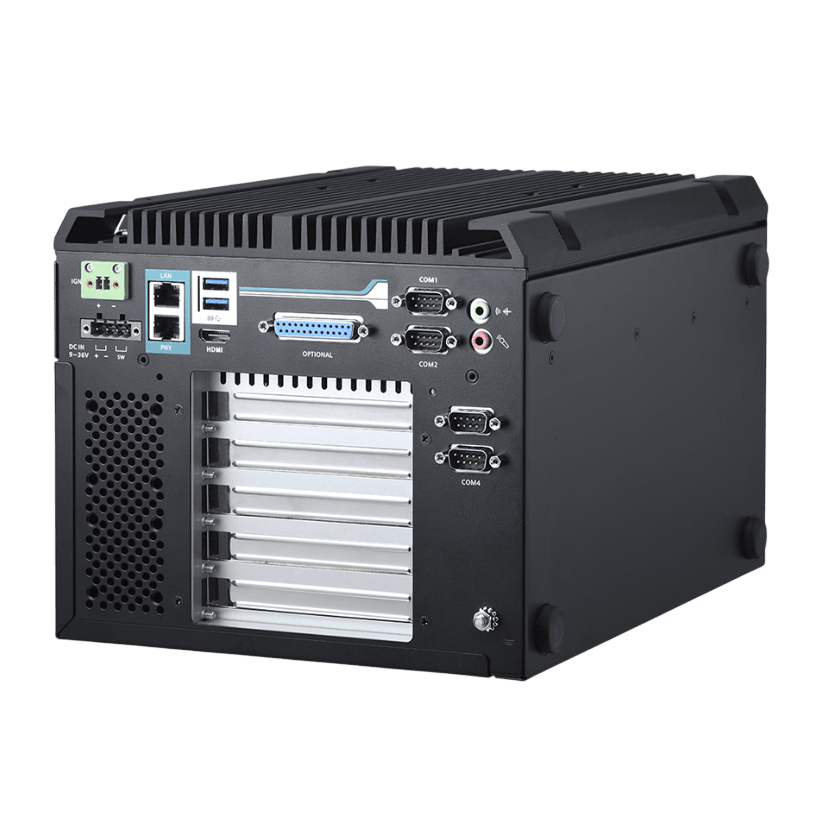
The Embedded PC already provides two 2.5GbE and two Gigabit Ethernet interfaces. For applications requiring four equivalent 2.5GbE connections, the system is configured with an additional four-port network adapter. This adapter occupies one of the two available PCIe x4 slots.
The separate PCIe x16 slot therefore remains available for a future NVIDIA GPU. The mechanical x16 slot is electrically connected with eight PCIe lanes. Whether this connection provides sufficient bandwidth depends on the selected GPU and the application's data flow. A further PCIe x4 slot also remains available after the network adapter has been installed.
The four additional ports can be reserved for parallel data sources. The onboard interfaces then remain available for functions such as machine communication, higher-level networks, remote maintenance or service access. Their assignment is defined according to the project's network topology.
This allocation is a key advantage of the solution. In many compact Embedded PCs, the only expansion slot is already required for additional network interfaces. A later GPU upgrade would then require replacing either the network adapter or the entire computer.
CPU processing first, GPU acceleration later
Not every application requires a dedicated GPU from the beginning. Data acquisition, control, preprocessing and storage can initially be handled by the CPU. If machine vision algorithms, AI models or other parallel computing workloads are added later, the system can be upgraded with a suitable NVIDIA GPU.
The FPC-8208-G1 supports graphics cards with a power consumption of up to 100W and provides a PEG power connector. This makes it suitable for professional NVIDIA GPUs with a compact form factor and moderate power requirements.
Professional GPU options for the planned upgrade include:
- NVIDIA RTX 2000 Ada, 16GB GDDR6, 224GB/s, 71 AI TOPS, 70W, dual-slot
- NVIDIA RTX 2000E Ada, 16GB GDDR6, 224GB/s, 71 AI TOPS, 50W, single-slot
- NVIDIA RTX PRO 2000 Blackwell, 16GB GDDR7, 288GB/s, 545 AI TOPS, 70W, dual-slot
- NVIDIA RTX PRO 4000 Blackwell SFF, 24GB GDDR7, 432GB/s, 770 AI TOPS, 70W, dual-slot
The GPU is selected for the specific project. In addition to power consumption, card length, height, width, cooling, driver support and the permitted operating temperature range must be considered. Before an upgrade, IPC2U therefore verifies that the selected GPU is mechanically, electrically and thermally compatible with the existing system configuration.
The required configuration can be requested directly from IPC2U via the configurable FPC-8208-G1-C product page.
Intel Core performance on an industrial platform
The system supports 12th, 13th and 14th generation Intel Core i3, i5, i7 and i9 processors. An Intel Core i7-14700T with a processor base power of 35W, for example, provides a balanced combination of computing performance and thermal headroom.
The choice between a 35W and a 65W CPU directly affects the permitted ambient temperature. With airflow, the datasheet specifies the following ranges for the base system:
- -20 to +70°C with a 35W-class CPU
- -20 to +55°C with a 65W-class CPU
- -20 to +45°C for the tested configuration with an NVIDIA GTX 1660
For other GPUs and additional PCIe cards, the operating temperature range of the complete configuration must be assessed separately. The highest temperature rating of the base system cannot be applied automatically to every expansion configuration.
Industrial-grade memory and storage
The IPC2U solution is configured with industrial-grade DDR5 memory modules and an industrial-grade NVMe SSD. Two DDR5 SO-DIMM sockets support up to 96GB of memory, allowing the capacity to be matched to the number of data sources and the required processing workload.
An M.2 slot with a PCIe Gen4 x4 interface is available for an NVMe SSD used by the operating system and high-speed data acquisition. Two additional industrial-grade 2.5-inch SATA SSDs can also be installed. The SATA drives support RAID 0 and RAID 1.
Industrial-grade memory and storage components provide important benefits, particularly for system configurations intended for long-term deployment:
- controlled bills of materials
- extended product availability
- traceable controller and NAND flash combinations
- defined endurance according to the selected SSD series
- options for extended temperature ranges
- improved reproducibility for repeat system deliveries
The storage architecture is designed around the expected data volume. The operating system, active data acquisition and data archive can be distributed across separate drives where required. In addition to capacity, sustained write performance and daily write volume are key selection criteria.
Comprehensive interfaces for integration and service
The following interfaces are also available for peripherals and service equipment:
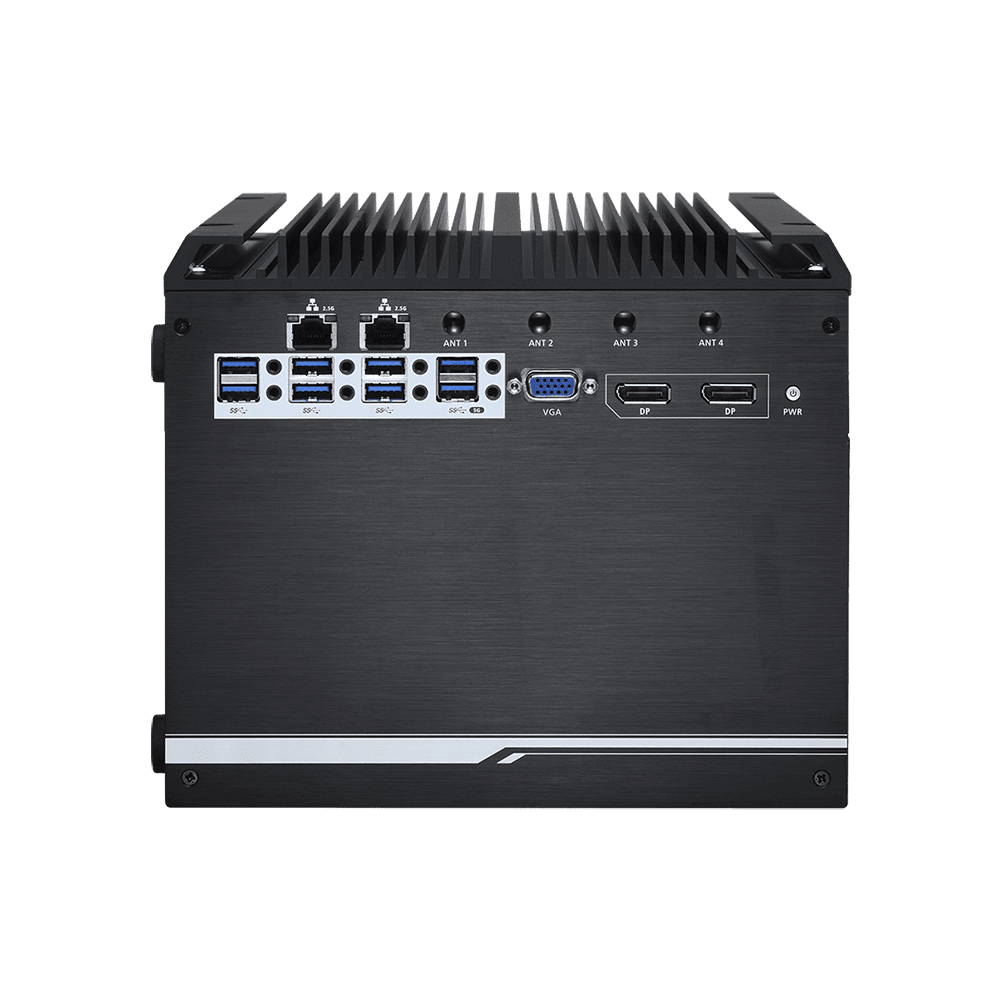
- 8x USB 3.2 Gen2 at 10Gbps
- 2x USB 3.2 Gen1 at 5Gbps
- 2x DisplayPort 1.4a
- 1x HDMI 2.1
- 1x VGA
- 2x RS-232/422/485
- 2x RS-232
- digital inputs and outputs
Wi-Fi and Bluetooth can be added via an M.2 E-Key module. Additional M.2 and Mini PCIe slots are available for cellular communication, GPS or other communication modules.
The interfaces are readily accessible on both I/O sides of the system. This simplifies the connection of multiple data sources as well as servicing and replacement within a machine, test bench or protected equipment enclosure.
DC power input for industrial systems
The Embedded PC operates from a 9 to 36V DC input and can therefore be integrated into a range of industrial power architectures. Delayed power-on and power-off functions as well as ignition power management are supported.
The datasheet specifies maximum power consumption of 65W for the base system with a 35W CPU and 95W with a 65W CPU, in both cases without additional expansion cards. The network adapter, GPU, drives and communication modules increase total power demand. The power supply must therefore be sized for the complete configuration with sufficient reserve.
Mechanical resilience of the complete configuration
For the base system with an SSD, the manufacturer specifies vibration resistance of 3Grms from 5 to 500Hz and shock resistance of 40G in operation and 60G when not operating. These values apply to the system configuration defined in the datasheet.
Once a network adapter or GPU is installed, its mounting, circuit board, cooling system and connectors must also be considered. The mechanical ratings of the base system cannot automatically be transferred to every expansion card. For mobile applications, the complete configuration, including mounting and expansion cards, must be assessed separately and tested where necessary.
Measuring 225 x 190 x 292mm and weighing 7.35kg, the Embedded PC combines three PCIe slots and space for multiple drives in a comparatively compact enclosure.
Long-term platform availability
The FPC-8208-G1 is based on the Intel Q670E chipset and supports processors from the Intel Embedded Roadmap. Embedded PC manufacturers generally align platform availability with the lifecycle of the Intel processors and chipsets used.
A newly introduced platform may therefore remain available for up to ten years from launch, provided that Intel or the system manufacturer does not discontinue relevant components earlier. For repeat projects, IPC2U can also provide a controlled configuration with industrial-grade memory and storage components and a defined bill of materials.
IPC2U system configuration at a glance
| Component | Configuration |
|---|---|
| System platform | FPC-8208-G1 |
| Processor | 14th generation Intel Core processor, for example Core i7-14700T |
| Memory | Industrial-grade DDR5 RAM, from 32GB, expandable to 96GB |
| System drive | Industrial-grade M.2 NVMe SSD |
| Additional storage | 2x industrial-grade 2.5-inch SATA SSDs; RAID 0/1 supported |
| High-speed network interfaces | 4x 2.5GbE via PCIe x4 network adapter |
| Additional LAN ports | 2x 2.5GbE and 2x Gigabit Ethernet onboard |
| GPU expansion | PCIe x16 slot with x8 lane connection, up to 100W |
| Additional expansion | 1x PCIe x4 remains available after installation of the network adapter |
| Wi-Fi | Optional via M.2 E-Key |
| Operating system | Windows 11 IoT or Ubuntu 22.04 Linux, project-specific |
| Power input | 9 to 36V DC |
| Dimensions | 225 x 190 x 292mm |
| Weight | 7.35kg |
One platform for different expansion stages
The solution can initially be used for CPU-based data acquisition and processing. Its network connectivity, memory and storage are already designed for multiple parallel data sources. If computing requirements increase, a suitable NVIDIA GPU can be added without replacing the base system or motherboard.
IPC2U coordinates the CPU, industrial-grade RAM, industrial-grade SSDs, network adapter, PCIe slot allocation, GPU, power supply and operating system. We support the selection and configuration of a suitable Embedded PC with expansion slots or Edge AI system for your application.