Selecting an onboard computer for an agricultural robot starts with understanding how the machine will navigate and perform its work. A field robot following predefined RTK-GNSS coordinates has very different computing requirements from a camera-guided weeding robot that must distinguish crops from weeds and position its tools accurately while moving.
More advanced machines may need to process multiple camera streams, generate local maps from LiDAR data, track vehicle motion and coordinate mechanical actuators simultaneously. All of this takes place on a moving platform exposed to dust, moisture, vibration and fluctuating temperatures, often with a limited power budget.
For agricultural robot manufacturers, the challenge is to select a computing platform that meets these requirements without introducing unnecessary power consumption, integration complexity or hardware costs.
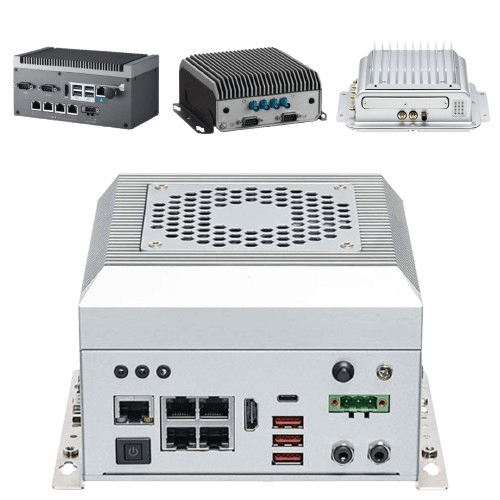
Onboard computing and vehicle control architecture
Autonomous agricultural robots typically combine several functions: environmental perception, localization, path planning, vehicle control and execution of the agricultural task itself.
A common architecture uses an industrial embedded computer for perception and navigation, with a separate vehicle controller handling propulsion, steering and other actuators. The navigation computer communicates movement commands and receives vehicle status information through interfaces such as CAN or Ethernet.
Where the agricultural task requires coordinated motion, such as positioning mechanical weeding tools or robotic harvesting mechanisms, a more integrated approach may be appropriate. Dedicated robot controllers can combine GPU-accelerated processing with real-time motion control and EtherCAT communication.
Consolidating these functions can simplify the hardware architecture, provided that computationally intensive perception workloads do not interfere with time-critical control processes.
Safety-related functions, including protective stops and personnel detection, require an appropriately designed and validated safety architecture. A conventional AI computer does not become a safety controller simply because it can detect obstacles.
Navigation beyond satellite positioning
RTK-GNSS can provide centimeter-level positioning accuracy under favorable reception conditions. For agricultural machinery operating across open fields, this may form the basis of the entire navigation system.
Orchards, vineyards and greenhouses present different challenges. Trees, vegetation and surrounding structures can obstruct satellite signals or introduce multipath errors. Wheel odometry also becomes less reliable when the vehicle encounters loose soil, mud or uneven terrain.
Depending on the operating environment, agricultural robots may therefore combine several sensing technologies:
- RGB and stereo cameras for crop row detection, visual navigation, plant recognition and depth estimation.
- 2D or 3D LiDAR for distance measurement, environmental mapping and obstacle detection.
- RTK-GNSS receivers for absolute positioning.
- Inertial measurement units (IMUs) for measuring acceleration and angular motion.
- Wheel encoders for estimating vehicle speed and displacement.
Sensor fusion combines complementary measurements to improve localization and motion estimation. SLAM (Simultaneous Localization and Mapping) can provide an additional means of navigation when reliable satellite positioning is unavailable.
Accurate sensor timing is particularly important on a moving vehicle. At a travel speed of 2 m/s, a camera image acquired 50 milliseconds before a corresponding LiDAR measurement represents a vehicle position 10 cm earlier along its path. Unless the processing pipeline accounts for this difference, combining the measurements can introduce spatial inconsistencies.
Hardware-supported timestamps, synchronization capabilities and sensor calibration should therefore be considered during the initial system design rather than added after the computing platform has been selected.
Camera connectivity: GMSL2 or Power over Ethernet?
Camera selection has a direct impact on the onboard computer, wiring architecture and software integration effort.
GMSL2 is widely used in vehicle perception systems where cameras are distributed across a mobile platform. Compatible implementations support high-speed image transmission and camera power over a single coaxial cable. Compact locking connectors are particularly useful where vibration and restricted installation space make conventional connections less practical.
However, a GMSL2 port alone does not guarantee camera compatibility. The image sensor, serializer, deserializer, camera driver and the computer's board support package (BSP) must work together. This is an important consideration when selecting a production-ready embedded platform.
Ethernet cameras offer a different approach, particularly in systems that also incorporate Ethernet-based LiDAR and other networked sensors. Power over Ethernet (PoE) reduces wiring by supplying power and carrying data through the same cable.
For multi-camera installations, engineers need to evaluate the available network throughput, internal interface architecture and total PoE power budget. Camera protocols and synchronization requirements must also be considered.
CAN interfaces provide connectivity to vehicle electronics, motor controllers and other embedded control units. EtherCAT is another option where the application requires deterministic communication and coordinated motion across multiple drives or actuators.
Sizing the computing platform
Not every agricultural robot needs dedicated AI acceleration. GNSS-based navigation, supervisory control and relatively lightweight sensor processing can often be handled by conventional industrial embedded computers.
Camera-intensive applications introduce a different workload. Crop classification, visual odometry, object detection and LiDAR point cloud processing may need to run concurrently, placing considerable demands on CPU resources, GPU performance and memory bandwidth.
NVIDIA Jetson Orin-based edge AI computers offer several performance classes for these applications.
Jetson Orin Nano provides an entry point for lightweight perception and inference workloads. Orin NX offers additional computing capacity for more demanding multi-camera applications, while AGX Orin provides greater processing resources and memory capacity for complex robotics workloads.
Peak AI performance expressed in TOPS is useful for comparing modules, but it is not a reliable measure of complete application performance. Camera resolution, frame rate, model complexity, memory requirements and concurrent processing tasks all affect achievable throughput and response times.
The cooling design of the finished industrial computer is equally important. A higher-power Jetson operating mode is only useful if the system can sustain it under the actual installation and ambient temperature conditions.
Software compatibility should be established before hardware procurement. For projects using ROS 2, NVIDIA Isaac ROS or custom computer vision pipelines, the supported JetPack release, BSP, camera drivers and application dependencies need to be aligned.
Designing for outdoor operation
Agricultural robots operate under conditions that differ considerably from those encountered by autonomous mobile robots in warehouses or production facilities.
On battery-powered machines, the energy budget must account for the entire computing and perception subsystem, including cameras, LiDAR, storage and communications hardware. PoE-powered devices also contribute to the electrical load on the onboard power supply.
The computer's DC input range must accommodate the actual operating voltage of the vehicle, not merely its nominal battery voltage. Voltage fluctuations, transient disturbances and short supply interruptions caused by motors or other electrical loads need to be considered.
Fanless industrial computers are attractive for dusty environments, but passive cooling still requires an effective thermal path. Direct sunlight, restricted airflow and installation inside sealed compartments can increase operating temperatures and reduce sustained computing performance.
For exposed mounting locations, rugged in-vehicle computers with sealed enclosures and locking connectors may be necessary.
An IP67 rating indicates protection against dust ingress and temporary immersion under specified conditions. It does not, by itself, establish suitability for high-pressure washdown.
Mechanical design must also account for continuous vibration, shock loads, connector retention and secure mounting of internal storage devices. Condensation and the routing of external sensor cables deserve particular attention when selecting the installation location.
Industrial computers and robot controllers for agricultural applications
IPC2U supplies embedded computing platforms and dedicated robot controllers covering different perception, navigation and motion control architectures.
Aetina AIE-VN44-128-A1 – GMSL2 camera integration
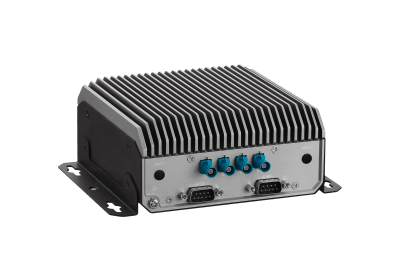
The Aetina AIE-VN44-128-A1 combines NVIDIA Jetson Orin NX 16 GB with four GMSL2 camera interfaces, CAN connectivity and a 9–36 V DC power input.
Its compact design makes it a candidate for camera-guided agricultural robots where several vehicle-mounted cameras are connected to a computer installed within a protected compartment.
NEXCOM ATC-3560-IP7-NX4C-16 – rugged outdoor computing
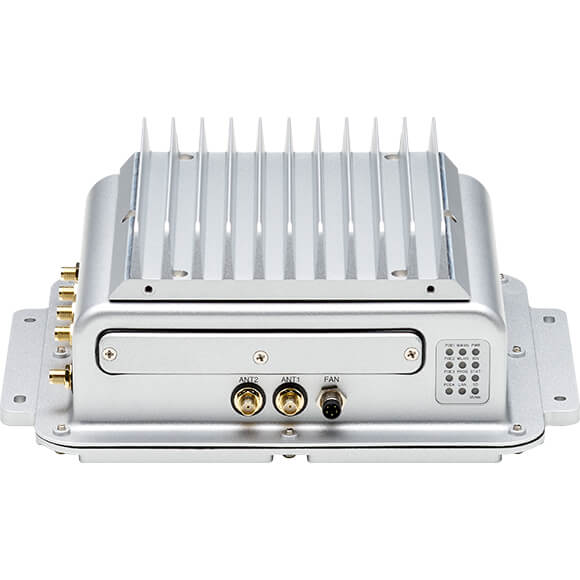
The NEXCOM ATC-3560-IP7-NX4C-16 is an IP67-rated fanless computer powered by Jetson Orin NX 16 GB. It features four Gigabit PoE+ ports, M12 connectors, CAN and a 9–36 V DC input.
This configuration is particularly relevant for mobile platforms using Ethernet-based cameras and sensors where the computer requires additional protection against dust and water ingress.
ARBOR AEC-4201-16 – flexible Ethernet sensor connectivity
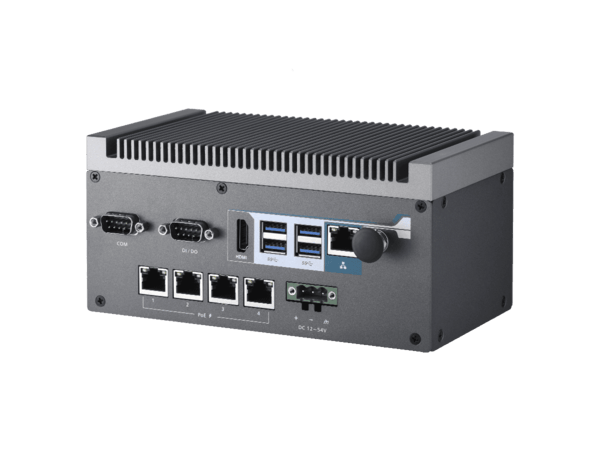
The ARBOR AEC-4201-16 provides Jetson Orin NX 16 GB, four Gigabit PoE+ ports, an additional Ethernet interface, CAN 2.0 and digital I/O.
Its 12–54 V DC input range offers flexibility when integrating the computer into different vehicle power architectures, subject to the actual battery operating voltage.
NexCOBOT ECM-M400-A10-04-C-1T-X – AI and real-time motion control
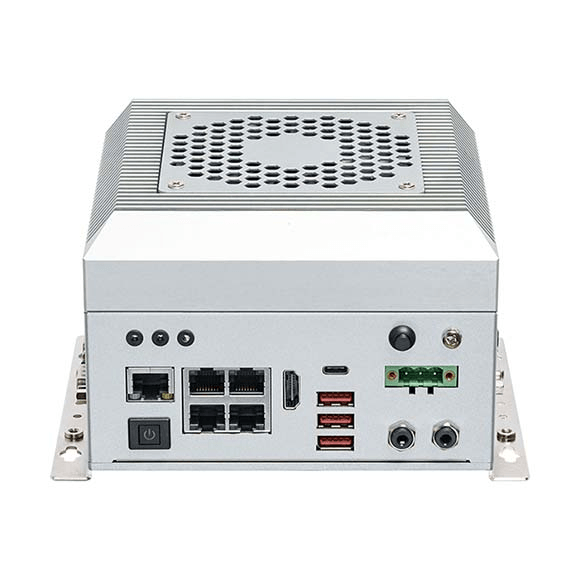
The NexCOBOT ECM-M400-A10-04-C-1T-X combines NVIDIA Jetson AGX Orin 64 GB, a 1 TB NVMe SSD, NexRTOS and integrated EtherCAT master functionality.
The platform is intended for robotics applications that require GPU-accelerated processing and deterministic motion control within a common computing architecture.
Additional industrial robot controllers, motion control platforms and EtherCAT components are available in the IPC2U robotics portfolio.
Hardware selection from prototype to production
A computing platform that performs well during laboratory development must also meet the electrical, thermal and mechanical requirements of the production vehicle. Long-term hardware availability, controlled revisions and continued driver compatibility are particularly important for agricultural machinery expected to remain in service for many years.
IPC2U works with agricultural robot manufacturers, machinery OEMs and system integrators to identify suitable industrial computers and robot controllers across multiple manufacturers.
Send us your project requirements. We can help you select the right computing platform, from prototype development through to series production.