With advances in technology and the growing number of connected devices, the need for high-speed and stable data transmission has increased. Wireless technologies are increasingly being used as an alternative to traditional Ethernet cables in areas such as factory automation, process monitoring, logistics automation, and mining. These environments may require increased Wi-Fi coverage and stable, seamless switching.

In response to this impact on the industrial segment, Moxa developed and implemented AeroMesh technology in its devices, which enables the creation of a self-healing adaptive network. AeroMesh technology uses an intelligent algorithm that can detect a failed network segment and rebuild the existing topology without the need for user configuration.
The diagram below illustrates how network construction, requiring Ethernet cabling, works in practice.
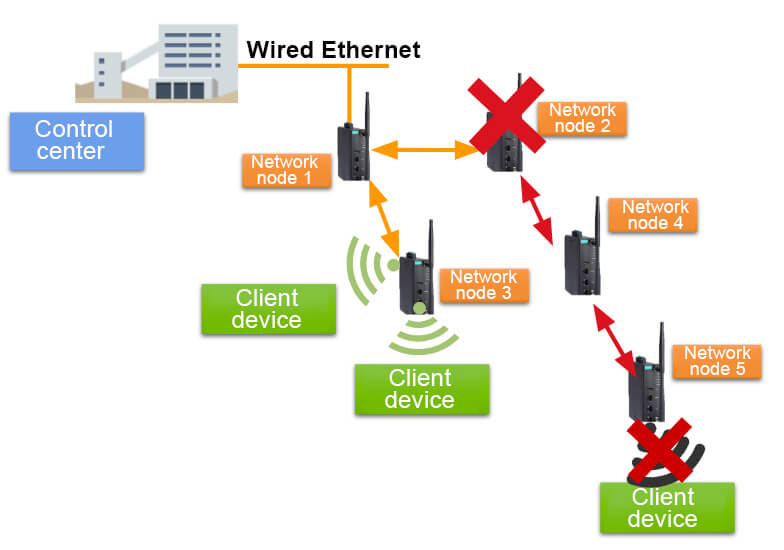
"Network node 1" will retransmit the signal from the wired Ethernet to subsequent nodes. For example, if access point "Network node 2" fails, devices behind it will also stop functioning, and a client device connected to "Network node 5" will lose connection. A functioning access point, "Network node 3," is unable to reconfigure the route to "Network node 4."
Next, let's look at the principle of wireless network organization using AeroMesh technology:
- Mesh Point Router (MPR) is a controller device that manages the network.
- Mesh Access Point (MAP) is an agent device that forms the network based on a wireless connection to the MPR.
- STA (Station) is an end device.
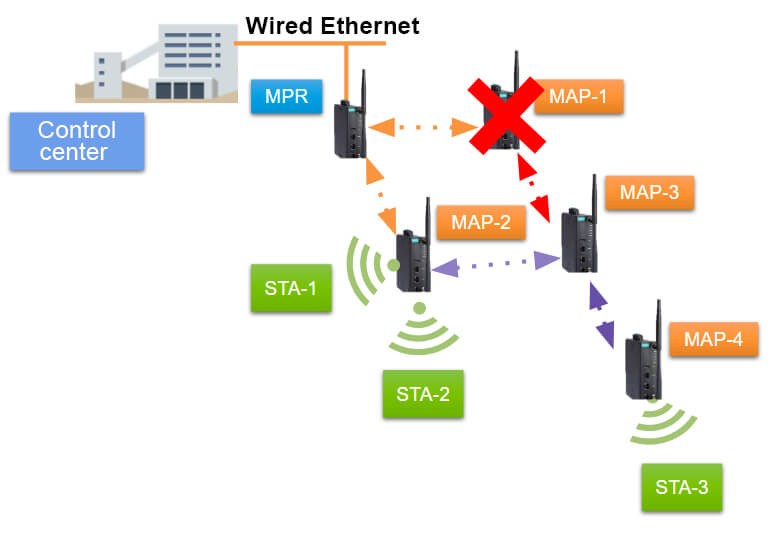
With AeroMesh technology, MAP-2 automatically detects and resolves connection issues, restoring the connection between the MAP-3 device and the STA-3 endpoint, thus restoring the wireless network connection with minimal latency. AeroMesh technology allows up to five MAP devices to be connected to one MPR device. Throughput will be reduced by approximately half after each hop, as all network nodes use the same radio interface for control commands and data transmission. Moxa places no limit on the number of connected STA devices when building a network using AeroMesh technology.
|
Feature |
AeroMesh |
|
Trunking network (MPR<->MAP) |
Wireless only, 5 GHz band |
|
Wireless network |
2.4 GHz band recommended |
|
Supported topologies |
Serial, star, hierarchical structure |
|
Supported encryption methods |
WPA3/ WPA2, WPA3 Mixed/WPA2 |
|
MAP devices |
up to 5 devices |
|
Network capacity |
op to 10 nides |
|
Repair time |
2.5 s (on average, depending on topology features) |
Practical application of AeroMesh
In the mining industry, communication between the control center and remote equipment is essential. Cable installation in tunnels is difficult, and given the nature of the work, there is a risk of damage or breakage. AeroMesh technology is the most practical solution in this case. Using an intelligent algorithm, AeroMesh creates the best route for the wireless network, ensuring rapid restoration of damaged connections and allowing for easy expansion of the wireless network's range, bypassing cable installation limitations.
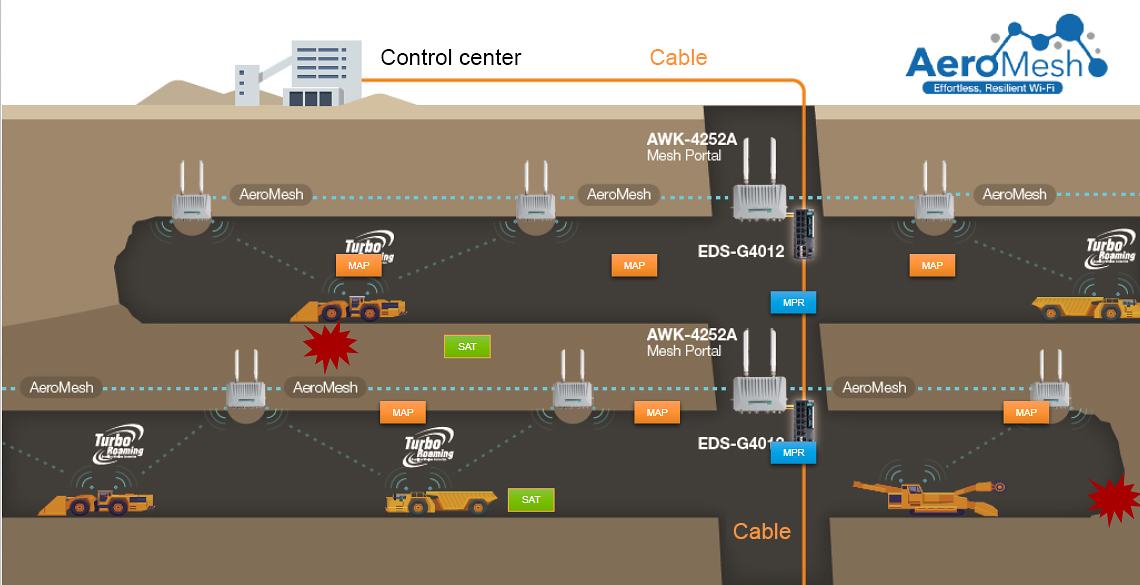
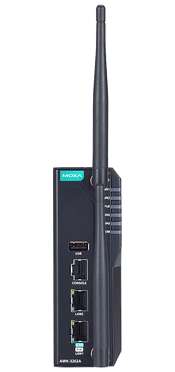
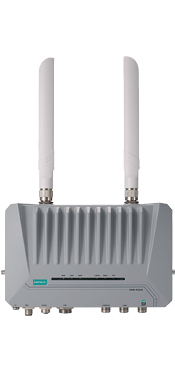
Below are devices that support AeroMesh technology, with a brief description.
|
|
Model name |
WI-Fi standard |
Reliable baud rate range |
Frequency range |
Supported encryption methods |
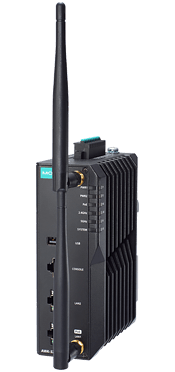
|
AWK‑3252A‑UN |
Wi-Fi 5 |
400 Mbps to 1267 Mbps |
2.4 GHz + |
WPA3/ WPA2, WPA3 Mixed/WPA2 |
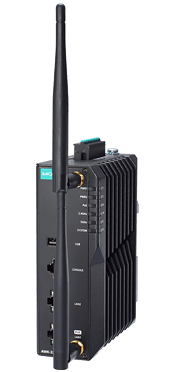
|
AWK‑3252A‑UN‑T (-40...+75С) |
||||
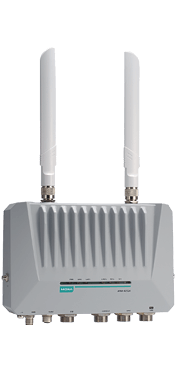
|
AWK‑4252A‑UN‑T |
||||
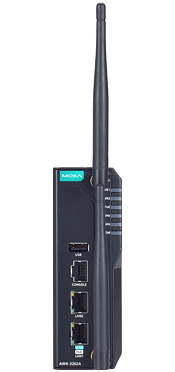
|
AWK‑3262A‑UN |
Wi-Fi 6 |
574 Mbps to 1774 Mbps |
||
|
AWK‑3262A‑UN‑T |
||||
|
AWK‑4262A‑UN‑T |