Power over Ethernet has evolved from supplying relatively low-power network devices to supporting equipment with substantially higher power requirements. Industrial IP cameras, PTZ cameras, wireless access points and other networked edge devices can require more power than IEEE 802.3af or IEEE 802.3at can provide.
IEEE 802.3bt extends standardized PoE to Type 3 and Type 4, providing up to 60 W or 90 W respectively at the PSE. At the powered device, the corresponding maximum power is up to 51 W for Type 3 and 71.3 W for Type 4.
For industrial networks, however, selecting an IEEE 802.3bt switch involves more than checking the maximum power per port. The total PoE budget, number of simultaneously powered devices, power input, network bandwidth and environmental requirements all need to be considered.
From PoE to High-Power PoE
A PoE connection consists of two basic components. The PSE (Power Sourcing Equipment) supplies power, typically from a PoE Ethernet switch or injector. The PD (Powered Device) receives power, for example an IP camera, wireless access point or another Ethernet-connected device.
The power available at the PD is lower than the maximum power supplied by the PSE because the Ethernet channel introduces power losses.
| Type | Standard | Maximum PSE Power | Maximum PD Power | Power Delivery |
|---|---|---|---|---|
| Type 1 | IEEE 802.3af | 15.4 W | 12.95 W | 2-pair |
| Type 2 | IEEE 802.3at | 30 W | 25.5 W | 2-pair |
| Type 3 | IEEE 802.3bt | up to 60 W | up to 51 W | 2-pair or 4-pair depending on class |
| Type 4 | IEEE 802.3bt | up to 90 W | up to 71.3 W | 4-pair |
IEEE 802.3bt extends power delivery to all four twisted pairs for higher-power operation. The higher Type 3 classes and Type 4 use four-pair power delivery, enabling substantially higher power levels than IEEE 802.3at.
IEEE 802.3bt PSEs retain compatibility with IEEE 802.3af and IEEE 802.3at PDs, allowing different PoE generations to be used within the same network where the PSE and PD negotiate a compatible power level.
Type 3, Type 4 and PoE Power Classes
IEEE 802.3bt extends the PoE classification system through Classes 5 to 8.
| Class | PoE Type | Maximum PSE Power | Maximum PD Power |
|---|---|---|---|
| 1 | Type 1 | 4 W | 3.84 W |
| 2 | Type 1 | 7 W | 6.49 W |
| 3 | Type 1 | 15.4 W | 13 W |
| 4 | Type 2 | 30 W | 25.5 W |
| 5 | Type 3 | 45 W | 40 W |
| 6 | Type 3 | 60 W | 51 W |
| 7 | Type 4 | 75 W | 62 W |
| 8 | Type 4 | 90 W | 71.3 W |
The distinction between PSE and PD power is important. A Class 8 PSE specified for 90 W does not mean that a connected PD can receive 90 W. The maximum power available to a Class 8 PD is 71.3 W after accounting for the permitted channel losses.
What IEEE 802.3bt Adds Beyond Higher Power
Higher output power is the most visible change introduced by IEEE 802.3bt, but the standard also includes mechanisms for device detection, classification and more precise power allocation.
Single-Signature and Dual-Signature PDs
IEEE 802.3bt supports both single-signature and dual-signature powered devices. A single-signature PD presents a common detection and classification signature across the pairsets. A dual-signature PD provides independent signatures for the two pairsets, allowing them to be detected and classified separately.
Connection Check
A four-pair-capable IEEE 802.3bt PSE can use Connection Check to determine the PD signature configuration before applying four-pair power.
Autoclass
Autoclass is an optional IEEE 802.3bt mechanism for compatible single-signature PDs. It allows the PSE to determine the power required by the PD during an Autoclass measurement and use this information for more accurate power allocation.
This can be useful in multi-port switches where many devices share a limited total PoE budget. Autoclass should not be assumed to be available in every IEEE 802.3bt installation and is not supported for dual-signature PDs.
Per-Port Power Is Not the Same as Total PoE Budget
A switch may provide several ports capable of delivering up to 90 W individually while its total available PoE budget is considerably lower than the sum of all port maximums.
For example:
8 ports × 90 W = 720 W
An eight-port switch with 90 W-capable ports would therefore need a 720 W PoE budget to supply the full 90 W simultaneously on every port. Many industrial switches have a lower total PoE budget because maximum power is not necessarily required on every port at the same time.
The correct approach is to calculate the simultaneous power requirement of the connected PDs and compare it with the switch's available total PoE budget.
For example:
8 devices × 45 W = 360 W
In this case, the switch needs sufficient available PoE budget for the 360 W simultaneous load, plus an appropriate engineering margin for the installation.
The power input architecture also matters. On some industrial PoE switches, the available total PoE budget depends on the DC input voltage, power supply capacity or power-input configuration.
Cabling for IEEE 802.3bt
IEEE 802.3bt does not make Cat6A cabling universally mandatory.
High-Power PoE places greater thermal demands on structured cabling, particularly where many powered cables are bundled together. Cable category, conductor size, temperature rating, bundle size, channel length and installation conditions therefore need to be considered together.
Cat6A can provide useful thermal margin for new high-power installations, but the cabling decision should be based on the actual installation rather than treating Cat6A as a general requirement of IEEE 802.3bt.
Industrial Applications for IEEE 802.3bt
PTZ and Industrial IP Cameras
PTZ drives, IR illumination, heaters and additional processing hardware can increase the power requirement of an IP camera beyond the capability of IEEE 802.3at. IEEE 802.3bt allows compatible cameras to receive higher power while retaining one Ethernet connection for data and power.
Wi-Fi 6 and Wi-Fi 7 Access Points
Wireless access points with multiple radios and additional functionality can require more power than conventional PoE+. IEEE 802.3bt provides standardized higher-power options where the access point requires Type 3 or Type 4 power.
Industrial Edge Devices
Network-connected edge devices with local processing, communication modules or additional peripherals can also benefit from higher PoE power where the device is designed as an IEEE 802.3bt PD.
Smart Building and Lighting Systems
High-Power PoE can also supply compatible lighting, building automation and control equipment, allowing data and power distribution to share the Ethernet infrastructure.
How to Select an Industrial IEEE 802.3bt Switch
The maximum wattage in the switch specification is only the starting point. For an industrial installation, the following parameters should be checked together:
- Required PD power. Determine the IEEE PoE Type and Class required by each powered device.
- Total PoE budget. Add the simultaneous power requirements of all connected PDs and compare the result with the total PoE budget of the switch.
- Power input. Check the required DC input voltage and whether the available PoE budget changes with input voltage, power supply capacity or power-input configuration.
- Network bandwidth. Depending on the application, Gigabit Ethernet access ports may need to be combined with 2.5GbE, SFP or 10GbE uplinks.
- Operating environment. Check temperature range, fanless construction, mounting, redundant power inputs, surge and ESD protection and required standards.
- Management and redundancy. Managed industrial switches can add VLANs, RSTP/MSTP or ERPS ring redundancy, PoE monitoring, port prioritization, scheduling and remote power cycling.
For a broader selection process covering PoE standards, power budget and network requirements, see How to Select an Industrial PoE Switch.
PoE Budget and High-Power PoE in Practice
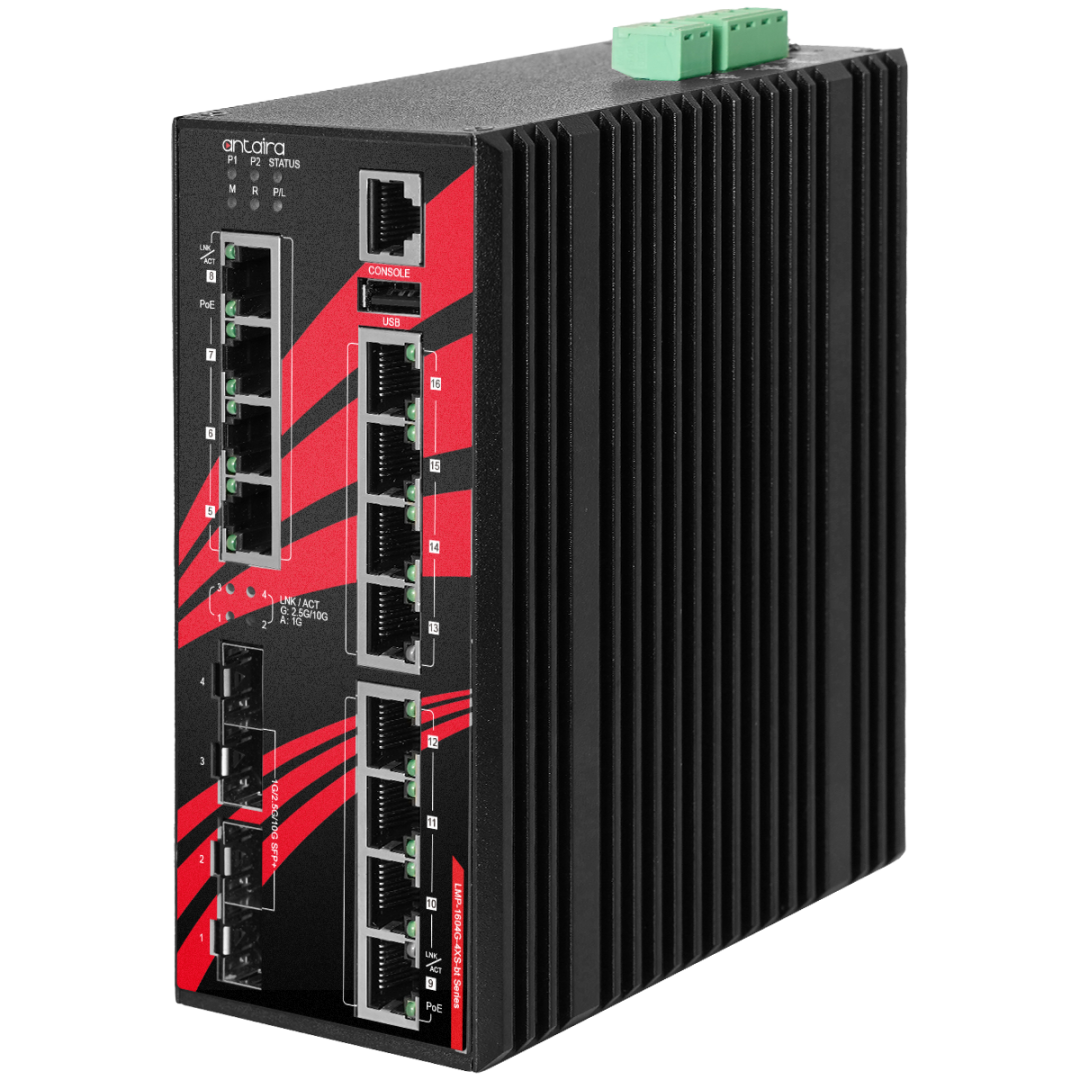
Maximum per-port power should not be confused with a switch's total PoE budget.
The Antaira LMP-1604G-4XS-bt-T, for example, provides twelve Gigabit IEEE 802.3bt ports rated at up to 90 W per port under the IEEE standard, while the switch has a 360 W total PoE budget. Maximum per-port capability and total simultaneously available PoE power are therefore separate selection criteria.
The relationship becomes particularly important with low-voltage industrial PoE switches, where the available power budget can depend on input voltage.
For a broader explanation of power budgeting, bandwidth and switch selection, see How to Select an Industrial PoE Switch: Power Budget, Bandwidth and PoE Standard.
Antaira IEEE 802.3bt Solutions for Different Network Architectures
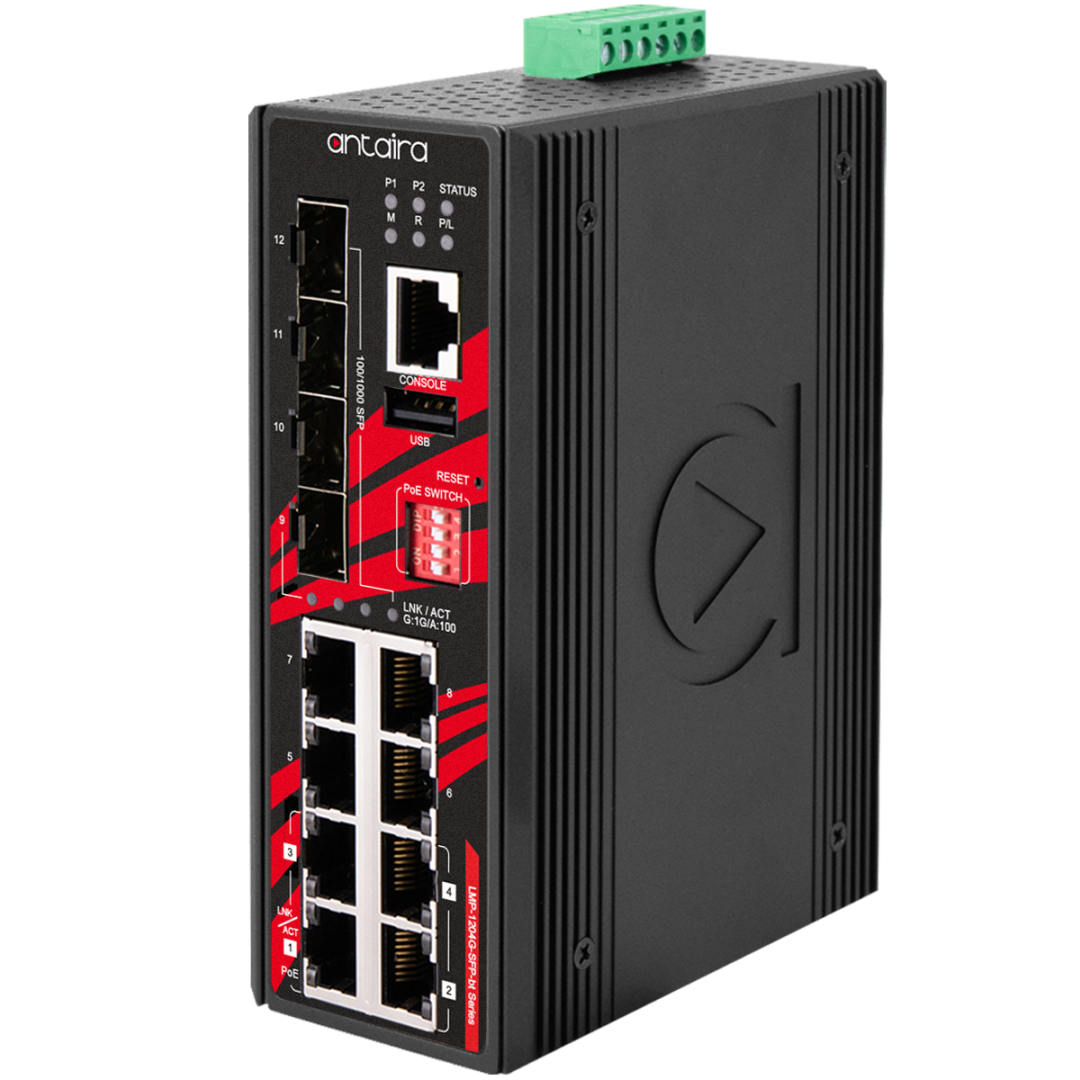
The appropriate High-Power PoE platform depends not only on maximum port power but also on port count, uplinks, management and installation requirements.
For networks requiring a mix of PoE++ and conventional PoE+ ports, the Antaira LMP-1204G-SFP-bt-T combines four IEEE 802.3bt ports with four IEEE 802.3af/at ports and four 100/1000 SFP slots. Its total PoE budget is 240 W at 48 to 55 VDC.
For larger networks, the Antaira LMP-1604G-4XS-bt-T combines twelve Gigabit IEEE 802.3bt ports with four 1G/2.5G/10G SFP+ slots and a 360 W PoE budget. This provides faster uplinks for aggregated traffic from multiple cameras or other data-intensive edge devices.
These examples show why High-Power PoE switch selection should consider the complete network architecture rather than only the wattage available on an individual port.
Advanced PoE Functions on Industrial Switches
IEEE 802.3bt defines the standardized power-delivery architecture, while individual industrial switch manufacturers can add functions beyond the IEEE standard.
Selected Antaira IEEE 802.3bt products provide Persistent PoE, which maintains PoE power to connected PDs during a switch reboot or firmware upgrade.
Safe PoE Disconnect is available on selected Antaira bt PoE switches and allows the PoE output of a port to be disabled before a high-power Ethernet connection is physically disconnected.
Another model-specific function is iPoE Budget Control. On supported Antaira low-voltage PoE switches, the available PoE budget is adjusted according to the input voltage.
These are manufacturer-specific functions and should not be confused with capabilities defined by IEEE 802.3bt itself. Their availability must be checked for the individual switch model.
IEEE 802.3bt: What Matters in Practice
IEEE 802.3bt extends standardized Power over Ethernet to applications requiring substantially more power than IEEE 802.3at can provide. Type 3 supports up to 60 W at the PSE and Type 4 up to 90 W, while the corresponding maximum power available at the PD is up to 51 W and 71.3 W.
For industrial applications, per-port power is only one part of the design. The required PD class, total PoE budget, input power architecture, cabling, network bandwidth and environmental requirements need to be considered together.
We support the selection of the appropriate industrial PoE switch for your application.