Selecting Intel, AMD, Arm, RISC-V and specialist x86 hardware for industrial systems
A change of processor can reopen a design that has already passed acceptance testing. In an industrial machine, it may affect firmware, drivers, peripheral connections and even the mechanical layout. Keeping a machine in service for another five or ten years is rarely just a question of finding a faster CPU.
That is why embedded processor selection has to account for the complete platform: computing performance, software compatibility, thermal limits, component availability and the effort involved when a board revision changes.
Embedded does not mean a different type of CPU
An embedded processor may use the same fundamental core design as a desktop processor. What sets a specific embedded offering apart is often its lifecycle programme, supported operating conditions or integration features. None of those can safely be inferred from the word embedded alone.
Industrial computers use several processor architectures. Intel and AMD x86 systems are common where existing Windows or Linux applications must be retained. Arm-based SoCs suit many compact controllers and edge devices. RISC-V is found in microcontrollers and selected embedded designs. Specialist 32-bit x86 parts continue to serve equipment that cannot readily move to a modern platform.
Processor choice also has implications beyond the chip itself. The industrial motherboard, BIOS, network devices, storage and memory all have their own revision histories. A long-life CPU does not guarantee an unchanged computer.
Reading CPU names without overinterpreting them
A generation number is a useful starting point, not a cross-vendor performance rating. New CPU families may introduce different cores, integrated graphics, memory technologies or PCIe capabilities. A generation change may also mean a different motherboard and a fresh round of system validation.
Intel's naming changes illustrate the problem:
| Example | What the designation tells you |
|---|---|
| Core i5-13500 | An older naming convention identifying a 13th-generation Core model in the i5 tier. |
| Core Ultra 5 245T | A Core Ultra Series 2 model. The T denotes a desktop variant designed for a lower power envelope; it says nothing about the complete PC's measured consumption. |
| Core Series 3 | A separate product family from Core Ultra Series 3. Certain embedded variants have extended availability programmes. |
For some Intel product lines, an E suffix identifies an embedded model. It does not establish temperature limits or a supply commitment on its own. Always check the full part number and its lifecycle documentation.
AMD names need equal care. "Ryzen Embedded 9000" identifies a family, not a performance level that can be directly matched against an Intel Core Ultra number. Architecture, core configuration, memory bandwidth, expansion resources and power limits provide a much better basis for comparison.
Which processor families fit industrial workloads?
Intel Atom is widely used in gateways, compact automation computers and communications equipment. It covers applications where size and power budgets are often tightly constrained. Core and Core Ultra address a broader range, from box PCs to rackmount systems. Selected processors also include an NPU, although available acceleration and application support vary by model and software stack.
For workstations, industrial servers or systems requiring more memory and expansion, Intel Xeon may be appropriate. ECC memory, PCIe resources and management features need to be confirmed for the CPU and board combination rather than assumed from the Xeon name.
AMD Ryzen Embedded serves industrial control, visualisation and machine vision, among other workloads. The Ryzen Embedded 9000 family uses Zen 5 and supports DDR5 and PCIe 5.0. Ryzen AI Embedded adds SoCs that bring CPU, GPU and NPU resources together; the P100 and X100 families were introduced in 2026. EPYC Embedded addresses infrastructure and server-class applications with greater demands for cores, memory and connectivity.
A higher-end processor is not necessarily the better choice. An application with limited parallelism might gain little from additional cores. A system with restricted cooling may be unable to sustain the performance advertised for a higher-power processor.
DMP Vortex86 and the value of a compatible replacement
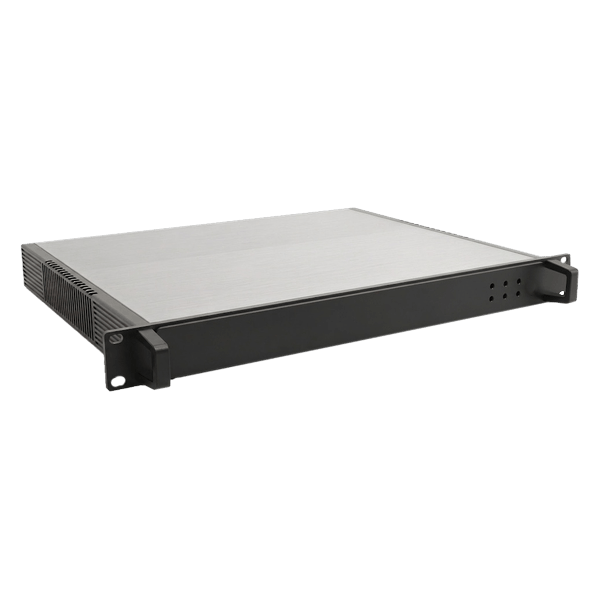
Some industrial platforms exist because the cost of rewriting a working application can outweigh the benefit of newer silicon. DMP Vortex86 is one such specialist 32-bit x86 family, used by ICOP in small embedded boards intended for control and equipment integration.
The ICOP VEX2-6415-4C3EE is built around a 600 MHz Vortex86EX2 and provides four serial ports, two 10/100 Ethernet ports and GPIO. It is not a substitute for a modern Core or Ryzen system. Its attraction is the possibility of retaining established software and industrial connections while replacing ageing hardware. Compatibility with a particular DOS, Linux or real-time application still needs verification against the board revision and software environment.
Architecture affects the software decision
The instruction set determines which machine code a CPU can execute. Moving between architectures can therefore have consequences for operating systems, drivers, third-party libraries and applications that were never designed to be portable.
| Platform | Where it can make sense | Main point to verify |
|---|---|---|
| 64-bit x86 | Industrial PCs running established Windows or x86 Linux software | Board lifecycle, I/O and the required expansion options |
| 32-bit x86 | Retaining older machine software and specialised interfaces | Exact software, operating-system and hardware compatibility |
| Arm | Compact edge devices, controllers and highly integrated SoCs | Board support package, drivers and long-term software maintenance |
| RISC-V | Microcontrollers and purpose-built embedded SoCs | Toolchain maturity, OS support and application portability |
Arm is not inherently more energy-efficient than x86. SoC design, process technology, accelerators, memory configuration and workload all affect measured power. An Arm Cortex-M microcontroller also belongs in a different comparison from a Cortex-A system capable of running Linux.
NVIDIA Jetson should not be treated as another CPU architecture. Jetson modules combine Arm-based processors with NVIDIA graphics and AI acceleration. For machine vision, the GPU, memory bandwidth and software ecosystem may have more bearing on throughput than the general-purpose CPU cores.
RISC-V offers an open instruction set, but it does not make an existing x86 application portable by itself. Migrating requires a supported operating system, drivers and suitable application builds.
The workload matters more than the headline specification
Clock speed is an incomplete measure of performance. Instructions per clock, cache design, memory bandwidth and the balance of performance and efficiency cores can change the outcome substantially, even between processors with similar frequencies.
A control application dominated by one processing thread calls for a different selection method from a parallel image-processing pipeline. AI inference adds another variable: the workload might run on CPU cores, integrated graphics, an NPU or a discrete GPU. Published TOPS figures are not directly interchangeable with throughput measured using the actual model, precision, framework and input data.
Memory requirements deserve the same level of scrutiny. ECC is not universally available across embedded CPUs, and successful error correction depends on the processor, memory controller, firmware, motherboard and memory configuration working together.
Power figures need to be measured at system level
Thermal Design Power (TDP) is a cooling design parameter, not a wall-plug measurement. Intel also specifies Processor Base Power and Maximum Turbo Power for many recent models. Electrical power varies with workload, firmware settings and configured limits.
The processor is only one consumer. RAM, SSDs, network interfaces, expansion cards and conversion losses in the power supply all contribute to total draw. Two computers with identical CPUs can behave differently once their peripherals and operating conditions are taken into account.
For an engineering comparison, measure complete systems at idle, under the intended application and at sustained load where relevant. The configurations and power settings should be documented. Otherwise, small differences between quoted processor specifications may be meaningless.
For perspective, an average difference of 10 W over continuous operation amounts to 87.6 kWh per computer per year: 0.010 kW × 24 hours × 365 days. Ten units would account for 876 kWh. This is an energy calculation, not a measured comparison between processor architectures.
Fanless does not mean thermally unrestricted
A fanless computer conducts heat into its heatsink and chassis, avoiding a fan as a wear component. Its sustained performance still depends on ambient temperature, mounting position, the space around the enclosure and the thermal design of the finished product. Those constraints can be particularly severe inside a sealed control cabinet.
Lower processor TDP can help a passive design, but it does not prove that a system will maintain peak performance indefinitely. Dense rackmount configurations and high-power expansion cards may need forced airflow. Cooling should be assessed with the complete configured system in its intended installation.
Supply longevity is not revision stability
Some embedded processors remain on manufacturers' product programmes considerably longer than mainstream office CPUs. Published examples include:
| Manufacturer | Selected lifecycle programmes |
|---|---|
| Intel | Up to 10 years of availability for selected Core Series 3 embedded models. |
| AMD | Up to 7 years for Ryzen Embedded 9000, with up to 10 years for selected PRO Embedded variants. |
| NXP | 10- or 15-year availability periods for products enrolled in its Product Longevity Program. |
These periods apply to specific products and programme terms. They are not assurances that every model will ship unchanged for that long, and the clock does not start when a customer buys the finished computer. Under NXP's programme, for example, the period is measured from the qualifying product's introduction.
For an OEM, the more difficult question is often whether a validated system can be built again with the same components. Processor, chipset, network controller, RAM and SSD may each have a different lifecycle. Industrial motherboards address this through managed bills of materials (BOMs), controlled revisions and Product Change Notifications (PCNs). End-of-Life (EOL) notices provide time to plan a replacement, but do not remove the work involved.
A seemingly minor component change can affect drivers, firmware or a field interface. Depending on the application, engineers may need to repeat functional tests, revalidate software and review compliance documentation. Not every change requires full recertification; treating all revisions as interchangeable is equally risky.
For an OEM building the same machine over several years, qualification and customer acceptance can cost more than any saving on the processor. Long-term availability is valuable because it reduces avoidable changes to a proven design, not because it guarantees that hardware will never change.
Processor choice in a complete industrial computer
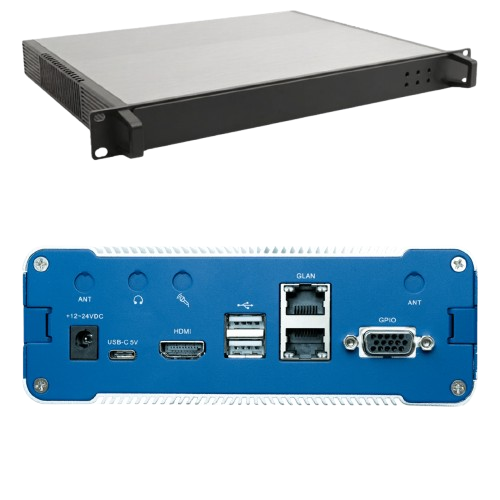
Three IPC2U examples illustrate very different integration priorities.
The ICOP iBPC-N8MP uses an NXP i.MX8M Plus with Arm Cortex-A53 cores and an integrated NPU. Its compact fanless enclosure and interfaces, including Ethernet, CAN and serial connections, are part of the platform decision; CPU architecture alone does not tell you whether it will connect to the equipment.
The iKERN-1810-AC80 takes a different approach: Intel Core Ultra processing in a fanless 19-inch 1U rackmount chassis, with an integrated 200 W power supply and optional PCIe expansion. The specified operating-temperature range is 0 to 45 °C for the described configuration.
For a custom design, the industrial motherboards and embedded boards available from IPC2U offer choices between compact soldered-processor designs and larger, more expandable platforms. BIOS maintenance, memory qualification, power delivery and component revisions may be just as important as benchmark results.
Before freezing a hardware specification, define the software environment, required I/O, sustained workload, ambient conditions, expected production volumes and support horizon. Those requirements establish whether a processor will merely run the application today or support a practical product lifecycle.
Contact IPC2U to discuss an industrial hardware configuration.