This combination makes the RUT204 particularly relevant for vehicle telematics, mobile machinery and industrial equipment where CAN data needs to be collected, processed or transmitted over a cellular connection.
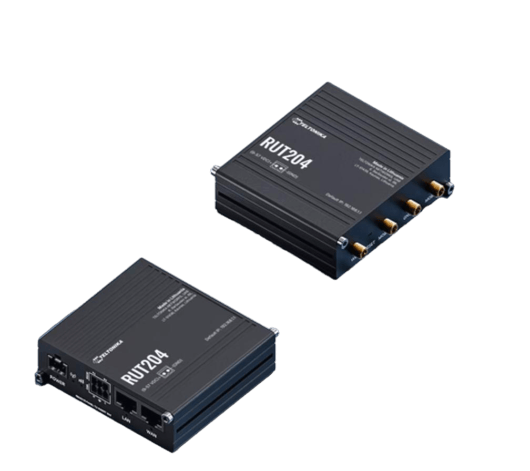
Native CAN FD for Direct Machine Data Access
The key difference between the RUT204 and a conventional industrial LTE router is its integrated CAN interface.
CAN is widely used in vehicles, construction equipment, agricultural machinery and industrial systems for communication between electronic control units, sensors and other devices. With native CAN FD hardware, the RUT204 can connect directly to a CAN network without an external converter.
CAN FD extends Classical CAN by allowing larger payloads and higher data rates during the data phase. For applications that generate increasing amounts of machine and vehicle data, this provides additional flexibility while retaining the established CAN communication concept.
Current RUT204 firmware provides CAN Bus Gateway functionality for configuring the physical CAN interface and handling data exchange between CAN and network services. Teltonika also lists CANopen and J1939 support for integration with CAN-based equipment.
LTE Cat 4 with Dual SIM and eSIM
For cellular connectivity, the RUT204 supports LTE Cat 4 with download rates of up to 150 Mbps and upload rates of up to 50 Mbps, together with fallback to 3G and 2G where supported.
Two physical Mini SIM slots provide connection redundancy and automatic SIM switching. Current Teltonika product documentation also lists eSIM support, providing additional options for cellular network configuration.
This makes the router suitable for mobile and distributed installations where wired network infrastructure is unavailable or where cellular connectivity is required as the primary communication path.
GNSS for Vehicle and Mobile Equipment
Integrated GNSS adds positioning information to the communication and CAN capabilities of the RUT204.
The GNSS implementation supports multiple satellite systems, including GPS, GLONASS, Galileo, BeiDou and QZSS. This allows position data to be combined with information obtained from the vehicle or machine network.
For fleet and mobile machinery applications, one device can therefore provide cellular connectivity, CAN access and positioning instead of distributing these functions across several separate components.
Ethernet, RS232 and Wi-Fi for System Integration
CAN FD is not the only interface available. The RUT204 also provides:
- 2 x 10/100 Mbps Ethernet
- RS232
- Wi-Fi 4 in access point and station modes
- digital input and output
- microSD storage
- GNSS
- USB-C for configuration and power
The combination of CAN, serial and IP interfaces is particularly useful when newer networked equipment and existing controllers need to be integrated within the same installation.
For projects requiring cellular connectivity without integrated CAN, IPC2U also offers a broader range of industrial cellular routers.
Active and Passive PoE Input
Installation flexibility is increased by support for both active and passive PoE input.
Active PoE-in is supported according to IEEE 802.3af Class 0 through the LAN port. Passive PoE provides an additional option for installations with an existing DC power infrastructure.
The router can also be powered through its dedicated DC input and supports a wide input voltage range of 9 to 57 VDC.
This flexibility is useful in vehicles, machines and control cabinets where the available power architecture can differ significantly between projects.
RutOS and Remote Management
The RUT204 runs Teltonika RutOS and supports routing, firewall, VPN, VLAN and remote management functions.
Teltonika RMS provides centralized remote access, monitoring and configuration for distributed devices. This can reduce on-site service requirements when routers are installed in vehicles, mobile equipment or machines at remote locations.
The RutOS platform also provides optional software packages for additional industrial and IoT functionality.
Designed for Industrial and Mobile Installations
The RUT204 is housed in an aluminium enclosure and is specified for an operating temperature range from -40 to +75 °C. Its compact dimensions make it suitable for installations where available space is limited.
Specification
| Specification | RUT204 |
|---|---|
| Cellular | LTE Cat 4, 3G/2G fallback |
| Maximum LTE speed | 150 Mbps down / 50 Mbps up |
| SIM | 2 x Mini SIM; eSIM support listed in current Teltonika documentation |
| CAN | Native CAN FD |
| CAN protocols | CANopen, J1939 |
| Ethernet | 2 x 10/100 Mbps |
| Serial interface | RS232 |
| Wi-Fi | Wi-Fi 4 |
| GNSS | GPS, GLONASS, Galileo, BeiDou, QZSS |
| Storage | microSD |
| PoE | Active IEEE 802.3af Class 0 and passive PoE-in |
| Power input | 9-57 VDC |
| Operating temperature | -40 to +75 °C |
| Protection | IP30 |
| Weight | approx. 140 g |
Where Does the RUT204 Fit?
The RUT204 is particularly interesting where CAN data and cellular connectivity are required in the same system.
Typical applications include vehicle telematics, construction and agricultural machinery, mobile equipment and industrial machines with CAN-based communication.
In these applications, the integrated CAN FD interface can reduce the number of separate devices required for connecting machine or vehicle data to IP and cellular networks.
RUT204 for CAN-Connected Machines and Vehicles
The RUT204 brings together functions that would otherwise often require several components: LTE connectivity, native CAN FD, GNSS, RS232, Ethernet, Wi-Fi and remote management.
Its main advantage is therefore not simply that it is another LTE Cat 4 router. It provides a direct connection between CAN-based equipment and cellular or IP networks within one compact industrial device.
For other connectivity requirements, see the complete range of industrial cellular routers at IPC2U.
We support the selection of the appropriate industrial communication solution for your application.
Featured Product
- Teltonika RUT204 — LTE Cat 4 industrial router with native CAN FD, GNSS, 2 x Ethernet, RS232 and Wi-Fi 4; -40 to +75 °C, IP30.