The current stage of development in industrial automation systems is characterized by an intensive shift of computational workloads from centralized higher-level systems directly to data sources — towards the edge computing layer. The design of distributed systems requires control devices to provide high computational performance, information security, hard determinism in processing technological cycles, and an advanced network peripheral set, while maintaining compact physical dimensions. Within this paradigm, ICP DAS has introduced the RPAC series of programmable controllers. Within the manufacturer's ecosystem, this product line occupies an intermediate yet technologically the most advanced position.
Unlike XPAC and WinPAC, the new series has transitioned to a 64-bit architecture and Linux. This has significantly increased CPU and memory performance, removing the limitations of legacy Windows Embedded platforms. At the same time, continuity with the Win-GRAF development environment has been fully preserved. Unlike LinPAC controllers, which are oriented toward traditional application development in C/C++ and therefore complicate rapid integration of standard fieldbuses, the RPAC series is shipped with a preinstalled Win-GRAF runtime environment. This ensures out-of-the-box readiness for IEC 61131-3 compliance, combined with deep customization capabilities at the Linux system level.
Hardware architecture and product range
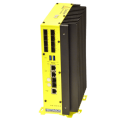
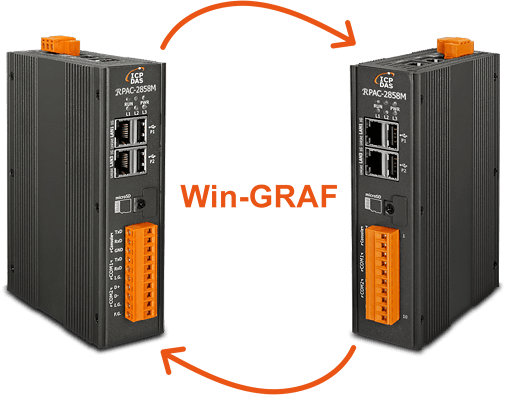
The RPAC line currently includes three key models, differentiated by computational core performance, chassis topology, and specialized functional purpose. At present, the RPAC-2658M model is in mass production status, while the RPAC-2858M and RPAC-9848 models have been announced for release, with exact dates not yet disclosed by the manufacturer.
Computing power and memory subsystem
|
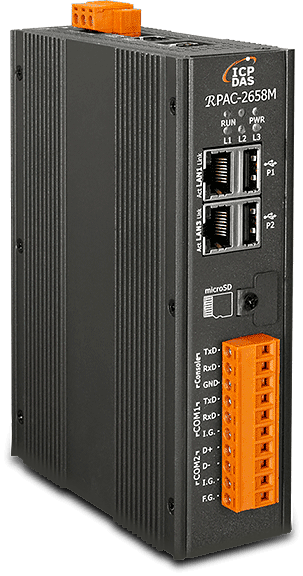
The RPAC-2658M is built on a quad-core Cortex-A9 processor with a clock frequency of 1.0 GHz. The amount of RAM is 1 GB of DDR3 SDRAM. |
|
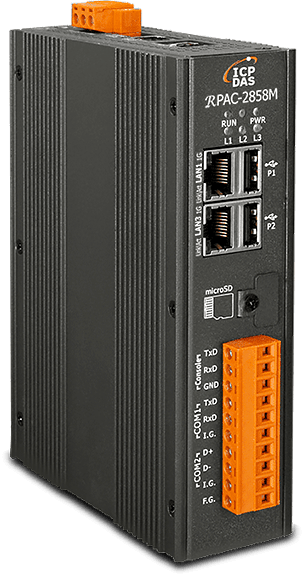
The RPAC-2858M is equipped with a more powerful 64-bit quad-core Cortex-A53 processor with a clock frequency of 1.6 GHz and 2 GB of LPDDR4 SDRAM. |
|
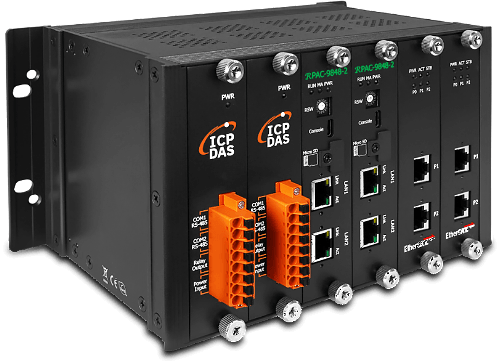
The RPAC-9848 features a similar high-performance platform: a quad-core Cortex-A53 (1.6 GHz) and 2 GB of LPDDR4 SDRAM. |
To store the operating system, runtime modules, and user projects, all three variants use a built-in 8 GB eMMC storage. Expansion of non-volatile memory for local data logging is provided via a microSD slot supporting up to 32 GB. The exception is the RPAC-9848 model, which does not include a microSD slot on the board; all data is written directly to the internal eMMC.
A special focus is placed on the subsystem for preserving critical data (Retain variables) in the event of a power failure. All devices in the series are equipped with two types of ultra-fast non-volatile memory that operate without lithium batteries:
- FRAM (Ferroelectric RAM), 64 KB: Used for cyclic storage of current process parameters, as it offers an almost unlimited number of write cycles. Note: variables declared and stored in FRAM memory are not automatically copied to a passive controller during the synchronization cycle. FRAM data synchronization must be implemented programmatically by the engineer via intermediate variables.
- MRAM (Magnetoresistive RAM), 128 KB: Provides high-speed non-volatile storage for configuration parameters and system flags.
In addition, the hardware is protected by a built-in dual watchdog timer for monitoring OS and runtime hangs, as well as a unique 64-bit hardware serial number used for cryptographic binding of application code to protect intellectual property.
Communication interfaces and protocol support
RPAC controllers are designed as advanced multi-protocol communication hubs. Integration into vertical and horizontal industrial network structures is ensured through a set of physical interfaces and an embedded protocol stack.
Network interfaces
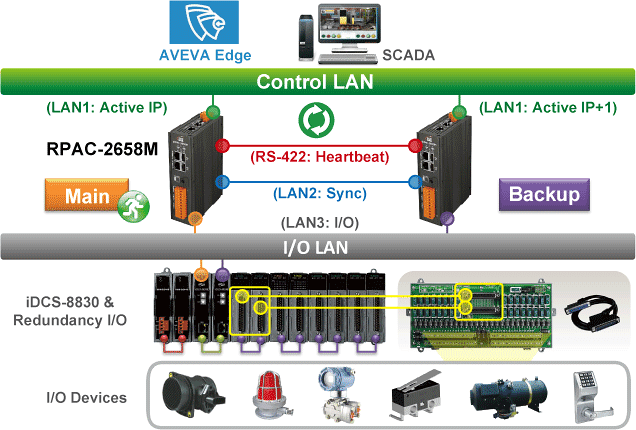
The RPAC-2658M, RPAC-2858M, and LP-2648M models are equipped with three independent Gigabit Ethernet ports (10/100/1000 Base-T). This enables physical segmentation of the plant network — for example, separating the local I/O field network, inter-controller communication network, and backbone data transmission to SCADA/MES levels. The RPAC-9848 model is equipped with an EtherCAT splitter for building end-to-end, ring, and daisy-chain topologies.
Serial ports
Integrated RS-232/485 ports (COM1) and dedicated RS-485 ports (COM2) are provided, supporting hardware-controlled direction switching for data transmission. The COM3 port (RS-422) in redundant configurations is reserved for a hardware Heartbeat monitoring channel.
Software stack
The Win-GRAF runtime includes native software support for the following data exchange standards:
- Modbus TCP/IP & Modbus RTU/ASCII
Operates simultaneously in both Master mode (for polling slave I/O modules, frequency converters, and sensors) and Slave mode (for providing data to operator panels or higher-level SCADA systems). - EtherCAT
The RPAC-2858M and RPAC-9848 models include an optimized hardware-software EtherCAT Master stack. It enables high-speed distributed I/O polling and servo drive synchronization with minimal cycle times. ICP DAS EtherCAT-compatible modules are recommended for use as distributed I/O devices. - DCON Protocol
A proprietary ICP DAS protocol for direct high-speed integration with remote I/O modules of the I-7000 and M-7000 series. - OPC UA Server
A built-in lightweight OPC UA server provides seamless and secure (including encryption support) transmission of automation tags directly to modern ERP, MES, and SCADA systems without the need for intermediate gateway converters. - MQTT / Web Server / SSH
A communication stack for integration with cloud platforms via MQTT is implemented. A built-in web server is available for local diagnostic HTML pages, as well as an SSH server for remote OS configuration by engineers. - User-Defined Protocols
Low-level access to TCP/UDP sockets and COM ports from C code is supported, enabling implementation of custom or proprietary industrial communication protocols.
Win-GRAF programming environment
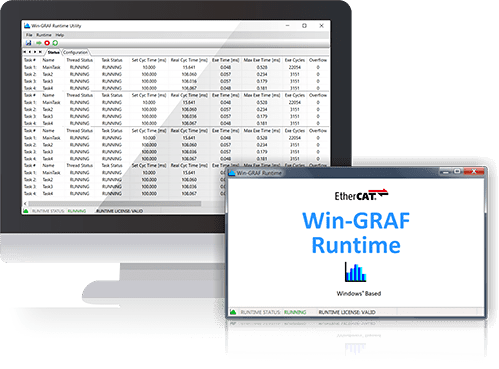
The RPAC software core is based on the Linux operating system (specifically Linux Kernel 4.14.78). To ensure hard determinism, which is critical for industrial PLC applications, a real-time Xenomai environment is deployed on top of the standard kernel. Xenomai uses a dual-kernel architecture, introducing an abstraction layer between the hardware and the operating system. This allows the real-time microkernel to handle timer interrupts and execute time-critical control tasks with the highest priority, minimizing jitter (cycle-time deviation). At the same time, standard Linux services (network stack, file system, SSH) run in the background without affecting the stability of the deterministic PLC cycle.
The Win-GRAF SoftLogic execution system is integrated directly at the Xenomai real-time kernel level. This ensures stable task execution and enables built-in mechanisms for ultra-fast controller switchover in redundant pairs within a time not exceeding 200 ms.
Application software development is carried out in the Win-GRAF Workbench engineering environment. All five standard IEC 61131-3 programming languages are supported:
- LD (Ladder Diagram) — relay ladder logic diagrams
- FBD (Function Block Diagram) — function block diagrams
- IL (Instruction List) — instruction list (assembly-like language)
- ST (Structured Text) — structured text (a high-level, Pascal-like language for complex mathematical calculations)
- SFC (Sequential Function Chart) — sequential function charts for step-based control algorithms
A key feature of the platform is support for hybrid execution. Engineers can develop low-level multithreaded applications in C and run them in parallel within Linux. Data exchange between Linux C applications (communication tasks, advanced encryption algorithms, databases) and the IEC runtime of Win-GRAF is implemented via an optimized shared memory mechanism and specialized API function blocks.
The Online Change function is supported, enabling "on-the-fly" program updates without stopping the controller or interrupting the technological process.
Summary table of RPAC model specifications
| Model | Processor (CPU) | RAM / Flash | Non-volatile memory (NVRAM) | Physical interfaces | Primary purpose |
|---|---|---|---|---|---|
| RPAC-2658M | Cortex-A9, 4 cores, 1.0 GHz | 1 GB DDR3 / 8 GB eMMC, microSD slot | 64 KB FRAM, 128 KB MRAM | 3 × Gigabit LAN, RS-232/485, RS-485, RS-422, USB | Universal PLC, high-availability systems (redundancy) |
| RPAC-2858M | Cortex-A53, 4 cores, 1.6 GHz (64-bit) | 2 GB LPDDR4 / 8 GB eMMC, microSD slot | 64 KB FRAM, 128 KB MRAM | 3 × Gigabit LAN, serial ports, USB | High-performance nodes, EtherCAT Master operation |
| RPAC-9848 | Cortex-A53, 4 cores, 1.6 GHz (64-bit) | 2 GB LPDDR4 / 8 GB eMMC | 64 KB FRAM, 128 KB MRAM | LAN, EtherCAT splitter, serial ports | Critical control nodes, wall-mount installation, dual power input |
The ICP DAS RPAC series of programmable automation controllers under Win-GRAF represents a mature, hard-core architectural solution for building modern distributed automation systems. The successful integration of the Xenomai real-time microkernel has enabled developers to overcome the limitations of conventional general-purpose operating systems and ensure computational determinism.