ARBOR ARES-2100: Ultra-Slim Fanless Edge AI System with Intel Core Series 3 and 40 TOPS
May 2026 | Product News | ARBOR Technology Corp. — Edge AI & Industrial IoT
ARBOR Technology has unveiled the ARES-2100 Series, an ultra-compact fanless Edge AI system built on Intel® Core™ Series 3 processors (Wildcat Lake). Announced on May 7, 2026, the ARES-2100 targets industrial automation, machine vision, AMR/AGV robotics, and smart factory deployments — delivering up to 40 TOPS of aggregate AI computing performance in a 1U chassis measuring just 188 × 120 × 44 mm. It is the result of ARBOR's continued co-development partnership with Intel to advance next-generation Edge AI hardware for real-world industrial environments.

Hybrid AI Architecture: CPU + GPU + NPU in One Package
The defining technical characteristic of the ARES-2100 is its hybrid AI computing architecture, which distributes AI inference workloads across three distinct processing engines within the Intel Core Series 3 SoC — rather than relying on a single compute resource. This architectural approach both increases total throughput and reduces latency by allowing different types of AI workloads to execute simultaneously on the engine best suited to each.
The Intel NPU 5.0's dedicated 17 TOPS are specifically significant for industrial AI applications: by handling neural network inference independently of the CPU, the NPU ensures that AI tasks such as defect detection, object classification, and anomaly detection do not compete with system control tasks for CPU cycles. This separation of concerns is essential for real-time industrial systems where both machine control and AI inference must occur simultaneously without one degrading the other.
Ultra-Slim 1U Form Factor Built for Space-Constrained Industrial Environments
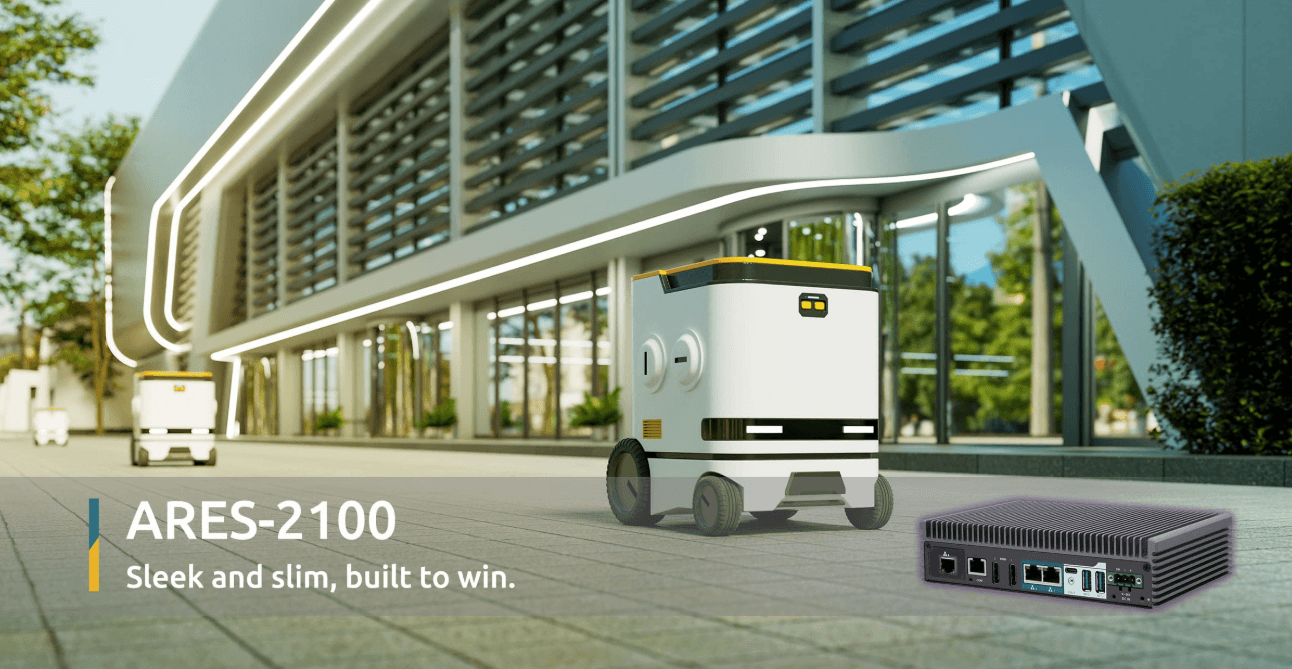
The ARES-2100's 188 × 120 × 44 mm, 1.1 kg chassis is designed to fit where full-size embedded computers cannot. At just 44 mm tall, it slides into standard 1U rack positions, fits inside slim industrial cabinet configurations, and integrates directly into the payload bays of AMR (Autonomous Mobile Robot) and AGV (Automated Guided Vehicle) platforms — where both weight and volume budgets are critical.
The fanless thermal design eliminates the primary mechanical failure point in industrial computing — the fan bearing — ensuring silent, maintenance-free operation in continuous 24/7 duty cycles. This is particularly important for AMR and AGV deployments where the system vibrates during movement and access for maintenance is limited.
MIL-STD-810H: Industrial-Grade Durability
The ARES-2100 carries MIL-STD-810H certification for shock and vibration resistance — the US military standard that defines the most rigorous mechanical durability testing protocols in industrial electronics. This certification is directly relevant to its intended deployment environments: factory floors with heavy machinery generating vibration, AGV platforms subjected to bumps and sudden stops, and outdoor industrial equipment exposed to transportation shock.
A secure cable-lock design prevents accidental cable disconnection under vibration or mechanical stress — a practical feature for mobile platforms and any installation where cables may be subject to movement or pulling forces. The operating temperature range of -20°C to +60°C covers all common indoor industrial environments as well as outdoor and vehicle-mounted deployments in most climatic regions.
Connectivity and I/O
Despite its compact footprint, the ARES-2100 provides a rich set of industrial connectivity options. Up to three 2.5GbE LAN ports deliver five times the bandwidth of standard Gigabit Ethernet, supporting high-throughput data flows from multiple high-resolution cameras, sensors, and other network-connected devices simultaneously — a key requirement in multi-stream machine vision and robotic sensor fusion applications.
Display output covers up to three simultaneous screens via HDMI and USB-C with DisplayPort Alt Mode — supporting multi-monitor HMI configurations, operator workstations, and dual-screen vision inspection setups. RS-232/422/485 serial connectivity via an RJ45 connector maintains compatibility with legacy PLCs, sensors, and instruments already installed on the factory floor. The CAN SKU adds two optional CAN FD Bus interfaces via terminal block — directly connecting the ARES-2100 to the CAN-based communication networks used in robotics, automotive, and AGV systems without requiring an external CAN adapter.
Storage: Flexible and Fast
The ARES-2100 supports a layered storage architecture optimized for both performance and industrial reliability. The M.2 M-Key slot (PCIe Gen4 x2 or SATA) accepts high-speed NVMe or standard SATA SSDs for the operating system and application storage. An optional onboard UFS 3.1 module provides up to 256 GB of embedded flash storage — UFS 3.1 offering significantly higher sequential read/write performance than eMMC while maintaining a compact, solder-down footprint with no moving parts. The M.2 E-Key slot handles wireless expansion (Wi-Fi, Bluetooth, or 4G LTE modules), keeping the main storage slot free for primary storage use.
Two SKUs: Choosing Between L3 and CAN
| Feature | ARES-2100-L3 | ARES-2100-CAN |
|---|---|---|
| LAN Ports | 3× 2.5GbE | 2× 2.5GbE |
| CAN Bus | — Not included | 2× CAN FD (terminal block) |
| USB | 3× USB | 3× USB |
| Display | 2× HDMI | 2× HDMI |
| Serial (COM) | 1× RS-232/422/485 (RJ45) | 1× RS-232/422/485 (RJ45) |
| M.2 M-Key | 1× (PCIe Gen4 x2 / SATA) | 1× (PCIe Gen4 x2 / SATA) |
| M.2 E-Key | 1× (Wi-Fi / BT / 4G LTE) | 1× (Wi-Fi / BT / 4G LTE) |
| Best For | Multi-camera machine vision, smart factory, AMR/AGV with Ethernet sensors | Robotics, AGV/AMR with CAN-based actuators, automotive-grade industrial systems |
The ARES-2100-L3 is the network-centric variant — three 2.5GbE ports provide maximum Ethernet bandwidth for applications connecting multiple IP cameras, industrial switches, or Ethernet-based sensors. The ARES-2100-CAN trades one LAN port for two CAN FD interfaces, making it the right choice for AGV/AMR platforms and robotics systems that use CAN-based motor controllers, servo drives, or sensor networks — a communication topology that is standard in mobile robotics and automotive-derived industrial automation equipment.
Full Technical Specifications
| Parameter | Specification |
|---|---|
| Processor | Intel® Core™ Series 3 (Wildcat Lake) — 5 or 6 core variants |
| AI Performance | Up to 40 TOPS combined (CPU + Intel Xe3 GPU + Intel NPU 5.0) |
| NPU | Intel NPU 5.0 — up to 17 TOPS dedicated AI inference |
| Graphics | Intel Xe3 Graphics (integrated) |
| Memory | 1× 262-pin DDR5 SO-DIMM, up to 64 GB |
| Storage | 1× M.2 M-Key (PCIe Gen4 x2 / SATA); optional onboard UFS 3.1 (up to 256 GB) |
| Wireless Expansion | 1× M.2 E-Key (Wi-Fi / Bluetooth / 4G LTE) |
| Display | 2× HDMI + 1× USB-C DP Alt Mode (up to 3 simultaneous displays) |
| Ethernet (L3 SKU) | 3× 2.5GbE LAN |
| Ethernet (CAN SKU) | 2× 2.5GbE LAN |
| CAN Bus (CAN SKU) | 2× CAN FD (optional, terminal block) |
| USB | 3× USB |
| Serial | 1× RS-232/422/485 (RJ45 connector) |
| Power Input | 9–36V DC wide input range |
| Max Power Consumption | 90W |
| Operating Temperature | -20°C to +60°C |
| Cooling | Fanless |
| Dimensions / Weight | 188 × 120 × 44 mm / 1.1 kg |
| Durability Certification | MIL-STD-810H (shock and vibration) |
| Cable Security | Secure cable-lock design |
| OS Support | Windows 10 IoT LTSC, Windows 11 IoT, Ubuntu Linux |
Target Applications
- Industrial Automation — real-time AI-driven process monitoring, quality control, and production line optimization in smart factories.
- Machine Vision — automated optical inspection (AOI), defect detection, barcode and QR reading, dimensional measurement — all executed locally at the edge without cloud dependency.
- AMR / AGV Systems — onboard AI inference for obstacle detection, path planning, and sensor fusion in autonomous mobile robots and guided vehicles. The slim 1U chassis and 9–36V input fit directly into standard AGV power and space budgets.
- Smart Factory Gateways — edge AI processing node connecting factory floor sensors, cameras, and PLCs to MES/ERP systems and cloud analytics platforms via 2.5GbE networking.
- Robotics — AI-powered perception and decision-making for collaborative and industrial robots, with CAN FD connectivity for direct integration with motor controllers and servo drives (CAN SKU).
- Lightweight Edge Inference — applications requiring 20–40 TOPS of inference performance without the power, size, or cost overhead of discrete GPU accelerators.
Intel Core Series 3 (Wildcat Lake): A Platform Built for the AI Edge
Intel Core Series 3 Wildcat Lake is a purpose-designed edge AI platform — not a downgraded desktop or laptop chip adapted for industrial use. Its architecture specifically combines energy-efficient CPU cores with integrated Xe3 graphics and the dedicated NPU 5.0 inference engine to deliver a heterogeneous compute substrate optimized for AI workloads in power- and thermally-constrained environments. The ARES-2100 is among the first industrial embedded systems to ship with this processor, positioning ARBOR and IPC2U customers at the leading edge of the Intel industrial platform roadmap.