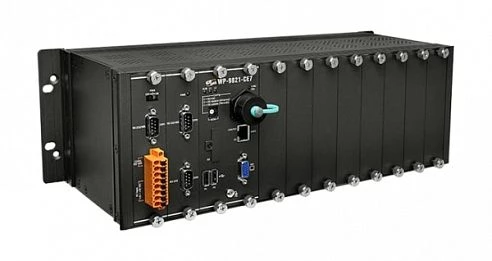
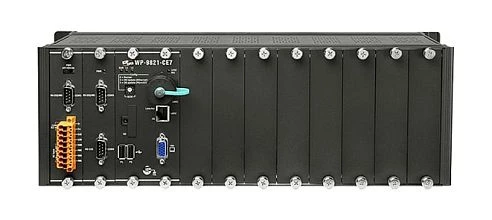
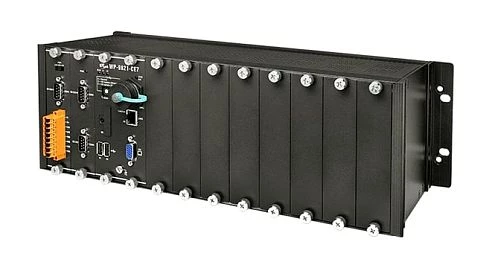
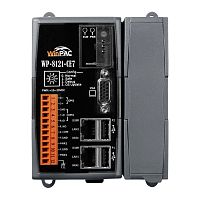
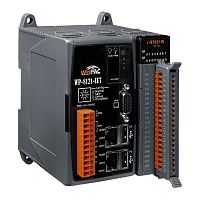
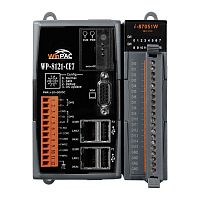
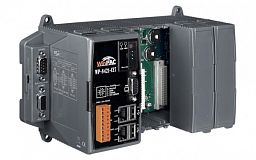
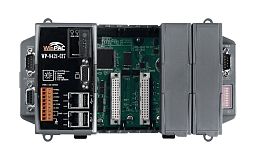
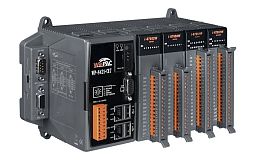
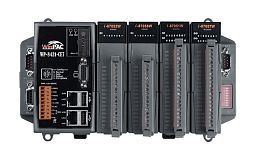
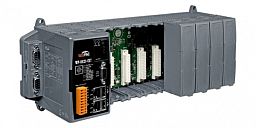
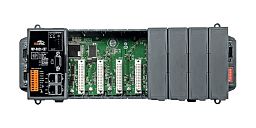
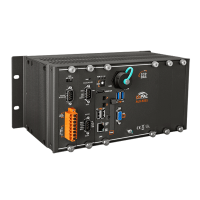
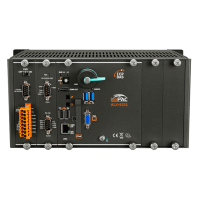
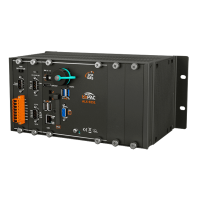
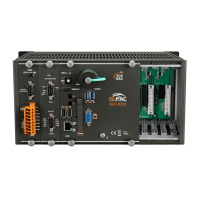
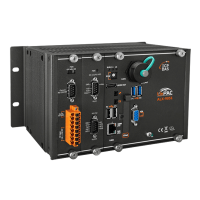
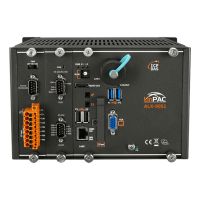
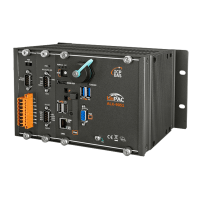
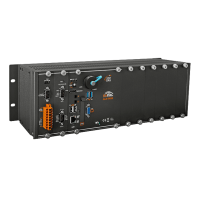
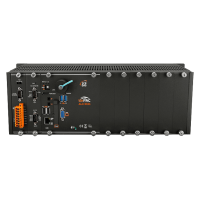
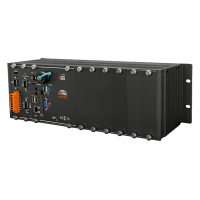
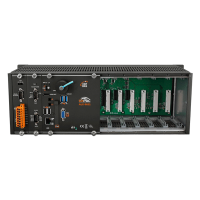
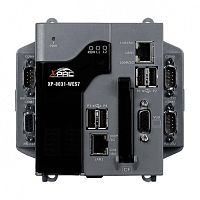
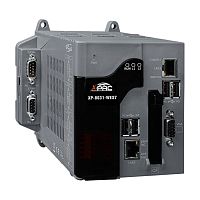
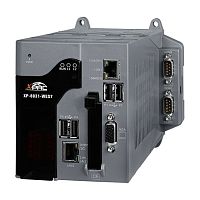
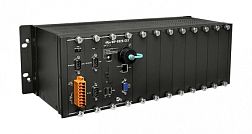
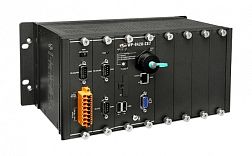
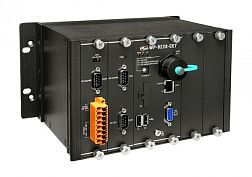
WP-9821-CE7
Unlike traditional PLCs with proprietary programming environments, the WP-9000-CE7 series runs .NET Compact Framework 3.5 and is programmed using Microsoft Visual Studio .NET 2008, supporting C#, Visual Basic .NET and C++ — enabling industrial control applications to be developed and maintained by standard Windows software engineers without vendor-specific IEC 61131-3 ladder logic tools. Built-in services include a web server (VBScript and JavaScript), an FTP server and an embedded SQL server for local data logging, remote browser-based process visualisation and structured query access to historian data without additional middleware software.
Key Features
- ARM Cortex-A8 1.0 GHz, Windows CE 7.0, .NET Compact Framework 3.5: The Cortex-A8 processor and Windows CE 7.0 RTOS provide a deterministic, low-latency execution environment for industrial control tasks; .NET Compact Framework 3.5 enables application development in C#, VB.NET and C++ using Visual Studio .NET 2008, making the WP-9000-CE7 accessible to engineers familiar with Windows software development without requiring IEC 61131-3 ladder logic or vendor-specific PLC programming tools; 512 MB DDR3 SDRAM supports multi-task runtime execution alongside the built-in web, FTP and SQL server services simultaneously
- 8 Expansion Slots for I-9K and I-97K Modules — High-Density Mixed I/O: The WP-9821-CE7 provides eight backplane slots accepting ICP DAS I-9K series high-performance I/O modules — including high-resolution analogue input (16-bit, 18-bit), analogue output, digital input, digital output and counter/frequency modules — and I-97K series serial communication modules for RS-232, RS-485 and PROFIBUS channel expansion; eight fully populated slots provide the I/O density for medium-scale process control applications from a single chassis without an external I/O rack
- Four Isolated Serial COM Ports — RS-232 and RS-485 with 3000 VDC Isolation: Two dedicated ports provide RS-232 and RS-485 with 3000 VDC galvanic isolation on each, breaking ground loops between the controller and field devices on separate earth potentials; two additional COM ports are configurable as either RS-232 or RS-485 for connection to PLCs, drives, instruments, barcode readers and Modbus RTU field devices; all four COM ports are independently addressable for simultaneous multi-device serial communication from the WP-9821-CE7's single CPU module
- Dual 10/100/1000 Mbps Ethernet — Redundant and Segmented Networking: Two independent Gigabit Ethernet ports support OT/IT network separation: one port connects to the control network (SCADA, OPC server, Modbus TCP masters) whilst the second provides IT connectivity for web browser access, FTP file transfer and SQL historian queries; dual NIC also enables active redundancy configurations where a hardware or cable failure on one port does not interrupt process data communication
- Built-In Web Server, FTP Server and Embedded SQL Server: Three server services run concurrently on the Windows CE 7.0 runtime without additional software licences: the web server serves VBScript and JavaScript process monitoring pages accessible from any browser on the plant network; the FTP server provides programmatic file upload and download for remote data collection and firmware updates; the embedded SQL server stores structured process data locally for trend analysis and report generation, queryable from connected PC clients using standard SQL tooling
- 1000 VDC Isolated Power Input, Redundant Power and Relay Output: The DC +10 to +30 V power input is isolated at 1000 VDC, preventing common-mode voltage events on the power supply rail from reaching the controller logic; redundant power input accepts two independent supply connections — if the primary supply fails, the secondary takes over without controller restart; a relay output signals power supply status to an external monitoring system for predictive maintenance in unattended remote installations
- IP30, −25 °C to +75 °C, Optional SD Card, CE/FCC/RoHS Certified: IP30 metal DIN-rail chassis resists finger-contact and solid particle ingress in panel and cabinet installations; the −25 °C to +75 °C operating range covers cold storage facilities, outdoor utility cabinets and high-ambient machine rooms; an optional SD card (up to 32 GB) expands storage for data logging files, firmware images and application binaries; 128 KB MRAM and 16 KB EEPROM provide non-volatile parameter and calibration data storage that survives power loss without a battery; CE, UKCA, FCC, RoHS and WEEE certification covers all major market compliance requirements
Application Use Cases
Industrial Process Control and Monitoring
The WP-9821-CE7's eight expansion slots accommodate a tailored mix of I-9K analogue input, analogue output and digital I/O modules to match the signal inventory of the controlled process. Pressure transducers, temperature sensors (4–20 mA, 0–10 V, thermocouple), flow meters and valve actuators connect through the I-9K modules directly to the PAC backplane; the Cortex-A8 processor runs the control application in the Windows CE 7.0 environment, executing PID loops, setpoint ramps and alarm logic at scan rates appropriate for continuous process applications such as blending, thermal treatment and chemical dosing without an external PLC or DCS.
SCADA Master Station with Local Web HMI
The built-in web server serves browser-based process monitoring and control pages written in VBScript and JavaScript to any connected PC, tablet or HMI panel without a dedicated SCADA software server licence. Operators on the plant network access real-time process variable values, setpoint adjustment forms and alarm lists through a standard browser session; the embedded SQL server logs timestamped process data locally; and the dual Ethernet ports separate operator HMI access from control network communication to field devices — all managed by a single WP-9821-CE7 without an additional server PC in the panel.
Multi-Protocol Serial Gateway and Data Concentrator
The four independent isolated COM ports simultaneously communicate with multiple field devices on different serial protocols: Modbus RTU on RS-485 to energy meters and motor drives, RS-232 to a barcode scanner or weighing terminal, and I-97K serial communication modules in the expansion slots adding further RS-232 or RS-485 channels for additional device connections. The WP-9821-CE7 aggregates data from all connected serial devices into the embedded SQL database and presents a unified Modbus TCP or OPC interface over Ethernet to upstream SCADA or MES systems — functioning as a protocol converter and data concentrator in one chassis.
Remote Monitoring and Telemetry Node
Deployed at remote pump stations, substations and pipeline monitoring points, the WP-9821-CE7 runs autonomously between maintenance visits: the redundant power input connects to primary and backup 24 V DC supplies from a solar regulator or UPS; MRAM and EEPROM retain operating parameters and calibration values through power cycles without a battery; the FTP server enables scheduled remote log file retrieval from a central server; and the web server provides on-demand process status access for maintenance engineers connecting over SCADA VPN without a dedicated remote desktop session to a Windows PC at the site. The SD card provides additional local storage for extended data history at low-bandwidth remote sites.
Building Automation and Utility Management Controller
Building management integrators deploying energy monitoring, HVAC control and utility sub-metering applications benefit from the WP-9821-CE7's combination of isolated RS-232/RS-485 COM ports for BACnet/MSTP and Modbus RTU device communication, dual GbE for BACnet/IP and IP network management, and .NET CF 3.5 for custom application development in C# — the same language used across the building management software stack. The IP30 metal chassis installs in electrical rooms and mechanical plant rooms where particulate ingress is a concern, and the −25 °C to +75 °C operating range accommodates plantroom and roof-space enclosure temperatures without active enclosure climate control.
Why Choose the WP-9000-CE7 Series
Windows CE 7.0 and .NET CF 3.5 — PLC Capability with Windows Developer Tools
The primary software differentiator of the WP-9000-CE7 series against traditional PLCs is the development environment: Visual Studio .NET 2008 with C# and VB.NET, rather than IEC 61131-3 ladder logic or vendor-specific graphical programming tools. For industrial system integrators whose software team is experienced in Windows application development, this means writing control applications, data logging routines and web interfaces in a familiar language with a standard IDE — no IEC 61131-3 training investment and no vendor-specific software licence for the programming tool. The .NET Compact Framework 3.5 provides access to threading, file I/O, network sockets, SQL queries and GUI controls within the same language runtime that the team already uses for Windows desktop and server applications.
I-9K and I-97K Module Ecosystem — High-Resolution Analogue in a Proven Backplane
The I-9K series I/O modules available for the WP-9000-CE7 expansion slots include 16-bit and 18-bit analogue input modules — a resolution specification that general-purpose digital I/O expansion cards and standard PLC analogue modules typically do not reach. For process control applications where measurement accuracy directly affects product quality or process efficiency — precision weighing, pH control, calorimetry, flow ratio control — the high-resolution analogue capability of the I-9K modules within the familiar Windows PAC architecture provides a combination that would otherwise require a specialised DCS. The I-97K serial modules extend the COM port count beyond the four onboard ports, enabling large-scale serial device networks from a single WP-9821-CE7 chassis.
Built-In Server Triad — Web, FTP and SQL Without Additional Software Licences
Many industrial controllers require additional software licensing for historian, web HMI or data export functions: a separate SCADA server licence, an OPC server package, a database middleware layer. The WP-9000-CE7 series includes web server, FTP server and embedded SQL server as built-in services running on the Windows CE 7.0 runtime at no additional software cost. For small to medium-scale process monitoring applications where the investment in a full SCADA server licence is not justified by the site scale, these built-in services enable browser-based monitoring, automated data file collection and structured data querying from the PAC directly — reducing the system architecture to the PAC itself, a network switch and connected client browsers.
Frequently Asked Questions
What processor and operating system does the WP-9000-CE7 series use?
The WP-9000-CE7 series uses an ARM Cortex-A8 processor running at 1.0 GHz with Windows CE 7.0 as the operating system and .NET Compact Framework 3.5 as the application runtime. Applications are developed using Microsoft Visual Studio .NET 2008 in C#, Visual Basic .NET or C++. The controller ships with 512 MB DDR3 SDRAM, 256 MB Flash, 128 KB MRAM and 16 KB EEPROM for non-volatile parameter storage.
What I/O modules are compatible with the WP-9000-CE7 expansion slots?
The WP-9000-CE7 expansion slots are compatible with ICP DAS I-9K series high-performance I/O modules (including 16-bit and 18-bit analogue input, analogue output, digital I/O, counter and frequency modules) and I-97K series serial communication modules (RS-232 and RS-485 channel expansion). The WP-9221-CE7 provides 2 slots, the WP-9421-CE7 provides 4 slots, and the WP-9821-CE7 provides 8 slots for module installation.
How many serial COM ports does the WP-9000-CE7 provide and what protocols are supported?
The WP-9000-CE7 provides four serial COM ports: one dedicated RS-232 with 3000 VDC isolation, one dedicated RS-485 with 3000 VDC isolation, and two configurable RS-232/RS-485 ports. All four ports are independently addressable for simultaneous multi-device communication. Additional RS-232 and RS-485 channels can be added via I-97K serial communication modules in the expansion slots. The ports support standard Modbus RTU, proprietary ASCII protocols and custom serial communication via the .NET Compact Framework serial port API.
What built-in server services does the WP-9000-CE7 provide?
The WP-9000-CE7 includes three server services as standard: a web server supporting VBScript and JavaScript for browser-based HMI pages accessible from any networked client; an FTP server for programmatic file upload and download of log files, configuration and firmware; and an embedded SQL server for local structured data storage and query access. All three services run concurrently on the Windows CE 7.0 runtime without additional software licences.
What is the power input range and does the WP-9000-CE7 support redundant power?
The WP-9000-CE7 accepts DC +10 V to +30 V input with 1000 VDC galvanic isolation from the controller logic. Redundant power input is supported — two independent supply connections can be connected simultaneously, and the controller switches to the secondary supply automatically if the primary fails. A relay output indicates power supply status to an external monitoring system. Power consumption ranges from 16.6 W for the 2-slot WP-9221-CE7 to 18 W for the 8-slot WP-9821-CE7 at 24 V DC nominal.


Get a Quote