Contents:
- The difference between NPort and MGate
- NPort and MGate examples of application
- More about NPort and set-up
- More about MGate and set-up
What are serial-to-Ethernet servers and protocol gateways and how do they function?
This category of hardware works by either encapsulating serial data into network packets for transparent transmission or by actively translating one communication protocol into another. This ensures that devices using different languages can communicate seamlessly across a unified network infrastructure, acting as a bridge between disparate systems.
The difference between NPort and MGate
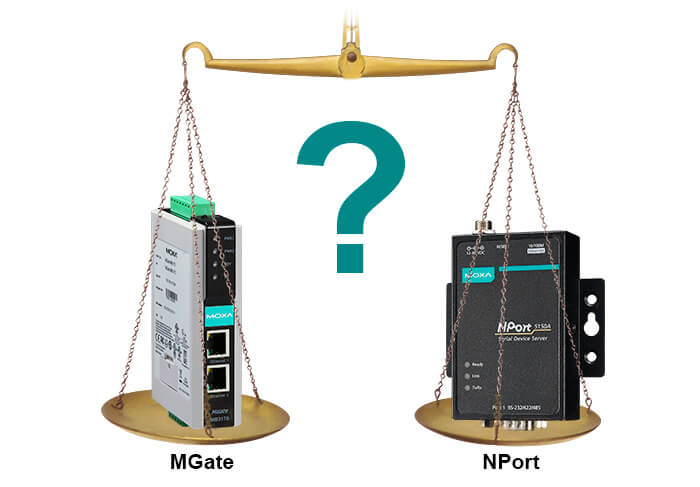
Engineers often have trouble deciding between NPort and MGate in their work. The answer lies in their specifications - let’s take a look!
NPort - these are serial device servers, i.e. devices that enable the connection of other devices with interface RS-232, RS-422 and RS-485 via Ethernet to your computer (or other device). Data is transferred in its original format and the program runs either with a virtual COM port or in TCP Client-Server mode.

MGate – these are gateways that also enable the connection of devices with interface RS-232, RS-422 and RS-485 to your computer (or other device) via Ethernet. In addition, they are able to convert protocols from Modbus RTU/ASCII to Modbus TCP and vice versa (as well as other protocols). In this case, instead of using a virtual COM port, the connected devices can be reached through the gateway’s IP address using Modbus TCP.

What Are the Key Advantages of industrial communication solutions?
These devices allow legacy serial equipment to be accessed and managed over modern Ethernet networks, significantly extending the life of older hardware. They provide reliable data transmission across long distances and enable centralized control of geographically dispersed field assets without the need for a direct physical connection.
NPort and MGate application examples
Let’s look at a few cases of applying NPort and MGate in practice:
You need to process data from a barcode scanner with RS-485 interface and specific protocol onto your computer using the available software.
In this case, NPort can convert the RS-485 interface to Ethernet without any changes to the transferred data. This requires installation of a virtual COM and specific software. NPort can also work under other modes.
You need to extend the RS-232 interface via Ethernet using a device running a specific protocol, for which the cable length is only 15 meters.
For this, use two NPort devices in pairing mode or TCP Client/Server mode. This allows transfer of data from one COM port to another without any changes to it.
You need to connect an RS-485 module of input-output with Modbus RTU protocol via Ethernet to a remote computer, on which the SCADA system is set up.
The best way to approach this is to use the MGate gateway to convert Modbus RTU to Modbus TCP and RS-485 interface to Ethernet. MGate is especially designed to work with Modbus protocols; moreover, it facilitates the correct interconversion of protocols and minimises risk of data loss.
You need to extend a RS-485 line via Ethernet, through which data will be transferred using the Modbus RTU/ASCII protocol.
Best thing for this is to use two MGate gateways connected to each other.
You need to connect an electricity meter running a Modbus RTU protocol to a computer which lacks a COM port and is situated in the building next to you. The software available only recognises Modbus RTU and does not work with Modbus TCP.
There are two ways of tackling this:
- Using an NPort to create a virtual COM port on the computer, whereby the protocol remains the same.
- Using MGate series MB3x70, which supports the Pro COM function for creating the virtual COM port. The protocol remains Modbus RTU.
Who needs this products, such as communication gateways?
System integrators and automation engineers in sectors like energy, manufacturing, and transportation require these tools to bridge the gap between field devices and central management software. They are essential for professionals who need to integrate diverse equipment into a single, cohesive monitoring system while avoiding expensive hardware replacements.
How helps this products to facilitate seamless data exchange?
These units simplify network architecture by allowing multiple serial devices to connect to a single network point, reducing the need for extensive cabling. By performing real-time protocol conversion, they eliminate compatibility issues and ensure that critical data is accurately delivered to higher-level industrial applications for analysis and control.
Now you can confidently decide between using MGate and NPort based on your specific purposes and apply them to your project.
More about Nport and set-up
You can learn more about NPort in this article Choosing NPort.
More about MGate and set-up
You can learn more about MGate in this article Converting protocols via MGate