Industrial robot systems must execute motion accurately, process sensor data, and communicate reliably with drives, I/O modules, and higher-level control systems. When machine vision or AI inference is added, the requirements for computing performance, interfaces, and software increase as well.
A powerful computing platform alone does not make an industrial robot controller. The complete control architecture matters: robot control, motion control, real-time communication, sensing, and functional safety must match the robot kinematics and the production process.
Which components are required for an industrial robot system?
The control architecture depends on the robot type and its task. A Cartesian robot in a handling machine has different requirements from a delta robot used for high-speed pick-and-place or a six-axis robot with camera-based object detection.
An industrial robot system may include:
- a robot controller for kinematics and path planning
- a motion controller for coordinated axis control
- servo drives and motors
- an EtherCAT Master or another real-time communication interface
- digital, analog, and safety I/O modules
- cameras and additional sensors
- a safety controller and safety communication
- an HMI or teach pendant
- an industrial computer or embedded computer for machine vision and AI inference
Several functions can be consolidated on one computing platform. Whether this is appropriate depends on the real-time, performance, and functional safety requirements. Time-critical motion tasks must remain deterministic while the system processes images, runs an HMI, or exchanges data with other machines.
Robot control and motion control are not the same
Robot control calculates the movement of the robot based on its kinematic model. It processes target positions and generates a path. The motion-control layer converts that path into coordinated setpoints for the individual axes.
Before selecting a controller, machine builders should define:
- the robot type and kinematics
- the number of robot and machine axes
- the required control cycle
- accuracy and repeatability targets
- the servo drives and motors to be used
- any conveyors, rotary tables, or additional machine axes that must be synchronized
Shorter control cycles place greater demands on the real-time operating environment and communication network. An AI model may detect a workpiece or calculate a target position, but precise motion execution remains the responsibility of the robot controller, motion controller, and drive system.
EtherCAT for synchronized multi-axis motion
EtherCAT connects the controller to servo drives, I/O modules, and other field devices. It is particularly relevant when multiple axes must be synchronized using short communication cycles.
The statement "supports EtherCAT" is not sufficient for controller selection. Engineers should also verify:
- EtherCAT Master functionality and performance
- achievable communication cycle time
- support for distributed clocks
- supported device profiles and EtherCAT services
- compatibility with the selected servo drives
- configuration and diagnostic tools
- system behavior under full axis and I/O load
The CiA 402 device profile can simplify the integration of compatible drives. However, the complete combination of controller, EtherCAT Master, servo drive, and motor must still be evaluated for the application.
When does a GPU-based robot controller make sense?
Machine vision and AI inference add data-intensive workloads to a robot system. Typical tasks include object detection, pose estimation, inspection, and the processing of 2D or 3D sensor data.
A GPU-based robot controller can process these workloads at the machine. This is useful when image data should not be transferred to a separate computing system or when the application requires a short response path between perception and robot control.
Important sizing parameters include:
- number, interface, resolution, and frame rate of the cameras
- the AI model and required inference performance
- CPU, GPU, and memory requirements
- network, USB, camera, and expansion interfaces
- power consumption and thermal conditions
- operating system and software environment
GPU performance and real-time control performance must be assessed separately. A high TOPS value does not indicate the achievable EtherCAT cycle time or the deterministic behavior of the motion-control application.
Functional safety starts with the system architecture
The safety concept should be considered before the controller and drive components are selected. The required safety functions follow from the machine risk assessment.
Depending on the application, this may include safely limited speed, safely limited position, or safe torque off. These requirements affect the selection of the safety controller, safety I/O, communication, and servo drives.
Machine builders should verify:
- which safety functions are supported by the controller and drives
- which safety communication protocol is required
- which certificates and manufacturer documents are available
- how safety sensors and safety I/O are integrated
- how standard control and safety functions are separated
AI-based perception may supply additional process information, but it does not replace a safety-rated function or the required validation of the machine safety concept.
Industrial robot controllers and automation hardware from IPC2U
The IPC2U portfolio of industrial robot controllers and automation hardware includes PC-based platforms for industrial robotics, multi-axis motion control, machine vision, and edge AI.
Intel x86 motion controllers are suitable for architectures that combine real-time communication, multi-axis control, and additional machine software on an open x86 platform. For applications with machine vision or AI inference, IPC2U offers NVIDIA Jetson AI robot controllers, which combine Arm CPU processing with an integrated NVIDIA GPU and industrial interfaces. The table below compares the two NVIDIA Jetson AGX Orin-based models available from IPC2U.
| Model | Key Specs | Best For |
|---|---|---|
| MARS400-A10-04-C | NVIDIA Jetson AGX Orin, 2048-core Ampere GPU, 64 GB LPDDR5, 5 × GbE, 4 × USB 3.2, 3 × M.2 | Local machine vision and AI inference alongside other control tasks |
| ECM-M400-A10-04-C-1T-X | NVIDIA Jetson AGX Orin, 64 GB LPDDR5, 1 TB NVMe SSD, NexRTOS, integrated EtherCAT Master | GPU-accelerated processing combined with EtherCAT-based motion control |
NexCOBOT MARS400-A10-04-C: NVIDIA Jetson AGX Orin Robot Controller
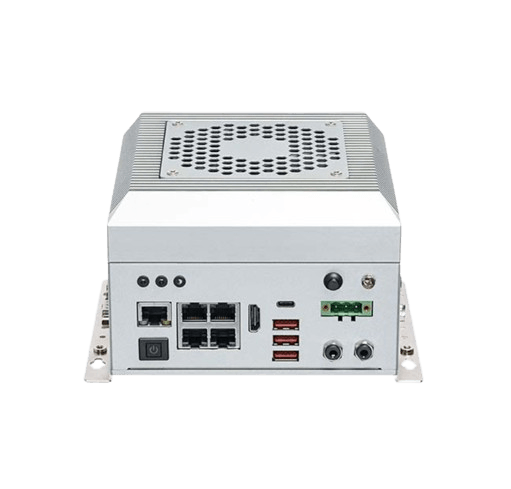
The NexCOBOT MARS400-A10-04-C is based on NVIDIA Jetson AGX Orin with 64 GB LPDDR5 memory. Its interfaces include five Gigabit Ethernet ports, four USB 3.2 ports, four serial interfaces, 16-bit GPIO, and three M.2 slots, together with 64 GB of onboard eMMC storage, HDMI output, and a 24–48 V DC power input.
The platform is suited to robotic systems that require local processing of camera and sensor data alongside other control applications, without transferring image data to a separate computing system.
This combination of GPU-accelerated compute and industrial interfaces is relevant for robot types such as six-axis arms with camera-based object detection, where machine vision and AI inference need to run close to the robot rather than on a remote server.
NexCOBOT ECM-M400-A10-04-C-1T-X: Jetson AGX Orin with Integrated EtherCAT Master
For projects that require an integrated EtherCAT Master, the NexCOBOT ECM-M400-A10-04-C-1T-X combines NVIDIA Jetson AGX Orin, 64 GB LPDDR5 memory, and a 1 TB NVMe SSD (in addition to the standard 64 GB eMMC) with NexRTOS, a real-time Linux environment, and built-in EtherCAT Master functionality.
Compared with the MARS400-A10-04-C, the ECM-M400-A10-04-C-1T-X trades one USB 3.2 port for a USB-C 3.2 port and adds the NVMe SSD and NexRTOS, providing a hardware basis for applications that combine GPU-accelerated processing with EtherCAT-based motion control on a single platform.
NexCOBOT also provides NexECM as the EtherCAT Master software layer running on top of NexRTOS. According to IPC2U's technical overview of NexECM and NexRTOS, the software supports EtherCAT cycle times as low as 250 microseconds, connects up to 64 EtherCAT slave devices, and offers a CiA 402-aligned API for servo drive integration.
Controller selection should not be based on CPU, GPU, or TOPS values alone. Robot kinematics, axis count, control cycle, drives, sensors, software, and safety requirements must be considered together.
Typical use cases for robotics hardware
Cartesian & Delta Pick-and-Place
High-speed handling and delta-robot pick-and-place depend on short, deterministic control cycles and tight coordination between the motion controller and servo drives.
Intel x86 Motion ControllersSix-Axis Robots with Machine Vision
Camera-based object detection adds data-intensive workloads. A GPU-based controller can process images locally while motion execution stays with the robot and motion controllers.
NVIDIA Jetson AI Robot ControllersMulti-Axis EtherCAT Synchronization
Conveyors, rotary tables, and additional machine axes can be synchronized with the robot over EtherCAT using distributed clocks and a common communication cycle.
ECM-M400-A10-04-C-1T-XFunctional Safety Integration
Safely limited speed, safely limited position, and safe torque off connect the safety controller, safety I/O, and servo drives to the machine's risk assessment.
Checklist for selecting robotics hardware
The following project information helps narrow down the appropriate control platform:
- robot type and kinematics
- number of robot and machine axes
- required control cycle, accuracy, and repeatability
- motors and servo drives
- fieldbus protocols and device profiles
- number and type of I/O signals
- cameras and other sensors
- machine vision or AI inference requirements
- required safety functions and safety protocols
- ambient conditions, installation space, and power supply
- operating system and existing software
- project stage, expected quantity, and production schedule
These details provide the basis for selecting a robot controller, motion-control platform, and complementary automation hardware.
Select robotics hardware with IPC2U
IPC2U supplies robot controllers, EtherCAT Master platforms, and industrial computing systems for machine builders, OEMs, and system integrators. Product selection is based on the required kinematics, control cycle, drives, interfaces, machine-vision workload, AI inference, and functional safety architecture.
Planning a robotics project? Send IPC2U the key technical requirements. An IPC2U representative will review the application and help identify a suitable hardware architecture.
Featured Robotics Hardware from IPC2U
- NexCOBOT MARS400-A10-04-C — NVIDIA Jetson AGX Orin, 64 GB LPDDR5, 5 × GbE, edge AI robot controller
- NexCOBOT ECM-M400-A10-04-C-1T-X — Jetson AGX Orin with integrated EtherCAT Master, 1 TB NVMe SSD, NexRTOS