An industrial video server handles two workloads that behave very differently. Recording creates a sustained stream of writes, while a VMS database, footage retrieval and analytics generate frequent reads and less predictable I/O. Placing everything on the same storage pool can make disk access the limiting factor.
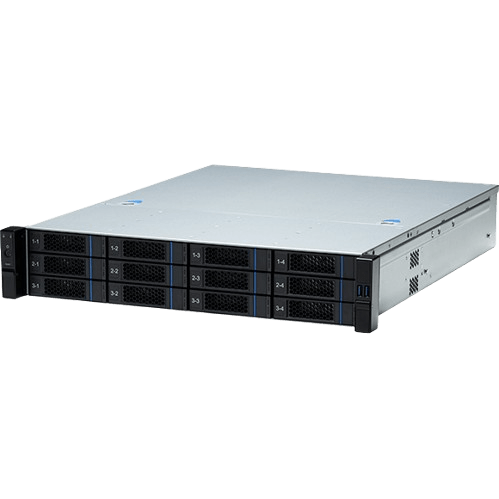
The NEXCOM NViS 6712 addresses that problem with separate resources for the archive and active data. Its 2U chassis combines twelve HDD bays, two PCIe 4.0 NVMe SSD slots, Intel Core Series 2 processing and several options for local analytics.
Storage Tiers for Retention and Active VMS Data
The twelve front-accessible, hot-swappable bays take 3.5-inch HDDs with capacities of up to 26 TB each. A fully populated system therefore provides as much as 312 TB of raw JBOD capacity. Usable space and retention time depend on the selected protection scheme, filesystem, recording schedule and aggregate bitrate.
Two M.2 2280 slots support PCIe 4.0 NVMe SSDs, with an additional M.2 2242 SATA slot available for another solid-state drive. System integrators can keep the high-volume footage archive on HDDs while assigning the operating system, VMS, databases, indexes, metadata or cache to SSD storage. This prevents active application traffic from relying on the same drives that are continuously receiving camera streams.
Projects that require protection against drive failures can add a hardware RAID controller. IPC2U can match the controller, drive set and RAID level to the required capacity, write load and resilience target.
Choose the Accelerator Around the Workload
For its current Series 2 configuration, the NViS 6712 uses a P-core-only Intel Core architecture with up to 12 Performance-cores, 24 threads and a maximum turbo frequency of 5.9 GHz. Two SO-DIMM sockets provide up to 64 GB of DDR5 memory for concurrent recording, playback, database and processing tasks.
A PCIe 5.0 x16 slot supports project-specific graphics or AI acceleration. The PCIe configuration accommodates dual-slot cards up to 260 mm long and up to 250 W, with supported Intel and NVIDIA graphics options. Rather than tying the server to a single card, the hardware can be matched to the VMS, inference model, stream count and required throughput.
Where both storage protection and graphics acceleration are needed, an optional riser provides two PCIe x8 connections for a hardware RAID controller and a compatible single-slot graphics card. Hailo-8 acceleration is also supported through M.2, offering another route for local inference. The M.2 storage and accelerator layout must therefore be planned as part of the system configuration.
Intel OpenVINO and Quick Sync Video add further options for supported inference and video-processing workflows. IPC2U engineers can assess the software stack and define a suitable combination of CPU processing, discrete graphics and an M.2 accelerator.
Turn Recorded Footage into Operational Data
In a factory, camera streams may serve more than conventional security recording. With the appropriate VMS and analytics software, the same infrastructure can support production monitoring, event investigation and visual data processing for anomaly detection or safety-related workflows.
High-volume footage can remain at the site, while selected clips, metadata or alerts are made available to a control room or higher-level application. Two 2.5GbE ports provide the base network connection; the project bandwidth still needs to be calculated from the incoming streams and the information shared beyond the local system.
To configure the platform, IPC2U needs the camera count, resolution, frame rate, codec, aggregate bitrate and retention target, together with the intended VMS, storage-protection requirements and planned analytics. We can then define the processor, memory, HDD and SSD layout and a compatible acceleration option. Contact IPC2U to discuss the NViS 6712 configuration.