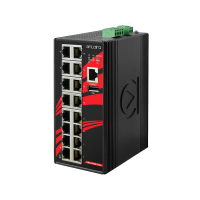
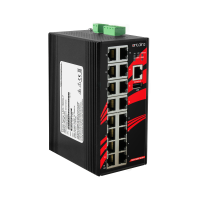
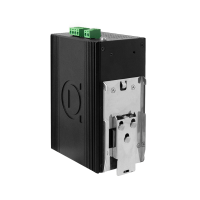
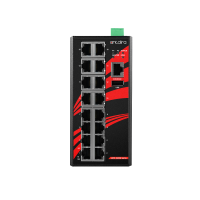
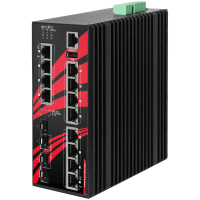
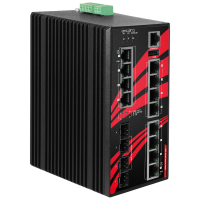
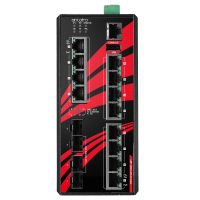
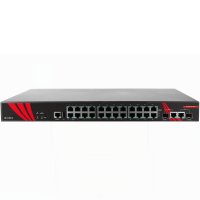
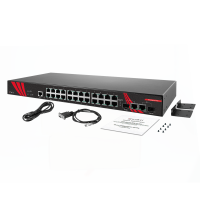
LMX-1600G-M12-67
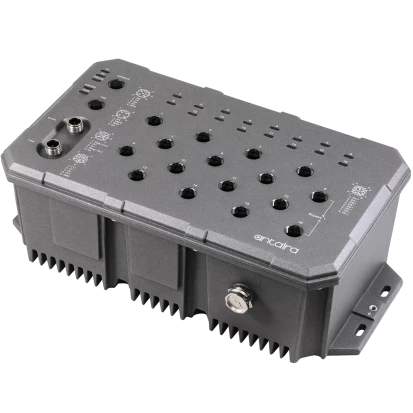
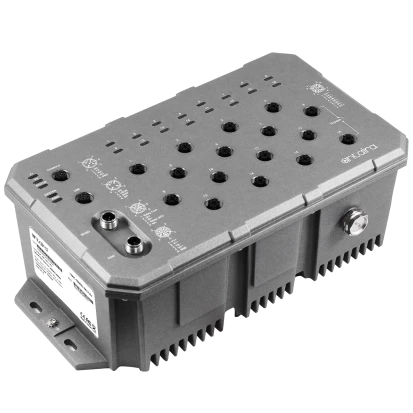
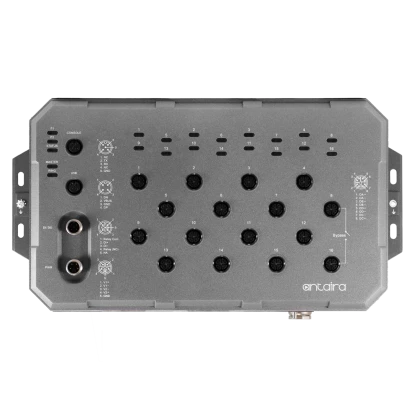
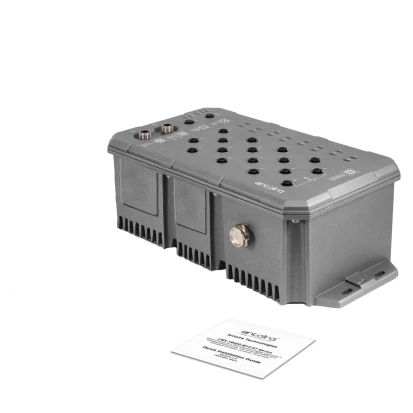
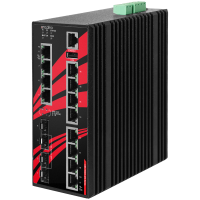
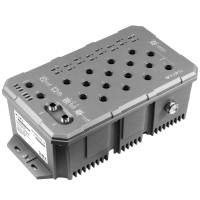
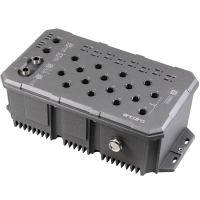
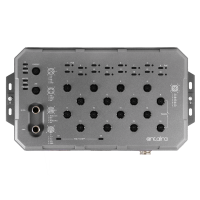
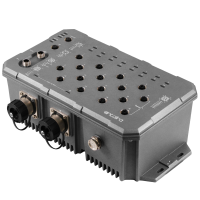
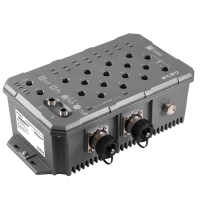
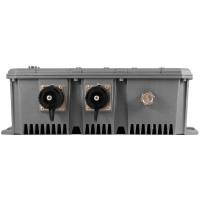
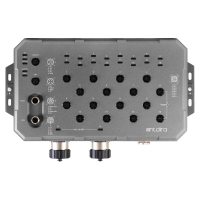
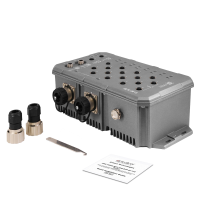
The Antaira LMX-1600G-M12-67 is a 16-port IP67 industrial Gigabit switch with M12 X-coded connectors and Light Layer 3 management, featuring G.8032 ERPS ring protection with sub-50 ms recovery — built for outdoor machinery, rail trackside, mining and port installations where IP20/IP40 switches cannot survive water, dust and shock. All 16 ports use IEC 61076-2-109 X-coded M12 push-lock connectors that hold IP67 without boot seals or dust caps.
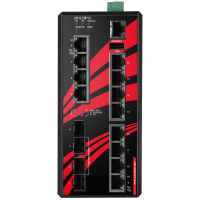
Management covers static inter-VLAN routing plus full L2 features — 802.1Q VLAN, QoS (802.1p + DSCP), IGMP snooping, port mirroring, rate limiting and ACL — with SNMP v3, RADIUS, TACACS+, SSH and SSL satisfying IEC 62443 access-control requirements. Redundant power inputs with a fail-relay alarm protect unmanned sites; the switch operates at −10 °C to +65 °C (−40 °C to +70 °C in the -T variant) and carries Antaira's 5-year warranty.
Key Features
- 16× M12 X-coded GbE: The industrial standard connector for IP67 Gigabit Ethernet — positive push-lock retention under vibration, gloved-hand field connection, no RJ45 adapters.
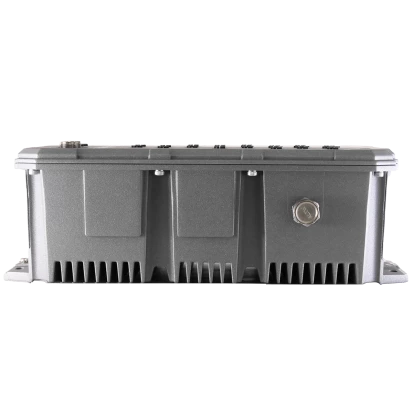
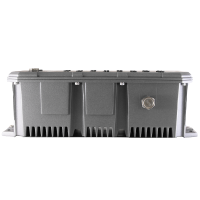
- IP67 enclosure: Dust-tight and 1 m immersion for 30 minutes — installs directly in the environment without a protective housing.
- G.8032 ERPS v2, <50 ms: Deterministic ring recovery regardless of ring size — within the timeout of PROFINET/EtherNet/IP; STP/RSTP/MSTP supported for non-ring topologies.
- Light Layer 3: IPv4 static routing between VLANs removes the need for a router at each field cabinet.
- Enterprise security: SNMP v1/v2c/v3, RADIUS, TACACS+, SSH, SSL, 802.1X, ACL and port security — IEC 62443 Level 2 features out of the box.
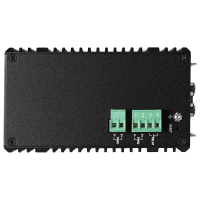
- Redundant power + fail relay: Dual inputs with dry-contact alarm output flag supply failures at unmanned sites before connectivity is lost.
- −10 °C to +65 °C (standard) / −40 °C to +70 °C (-T), 5-year warranty.
Model Variants
| Model | Operating Temperature | Ports | Redundancy |
|---|---|---|---|
| LMX-1600G-M12-67 | −10 °C to +65 °C | 16× M12 X-coded GbE, IP67 | ERPS v2, STP/RSTP/MSTP |
| LMX-1600G-M12-67-T | −40 °C to +70 °C | 16× M12 X-coded GbE, IP67 | ERPS v2, STP/RSTP/MSTP |
Application Use Cases
Construction and Mining Machinery Networks
On-machine camera, control and telematics systems are M12-wired and exposed to mud, wash cycles and vibration — the LMX-1600G-M12-67 switches them all from the main electronics compartment without an extra housing.
Rail Trackside and On-Board Switching
M12 X-coding is the connector standard of European trackside Ethernet; ERPS delivers the sub-50 ms redundancy expected near safety systems, and the -T variant covers the EN 50155-relevant temperature range.
Port, Harbour and Shipyard Infrastructure
Crane, AGV and CCTV networks in salt-spray and hose-down environments connect natively via M12, with VLAN segmentation between terminal operations and management networks and RADIUS-centralised access control.
Smart Traffic and Roadside Cabinets
Connects IP67 cameras, signs and sensors over a 20-year outdoor service life; ERPS rings survive cable faults and static L3 routing links roadside subnets to the traffic control centre without a router per cabinet.
Why Choose the LMX-1600G-M12-67
Native M12, not an adapted RJ45 switch. The common alternative — an IP20 switch in a sealed box with M12-to-RJ45 pigtails — adds connectors, failure points and bulk. Sixteen native X-coded ports remove the adaptation layer entirely.
ERPS is the right ring protocol. RSTP recovery scales with ring size (1–30 s) — long enough to fault out automation protocols. G.8032 ERPS recovers deterministically in under 50 ms regardless of ring size.
Cybersecurity without licence unlocks. RADIUS/TACACS+ authentication and SSH/SSL encrypted management ship enabled, covering IEC 62443-3-3 Level 2 requirements for NIS2-scope industrial networks.
Frequently Asked Questions
What is M12 X-coding?
The IEC 61076-2-109 connector standard for Gigabit Ethernet (1000BASE-T) over M12 — a keyed 8-pin connector that maintains IP67 sealing when mated, without the boot seals RJ45 needs in wet environments. Only X-coded cable assemblies mate with X-coded ports.
What does "Light Layer 3" mean?
IPv4 static routing between VLANs in addition to full L2 management. Dynamic routing protocols (OSPF, BGP) are not included — static routing covers most field-switching inter-VLAN needs at lower cost and complexity.
What is the difference between the -67 and -67-T models?
Only the operating temperature: −10 °C to +65 °C standard versus −40 °C to +70 °C for the -T variant, which is recommended for Nordic, high-altitude and Arctic deployments.
Which redundancy protocols are supported?
G.8032 ERPS v2 with sub-50 ms recovery, plus IEEE 802.1D STP, 802.1w RSTP and 802.1s MSTP for non-ring and legacy topologies.
What management and security features are included?
SNMP v1/v2c/v3, RADIUS and TACACS+ authentication, SSH v2, SSL/TLS web management, IEEE 802.1X port access control, ACLs, MAC port security and management VLAN isolation — enabled as standard.
The Antaira LMX-1600G-M12-67 is a 16-port IP67 industrial Gigabit switch with M12 X-coded connectors and Light Layer 3 management, featuring G.8032 ERPS ring protection with sub-50 ms recovery — built for outdoor machinery, rail trackside, mining and port installations where IP20/IP40 switches cannot survive water, dust and shock. All 16 ports use IEC 61076-2-109 X-coded M12 push-lock connectors that hold IP67 without boot seals or dust caps.
Management covers static inter-VLAN routing plus full L2 features — 802.1Q VLAN, QoS (802.1p + DSCP), IGMP snooping, port mirroring, rate limiting and ACL — with SNMP v3, RADIUS, TACACS+, SSH and SSL satisfying IEC 62443 access-control requirements. Redundant power inputs with a fail-relay alarm protect unmanned sites; the switch operates at −10 °C to +65 °C (−40 °C to +70 °C in the -T variant) and carries Antaira's 5-year warranty.
Key Features
- 16× M12 X-coded GbE: The industrial standard connector for IP67 Gigabit Ethernet — positive push-lock retention under vibration, gloved-hand field connection, no RJ45 adapters.
- IP67 enclosure: Dust-tight and 1 m immersion for 30 minutes — installs directly in the environment without a protective housing.
- G.8032 ERPS v2, <50 ms: Deterministic ring recovery regardless of ring size — within the timeout of PROFINET/EtherNet/IP; STP/RSTP/MSTP supported for non-ring topologies.
- Light Layer 3: IPv4 static routing between VLANs removes the need for a router at each field cabinet.
- Enterprise security: SNMP v1/v2c/v3, RADIUS, TACACS+, SSH, SSL, 802.1X, ACL and port security — IEC 62443 Level 2 features out of the box.
- Redundant power + fail relay: Dual inputs with dry-contact alarm output flag supply failures at unmanned sites before connectivity is lost.
- −10 °C to +65 °C (standard) / −40 °C to +70 °C (-T), 5-year warranty.
Model Variants
| Model | Operating Temperature | Ports | Redundancy |
|---|---|---|---|
| LMX-1600G-M12-67 | −10 °C to +65 °C | 16× M12 X-coded GbE, IP67 | ERPS v2, STP/RSTP/MSTP |
| LMX-1600G-M12-67-T | −40 °C to +70 °C | 16× M12 X-coded GbE, IP67 | ERPS v2, STP/RSTP/MSTP |
Application Use Cases
Construction and Mining Machinery Networks
On-machine camera, control and telematics systems are M12-wired and exposed to mud, wash cycles and vibration — the LMX-1600G-M12-67 switches them all from the main electronics compartment without an extra housing.
Rail Trackside and On-Board Switching
M12 X-coding is the connector standard of European trackside Ethernet; ERPS delivers the sub-50 ms redundancy expected near safety systems, and the -T variant covers the EN 50155-relevant temperature range.
Port, Harbour and Shipyard Infrastructure
Crane, AGV and CCTV networks in salt-spray and hose-down environments connect natively via M12, with VLAN segmentation between terminal operations and management networks and RADIUS-centralised access control.
Smart Traffic and Roadside Cabinets
Connects IP67 cameras, signs and sensors over a 20-year outdoor service life; ERPS rings survive cable faults and static L3 routing links roadside subnets to the traffic control centre without a router per cabinet.
Why Choose the LMX-1600G-M12-67
Native M12, not an adapted RJ45 switch. The common alternative — an IP20 switch in a sealed box with M12-to-RJ45 pigtails — adds connectors, failure points and bulk. Sixteen native X-coded ports remove the adaptation layer entirely.
ERPS is the right ring protocol. RSTP recovery scales with ring size (1–30 s) — long enough to fault out automation protocols. G.8032 ERPS recovers deterministically in under 50 ms regardless of ring size.
Cybersecurity without licence unlocks. RADIUS/TACACS+ authentication and SSH/SSL encrypted management ship enabled, covering IEC 62443-3-3 Level 2 requirements for NIS2-scope industrial networks.
Frequently Asked Questions
What is M12 X-coding?
The IEC 61076-2-109 connector standard for Gigabit Ethernet (1000BASE-T) over M12 — a keyed 8-pin connector that maintains IP67 sealing when mated, without the boot seals RJ45 needs in wet environments. Only X-coded cable assemblies mate with X-coded ports.
What does "Light Layer 3" mean?
IPv4 static routing between VLANs in addition to full L2 management. Dynamic routing protocols (OSPF, BGP) are not included — static routing covers most field-switching inter-VLAN needs at lower cost and complexity.
What is the difference between the -67 and -67-T models?
Only the operating temperature: −10 °C to +65 °C standard versus −40 °C to +70 °C for the -T variant, which is recommended for Nordic, high-altitude and Arctic deployments.
Which redundancy protocols are supported?
G.8032 ERPS v2 with sub-50 ms recovery, plus IEEE 802.1D STP, 802.1w RSTP and 802.1s MSTP for non-ring and legacy topologies.
What management and security features are included?
SNMP v1/v2c/v3, RADIUS and TACACS+ authentication, SSH v2, SSL/TLS web management, IEEE 802.1X port access control, ACLs, MAC port security and management VLAN isolation — enabled as standard.