| Model | Function | Interface | Isolation |
|---|---|---|---|
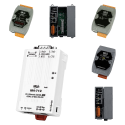
| tM-7520U | Converter | RS-232 to RS-485 | 2500 VDC Isolation on RS-232 side |
| I-7520 | Converter | RS-232 to RS-485 | 3000 VDC Isolation on RS-232 side |
| I-7520R | Converter | RS-232 to RS-485 | 3000 VDC Isolation on RS-485 side |
| tM-7520A | RS-232 to RS-422/485 | RS-232 to RS-422/485 | 2500 VDC Isolation on RS-232 side |
| I-7520A | RS-232 to RS-422/485 | RS-232 to RS-422/485 | 3000 VDC Isolation on RS-232 side |
| I-7520AR | RS-232 to RS-422/485 | RS-232 to RS-422/485 | 3000 VDC Isolation on RS-422/485 side |
| I-7520U4 | Converter and 4-Channel Hub | RS-232 to RS-485 | 3000 VDC Isolation |
| I-7551 | Repeater | RS-232 to RS-232 | 3000 VDC Isolation on 3 ways |
| tM-7510U | Repeater | RS-485 | 2500 VDC Isolation |
| I-7510 | Repeater | RS-485 | 3000 VDC Isolation |
| I-7510P | Repeater | RS-485 | 5000 VDC Isolation on 3 ways |
| I-7510A | Repeater | RS-422/485 | 3000 VDC Isolation |
| I-7510AR | Repeater | RS-422/485 | 3000 VDC Isolation on 3 ways |
| I-7513 | 3-Channel Hub | RS-485 | 3000 VDC Isolation on 3 ways |
| I-7514U | 4-Channel Hub | RS-485 | 3000 VDC Isolation |
The RS‑232/422/485 Converter / Repeater / Hub family includes compact and industrial-grade modules that convert, repeat, and isolate serial signals. Devices such as the I‑7520, tM‑7520U, I‑7510, I‑7551, and I‑7520U4-G are designed for point-to-point or multi-drop configurations, enabling communication over long distances or across electrically noisy environments. These modules feature optical isolation (up to 3000 VDC), automatic RS‑485 direction control, support for baud rates from 300 to 115200 bps, and simple DIN-rail installation.
Repeaters like the I‑7510 and tM‑7510U amplify RS‑485 signals to extend communication up to 1.2 km, while converters like I‑7520 enable smooth translation between RS‑232 and RS‑485. Multi-channel models such as I‑7520U4-G allow for hub-style deployments with multiple output lines. These devices are widely used in industrial control, building automation, and utility monitoring where reliable serial communication is critical.
What Are the Key Advantages of Serial Communication Tools?
These devices provide essential galvanic isolation and surge protection, shielding sensitive equipment from electrical noise and voltage spikes in industrial environments. They significantly extend the transmission range of standard signals, allowing for reliable data exchange over distances up to 1200 meters without signal degradation.
Product Examples
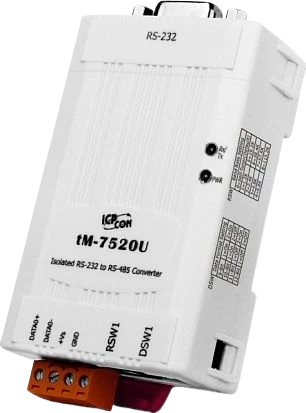
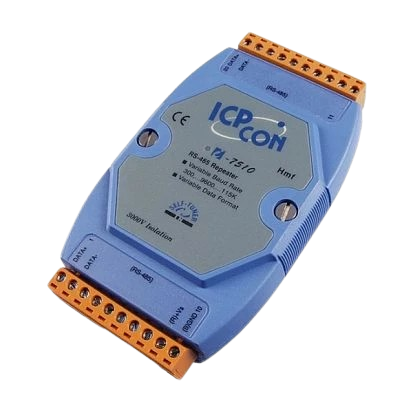
- ICP DAS – tM‑7520U
Isolated RS-232 to RS-485 Converter, RoHS - ICP DAS – I‑7510
RS-485 Isolated Repeater
typical Application
- Extending RS‑485 communication lines up to 1.2 km
- Electrically isolating segments of serial networks
- Connecting multiple RS‑232 or RS‑485 devices in star or daisy-chain topologies
- Protecting control systems from ground loops and electrical surges
- Retrofitting serial sensors and controllers into modern control systems
USB to RS‑232/422/485 Converter / Hub
| Model | Function | Interface | Isolation |
|---|---|---|---|
| I-7560 | Converter | USB to RS-232 | Non-isolated |
| I-7560U | Converter | USB to RS-232 | Non-isolated |
| tM-7561 | USB to RS-485 | USB to RS-485 | 2500 VDC Isolation on RS-485 side |
| USB-2514 | USB to 4-Port RS-232 Converter | USB to RS-232 | Non-isolated |
| I-7561 | USB to RS-232/422/485 | USB to RS-232/422/485 | 3000 VDC Isolation on RS-232/422/485 side |
| I-7561U | USB to RS-232/422/485 | USB to RS-232/422/485 | 3000 VDC Isolation on RS-232/422/485 side |
| I-7563 | Converter and 3-Channel Hub | USB to RS-485 Hub | 3000 VDC Isolation on RS-485 side |
| I-7563U | Converter and 3-Channel Hub | USB to RS-485 Hub | 3000 VDC Isolation on RS-485 side |
The USB to RS‑232/422/485 Converter / Hub series from ICP DAS serves as a vital bridge between modern USB interfaces and legacy serial communication standards. These devices provide seamless USB connectivity, transforming USB ports into versatile serial interfaces with options for RS‑232, RS‑422, and RS‑485. With features such as high-speed data transfer, optical isolation, multiple channels, and plug-and-play convenience, they are perfect for integrating serial devices in contemporary industrial and laboratory systems.
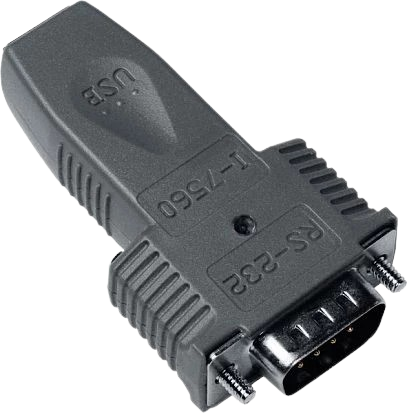
- Models like I‑7560 and I‑7560U offer simple USB-to‑RS‑232 conversion, compatible with a variety of legacy equipment and supporting full modem control signals with speeds up to 115,200 bps.
- The I‑7561 and I‑7561U-G expand functionality by adding optical isolation (up to 3000 VDC), supporting RS‑232, RS‑422, and RS‑485, making them suitable for high-noise industrial settings.
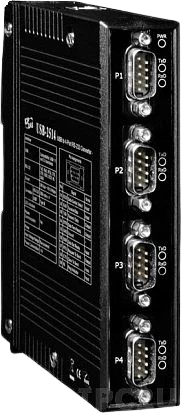
- For multi-device setups, the USB‑2514 allows one USB port to be converted into four separate RS‑232 serial ports, facilitating multiple device connections from a single host.
- The I‑7563 and I‑7563U-G act as 3-channel USB to RS‑485 hubs with isolation, enabling star-wired RS‑485 networks and simplified wiring for networked devices.
- Additionally, the tM‑7561 provides USB to isolated RS‑485 conversion with 2500 VDC isolation, delivering reliable connectivity in electrically challenging environments.
What are serial converters and how do they facilitate interface compatibility?
This product type translates signals between different communication standards, such as converting RS-232 to RS-422 or RS-485. They enable modern controllers to communicate seamlessly with legacy equipment, ensuring that diverse hardware can be integrated into a single, functional network architecture.
These converters and hubs are ideal for connecting serial instrumentation—such as sensors, PLCs, data loggers—to modern computers, PACs, or IoT gateways with USB ports. They facilitate simplified wiring, enhanced flexibility, and improved protection in industrial automation, laboratory testing, or field deployments.
Product Examples
- ICP DAS – I‑7560U
USB to RS-232 Converter (RoHS)
- ICP DAS – USB‑2514
USB to RS-232/422/485 Converters USB-2514 by ICP DAS
CAN / PROFIBUS & RS‑232/422/485 Converter
| Model | Function | Interface | Isolation |
|---|---|---|---|
| I-7530 | Converter | RS-232 to CAN | 3000 VDC Isolation on CAN side |
| I-7530A-MR | Modbus RTU to CAN | 3000 VDC Isolation on CAN and UART side | |
| I-7520R30A | RS-232/422/485 to CAN | 3000 VDC Isolation on CAN side | |
| I-7520A30-FT | RS-232 to low speed fault tolerant CAN | 3000 VDC Isolation on CAN side | |
| I-7550-B | PROFIBUS to RS-232/422/485 | 3000 VDC Isolation on PROFIBUS side | |
| I-7550-M | PROFIBUS to RS-232/422/485 | 3000 VDC Isolation on PROFIBUS side |
The CAN / PROFIBUS & RS‑232/422/485 Converter series from ICP DAS enables seamless integration between modern fieldbus networks and traditional serial interfaces. These converters support communication between CAN or PROFIBUS DP buses and RS‑232/422/485 serial devices, allowing bidirectional data flow without complex protocol translation. With industrial-grade isolation, terminal resistance control, watchdog protection, and flexible baud rate support, these models ensure reliable operation within harsh automation environments.
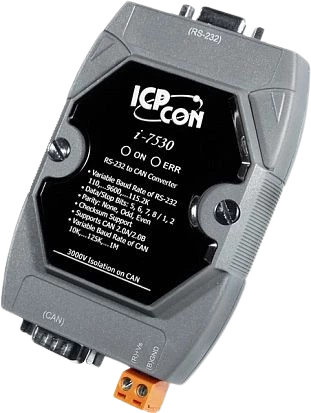
- The I‑7530‑G enables transparent communication between the CAN bus (CAN 2.0A/B, ISO 11898‑2) and RS‑232 systems. It includes selectable terminators, buffers for up to 1,000 CAN frames, and supports baud rates from 10 kbps to 1 Mbps.
- The I‑7530A‑MR‑G functions as a Modbus RTU to CAN converter, bridging Modbus masters with CAN network nodes. It supports Modbus function codes (0x03/0x04/0x10), programmable baud rates, isolation up to 3 kV, and offers transparent pair‑connection mode for serial devices.
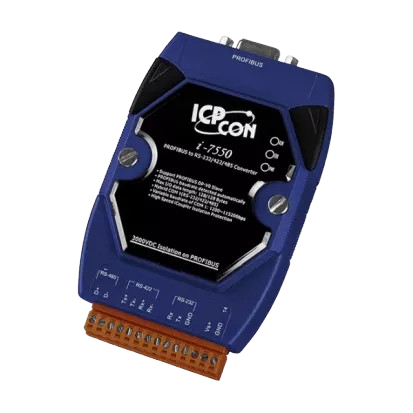
- For PROFIBUS integration, the I‑7550‑B and I‑7550‑M act as PROFIBUS DP‑V0 slave converters, granting serial RS‑232/422/485 devices access to PROFIBUS networks. These models feature auto detection of PROFIBUS baud rate (up to 12 Mbps), up to 3 kV isolation on PROFIBUS side, “self-tuner” serial port, and compact DIN‑rail design.
These converters are ideal for connecting legacy serial field equipment, instrumentation, and controllers to modern industrial bus systems, without requiring labor-intensive rewriting of device software or protocols.
Product Examples
- ICP DAS – I‑7530
RS-232 to CAN Converter, Isolation Protection
- ICP DAS – I‑7550-B
PROFIBUS to RS-232/422/485 Converter
Typical Applications
- Integrating RS‑232 devices like sensors, gauges, or PLCs into CAN-based control networks.
- Allowing Modbus RTU systems to interact with CAN nodes for data aggregation.
- Bringing legacy serial instruments into PROFIBUS DP automation architectures.
Fiber Optics Converter
| Model | Function | Interface | Connector | Mode | Communication Distance |
|---|---|---|---|---|---|
| I-2541 | Converter | RS-232/422/485 to Fiber Optics | ST type | Multi-mode | 2 km |
| I-2542-A | SC type | Single-mode | 15 km | ||
| I-2542-B | 15 km | ||||
| I-2542-A25 | 25 km | ||||
| I-2542-B25 | 25 km |
The Fiber Optics Converter series by ICP DAS enables industrial-grade serial communication over optical fiber, ensuring immunity from electromagnetic interference (EMI/RFI), lightning strikes, and ground loops. This line includes both multimode and single-mode converters suited for RS‑232, RS‑422, and RS‑485 interfaces. Each model delivers long-distance data transmission capabilities, robust isolation, DIN-rail installation, and reliable performance in harsh industrial environments.
- I‑2541 – Multimode fiber converter with 3000 VDC isolation, supports RS‑232/422/485, and transmits up to 2 km at 115.2 kbps—ideal for protecting sensitive data communication in electrically noisy areas.
- I‑2542 Series – Single-mode converters utilizing Wavelength Division Multiplexing (WDM) to enable bi-directional communication over a single fiber, ideal for long-distance transmission:
- I‑2542‑A / I‑2542‑B support up to 15 km ranges.
- I‑2542‑A25 / I‑2542‑B25 extend reach to 25 km.
Applications: These converters are perfect for linking industrial control rooms, substations, and remote automation nodes—specifically when serial communication continuity is required across large or electrically hostile environments.
Product Examples
- ICP DAS – I‑2541
RS-232/422/485 to ST Fiber Multi-mode Optic Converter - ICP DAS – I‑2542‑A
RS-232/422/485 to Single-Mode 15 Km, SC Fiber optic converter, TX 1310 nm, RX 1550 nm (RoHS)
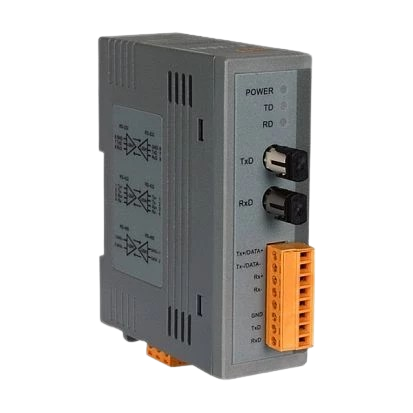
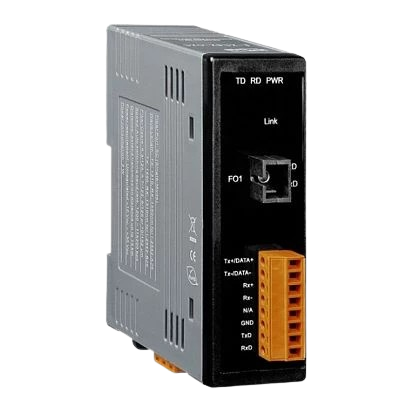
Quick Comparison
| Model | Fiber Type | Distance | Key Features |
|---|---|---|---|
| I-2541 | Multimode | Up to 2 km | High isolation, simple RS interface setup |
| I-2542-A/B | Single-mode WDM | Up to 15 km | Dual-channel over one fiber, long reach |
| I-2542-A25/B25 | Single-mode WDM | Up to 25 km | Ultra-long-range industrial fiber conversion |
PCI/ISA Bus RS-232 to RS-485/422 Converter
| Model | Function | Interface | Isolation |
|---|---|---|---|
| PCISA-7520R | Converter Card | Isolated RS-232 to RS-485 | 3000 VDC Isolation on RS-232 side |
| PCISA-7520AR | Converter Card | Isolated RS-232 to RS-422/485 | 3000 VDC Isolation on RS-232 side |
ICP DAS PCISA-7520 series cards are internal (slot-mounted) converters that bridge a PC’s RS-232 interface to RS-485 or RS-422 on the field side. They draw power from the PCI/ISA bus (no external PSU), add 3 kV DC isolation on the RS-485/422 side, and feature Self-Tuner auto-baud with automatic data-direction control for RS-485 (300–115 200 bps). Functionally they mirror the well-known I-7520 external modules, but in a compact in-chassis form factor—ideal when you want robust, isolated serial conversion without adding an external box or a new COM port to the OS.
product examples:
Who needs this products, such as serial repeaters and hubs?
Industrial engineers and system integrators who need to expand the number of connected devices or boost signal strength over long cable runs rely on these tools. They are indispensable for professionals managing complex automation systems where multiple sensors and actuators must be linked reliably to a central control unit.
- ICP DAS – PCISA-7520AR
PCI/ISA RS-232 to RS-422/485 Converter Card with RS-485 Automatic Data Direction Control, Isolation Protection
- ICP DAS – I-7520R
(external module, same conversion behavior as PCISA-7520 series) RS-232 to RS-485 Converter with RS-485 Automatic Data Direction Control, Isolation Protection
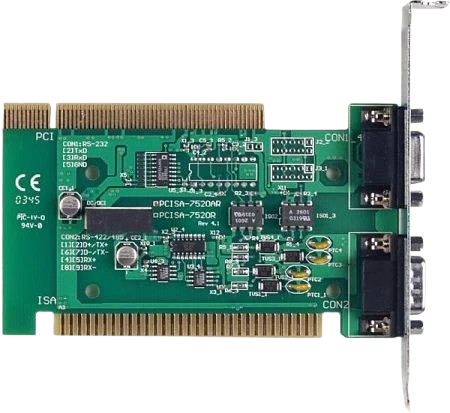
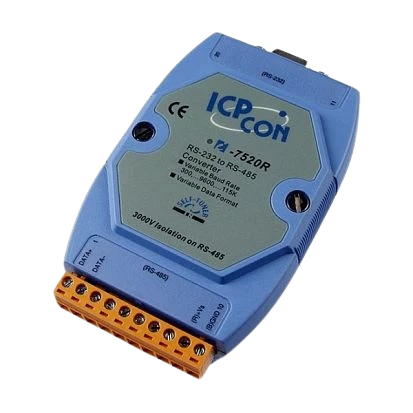
Typical applications: retrofitting legacy RS-232-based HMIs/PLCs to multi-drop RS-485/422 networks inside control PCs; adding an isolated field bus for remote I/O (up to hundreds of nodes) without driver changes; minimizing wiring clutter by keeping conversion inside the chassis while maintaining industrial-grade isolation and auto-baud convenience.
Ethernet to Serial Converter
| Model | Ethernet Port | Total COM Port | RS-232 | RS-485 | RS-422 |
|---|---|---|---|---|---|
| I-7188E1 | 10 Base-T | 1 | 1 | 0 | 0 |
| I-7188E2 | 2 | 1 | 1 | 0 | |
| I-7188E3 | 3 | 1 | 1 | 1 | |
| I-7188E3-232 | 3 | 2 | 1 | 0 | |
| I-7188E4 | 4 | 3 | 1 | 0 | |
| I-7188E5 | 5 | 4 | 1 | 0 | |
| I-7188E5-485 | 5 | 1 | 4 | 0 | |
| I-7188E8 | 8 | 7 | 1 | 0 |
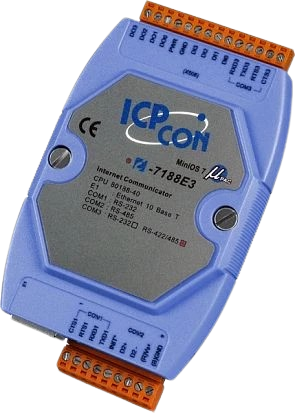
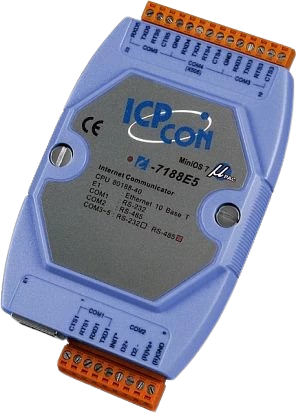
The I-7188E series from ICP DAS is a family of embedded Ethernet-to-serial device servers that bridge RS-232/422/485 communication to Ethernet networks. These compact modules are built on the ICP DAS MiniOS7 platform, combining a powerful communication processor with multiple serial ports, Ethernet connectivity, and programmable logic. They are designed for scenarios where legacy serial devices need to be integrated into Ethernet-based SCADA, DCS, or IIoT systems.
Each model in the I-7188E line offers different serial port configurations to suit application requirements:
- I-7188E1 / E2 / E3 / E4 / E5 / E8: Variants with 1, 2, 3, 4, 5, or 8 serial ports (RS-232/422/485 depending on the model).
- I-7188E3-232 / I-7188E5-485: Specialized versions supporting only RS-232 or only RS-485.
- All models feature built-in TCP/IP stack, Modbus/TCP support, and programming flexibility for custom automation logic.
- Benefits include watchdog timers, industrial-grade reliability, and DIN-rail mounting for easy installation in control panels.
These converters are widely deployed in factory automation, energy monitoring, building management systems, and distributed control applications—where robust and flexible serial-to-Ethernet bridging is required.
IPC2U Product Examples
- ICP DAS – I-7188E3
PC-compatible AMD188ES 40MHz Industrial Controller, 256kb Flash, 256kb SRAM, Ethernet, 1xRS232, 1xRS485, 1xRS422/485, 4DI&4DO, cable CA-0910x1 - ICP DAS – I-7188E5-485
PC-compatible AMD188ES 40MHz Industrial Controller, 256kb Flash, 256kb SRAM, Ethernet, 1xRS232, 4xRS485, cable CA-0910x1
Typical Applications
- Remote access to RS-232/485 controllers in process automation
- Integration of distributed sensors into Ethernet-based SCADA/DCS
- Multi-port serial data collection over Ethernet
- Reliable gateway solutions for building automation and utility monitoring
Sharer / Converter (tSH-700 Series)
| Model (Non-Isolated) | Model (Isolated) | RS-232 | RS-485 | Application |
|---|---|---|---|---|
| tSH-722 | tSH-722i | 2 | - | Converter |
| tSH-724 | tSH-724i | 1 | 1 | Converter |
| tSH-725 | tSH-725i | - | 2 | Converter |
| tSH-732 | tSH-732i | 3 | - | Sharer |
| tSH-734 | tSH-734i | 2 | 1 | Sharer |
| tSH-735 | tSH-735i | - | 3 | Sharer |
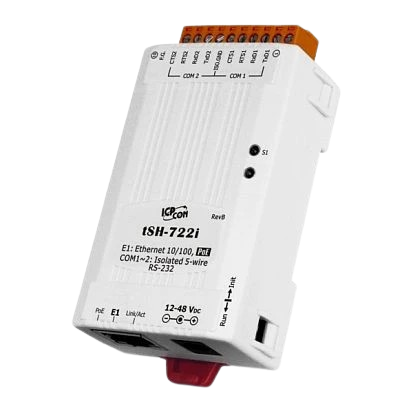
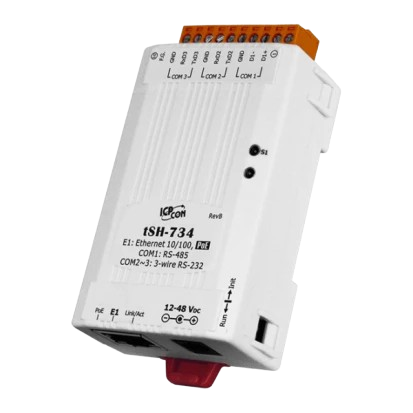
The Sharer / Converter product family from ICP DAS, specifically the tSH-700 series, provides intelligent solutions for sharing one serial device among multiple hosts or, conversely, allowing one host to control multiple serial devices. These modules are designed to reduce wiring complexity and increase flexibility in automation systems where several controllers need access to the same equipment or where one controller must communicate with multiple endpoints.
All models support RS-232/422/485 interfaces, and most include 3 kV isolation protection (in the “i” versions). The tSH-700 modules can operate in various modes, including:
With features such as web-based configuration, DIN-rail mounting, built-in watchdogs, and support for Modbus RTU/ASCII, these devices are widely applied in energy monitoring, building automation, and factory communication networks.
Product Examples
- ICP DAS – tSH-722i : Tiny Serial Port Sharer with PoE and 2 RS-232 Ports isolated
- ICP DAS – tSH-734 : Tiny Serial Port Sharer with PoE, 2 RS-232 and 1 RS-485 Ports
Typical Applications
- Connecting two SCADA systems to the same RS-485 energy meter for redundancy.
- Allowing multiple PLCs to access a single RS-232/422 sensor without rewiring.
- Broadcasting commands from one master to several distributed devices (e.g., building control units).
- Creating point-to-point transparent serial bridges over Ethernet in factory automation.
Addressable RS-485 to RS-232 Converter (I-752N Series)
| Model | CPU | SRAM | Flash | EEPROM | RTC | 7-Segment LED Display | RS-232 | RS-422 | RS-485 | RS-232/RS-485 | DI | DO | |
|---|---|---|---|---|---|---|---|---|---|---|---|---|---|
| I-7521 | 80188, 20 MHz | 512 KB | 512 KB | 2 KB | - | - | - | 1 (Note 4) | 1 (Note 6) | 2 | 3 | 3 | |
| I-7521D | Y | - | - | - | - | - | - | - | - | - | |||
| I-7522 | - | - | - | - | - | - | - | - | - | - | |||
| I-7522D | Y | - | - | - | - | - | - | - | - | - | |||
| I-7523 | - | - | - | - | - | - | - | - | - | - | |||
| I-7523D | Y | - | - | - | - | - | - | - | - | - | |||
| I-7522A | 80188, 40 MHz | 1 (Note 3) | 1 (Note 5) | 1 (Note 7) | Yes | 5 | 5 | - | - | - | |||
| I-7522AD | Y | - | - | - | - | - | - | - | - | ||||
| I-7524 | - | 1 | 1 | - | 1 | 1 | - | - | - | ||||
| I-7524D | Y | - | - | - | - | - | - | - | - | ||||
| I-7527 | - | - | - | - | - | - | - | - | - | ||||
| I-7527D | Y | - | - | - | - | - | - | - | - |
tM-752N Series
| Model | RS-232 | RS-485 | CPU | Ethernet | Baud Rate | COM1 | COM2 | COM3 |
|---|---|---|---|---|---|---|---|---|
| tM-7521 | 1 | 1 | 32-bit ARM | 10/100 Base-TX, PoE | 115200 bps | 2-wire RS-485 | 5-wire RS-232 | - |
| tM-7522 | 2 | 1 | 32-bit ARM | 10/100 Base-TX, PoE | 115200 bps | 2-wire RS-485 | 3-wire RS-232 | 3-wire RS-232 |
Overview
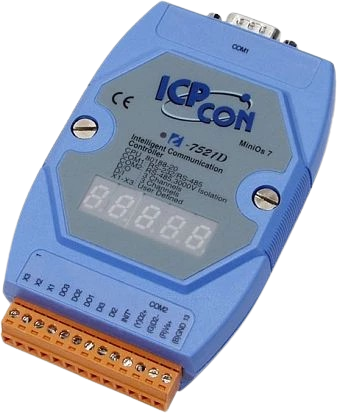
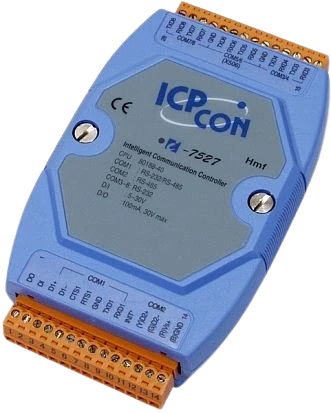
The I-752x series from ICP DAS provides addressable RS-485 to RS-232 converters, enabling multiple RS-232 devices to be connected and managed within a single RS-485 network. Each module is assigned a unique address, allowing the RS-485 master to selectively communicate with individual RS-232 devices. This architecture simplifies wiring, reduces cabling costs, and makes it possible to control and monitor many RS-232 devices remotely over long distances.
Key features across the series include:
- Address-based communication: each converter is recognized as an independent node on the RS-485 bus.
- Data direction control: automatic management of RS-485 transmission, ensuring smooth operation.
- LED indicators: clear status display for data transmission and errors.
- Wide selection of models: from basic (I-7521, I-7522) to enhanced versions with displays (I-7521D, I-7522D, I-7523D) or extended functions (I-7527, I-7527D).
- Industrial-grade design: isolation, watchdog timers, and DIN-rail mounting for robust deployment.
These converters are ideal for applications where numerous RS-232 devices (sensors, instruments, controllers) need to be integrated into a centralized RS-485 fieldbus for supervisory control, energy monitoring, and distributed automation systems.
Product Examples
- ICP DAS – I-7521D : Addressable RS-485 to RS-232/485 Converter, cable CA-0910Fx1
- ICP DAS – I-7527 : Addressable one RS-485 to one RS-232/485 and seven RS-232 Converter, cable CA-0910x1
Typical Applications
- Connecting multiple RS-232 devices (meters, sensors, terminals) to a single RS-485 network.
- Distributed control in building automation, energy management, and industrial process monitoring.
- Centralized SCADA systems requiring cost-effective RS-232 integration over long distances.
- Scenarios where address-based device management reduces wiring complexity and improves maintainability.
How helps this products to maintain signal integrity in serial networks?
These units regenerate weak signals and filter out electromagnetic interference, preventing data corruption during long-distance transmissions. By enabling stable multi-point configurations and providing port expansion, they ensure that critical monitoring data reaches the management system without loss or delay.