Introduction
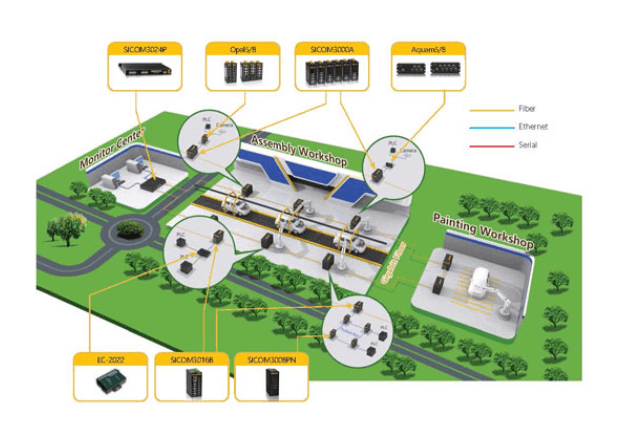
In modern automobile manufacturing, a finished vehicle is the result of multiple precisely coordinated processes — stamping, welding, painting, and final assembly. Automated production lines have largely replaced manual labor, with operators supervising the entire workflow from centralized monitoring centers.
This shift toward full automation places enormous demands on the underlying network infrastructure. Every second of unplanned downtime on a production line translates directly into financial loss, making network reliability, redundancy, and real-time visibility absolutely critical.
System Requirements
Deploying a robust industrial network in an automobile manufacturing environment requires meeting a specific set of operational and technical criteria:
- Reliable and stable network equipment to ensure uninterrupted monitoring and control of the entire manufacturing process
- Compact form factor to fit within the limited installation space typical of production line enclosures
- Redundant network architecture with fast failover recovery to minimize the impact of any single point of failure
- Industrial-grade design built to withstand the harsh conditions of a production line environment — vibration, dust, and temperature extremes
- Easy fault detection and status monitoring to enable rapid identification and resolution of device or network issues
- Broad device connectivity to support PLCs, IP cameras, SCADA terminals, and other production floor equipment
Why Industrial Ethernet for Automotive Production Lines
Traditional fieldbus systems can no longer keep pace with the bandwidth and real-time requirements of modern automobile production. Industrial Ethernet — with its deterministic communication, scalability, and seamless integration with IT systems — has become the backbone of choice for automotive OEMs and tier-1 suppliers worldwide.
Key advantages of Industrial Ethernet in this application include:
- High-speed, deterministic data transfer across all production zones
- Seamless convergence of OT (Operational Technology) and IT (Information Technology) networks
- Support for Time-Sensitive Networking (TSN) for ultra-precise motion and process synchronization
- Centralized and remote network management via standard protocols (SNMP, web-based GUI)
- Fast network recovery (<50 ms) using ring redundancy protocols such as RSTP and proprietary rapid ring technologies
Recommended Solution Features
- Industrial-grade Layer 2 managed switches — rackmount or DIN-Rail, fanless design, wide operating temperature range, high MTBF
- Support for Ethernet, serial, DI/DO access — enabling connectivity for legacy and modern devices in the same infrastructure
- Network redundancy with fast recovery <50 ms — supporting RSTP and ring topologies
- Centralized network management and remote diagnostics — reducing on-site maintenance effort
- Compact, rugged housing — suitable for panel-mount and cabinet installation in production environments
Typical Architecture
A well-designed automotive manufacturing network typically consists of three layers:
1. Field Layer
At the field level, industrial switches provide direct connectivity for PLCs, servo drives, vision inspection cameras, barcode readers, and robotic arm controllers along each production segment — stamping, body shop, paint shop, and general assembly.
2. Control & Aggregation Layer
Aggregation switches collect data from all field nodes and route it to the control systems and SCADA platform. Ring redundancy at this layer ensures that any single link or device failure does not interrupt production monitoring or control.
3. Management & MES Layer
At the top level, the industrial network connects to the Manufacturing Execution System (MES) and enterprise IT infrastructure, enabling real-time production data visibility, traceability, and quality management across the entire facility.
Recommended Products
IPC2U offers a comprehensive range of industrial Ethernet switches specifically suited for automotive manufacturing environments — DIN-Rail and rackmount formats, wide temperature ratings, redundant power inputs, and support for all major industrial redundancy protocols.
Recommended Product
- SICOM3000A — Layer 2 managed DIN-Rail switches, wide temperature -40...+75°C, redundant power, IEEE1588, IEC61850