In the context of the global transition to the digitalization of utilities, automated data collection systems have become the foundation for energy management. Automatic meter reading of water, gas, heat, and electricity consumption not only eliminates manual entry errors but also provides a rich dataset for predictive analytics and cost optimization.
The M-Bus (Meter-Bus) protocol, compliant with the European standard EN 13757, was specifically developed for remote reading of electricity, gas, and water consumption data. One of the advantages of this standard is the ability to transmit data while simultaneously powering slave devices.
To implement this engineering solution, various signal modulation methods are used:
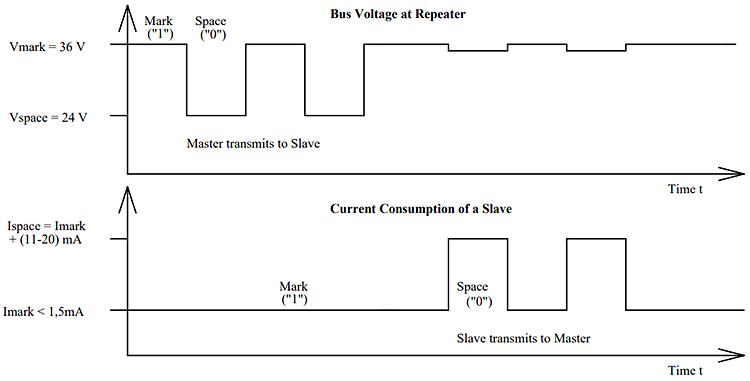
- To transmit a signal from the master to the slave, voltage level changes are used: a logical “1” (Mark) corresponds to the nominal voltage of 36 V, while a logical “0” (Space) corresponds to 24 V.
- The response from the slave device is encoded by modulating the current consumption. In this case, a logical “1” is represented by a constant standby current of up to 1.5 mA, while a logical “0” is indicated by increasing the current consumption by an additional 11–20 mA.
This combined approach allows for remote powering of slave devices over the same two-wire line used for data transmission. Since transmission is possible in only one direction at a time, the system operates in half-duplex mode. The use of significant voltage changes (12 V) and current changes (minimum 11 mA) ensures a high level of immunity to external electromagnetic interference.
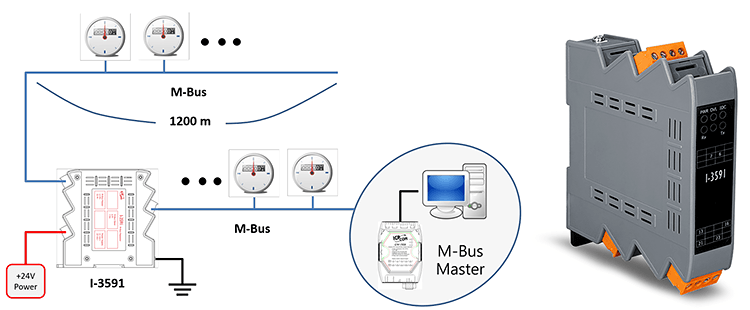
The standard M-Bus configuration supports connection of up to 250 devices, with a maximum distance between the master and a slave or repeater of 350 m. However, by reducing the communication speed, this distance can be extended up to 5 km. This can also be achieved by installing the I-3591 repeater, which not only extends the line up to 1,200 m (at speeds up to 2,400 bps) but also provides galvanic isolation up to 3,750 V and features short-circuit protection on the M-Bus.
The repeater allows up to 100 devices to be connected in an expandable segment. It also has an OVL (Over Voltage Level) indicator that signals network overloads on the M-Bus, enabling quick detection of issues on the bus without the need for specialized measuring equipment.
Despite all the advantages of the M-Bus, its adoption in supervisory control systems developed slowly due to the limited number of solutions based on it. However, over time, the number of devices supporting M-Bus has steadily increased. Today, it is implemented in solutions from well-known manufacturers such as Siemens, Schneider, ABB, Danfoss, Pulsar, and others.
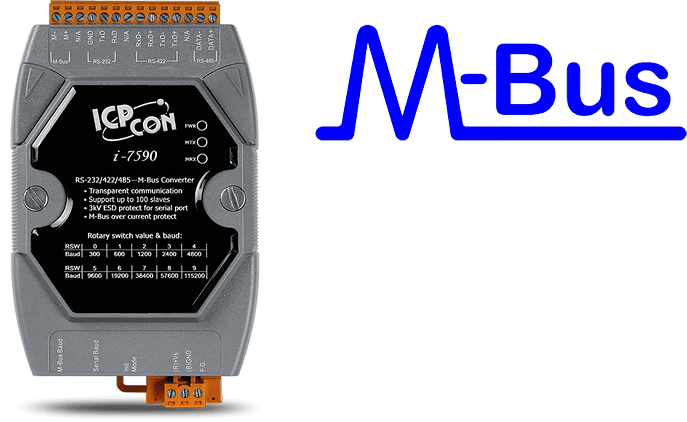
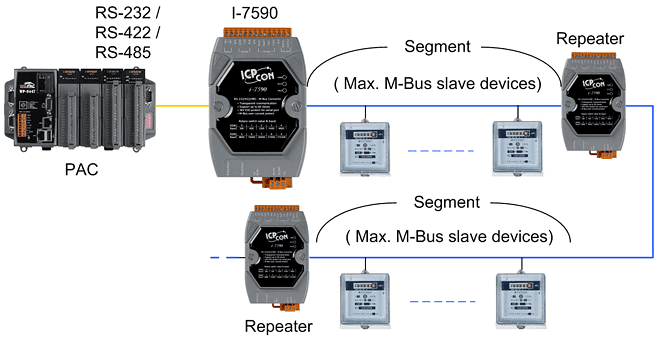
Metering and control systems often use controllers and PCs that do not have built-in M-Bus support. To address this issue, ICP DAS has released several devices and solutions. If a PLC or PC has an RS-232/422/485 interface, it is recommended to use the I-7590 converter for connection to the M-Bus. This simple device converts serial interfaces to M-Bus at the physical level without altering the data passing through it.
ICP DAS also offers M-Bus protocol gateways. While the I-7590 simply “passes through” bytes from one bus to another, the GW-7828 and GW-7838-M protocol gateways act as intelligent intermediaries. They take M-Bus protocol data—which has its own data structure, specific encoding, and variable frame lengths—and transform it into Modbus RTU/TCP frames familiar to all industrial systems.
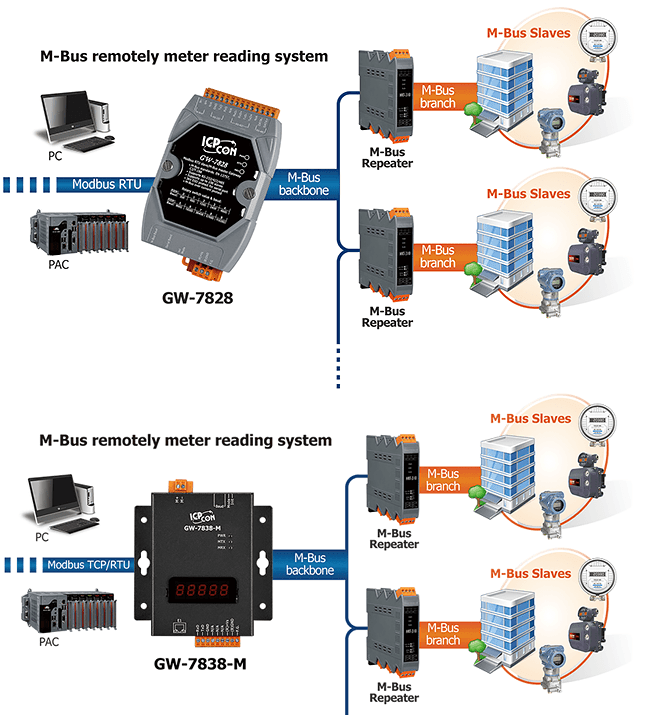
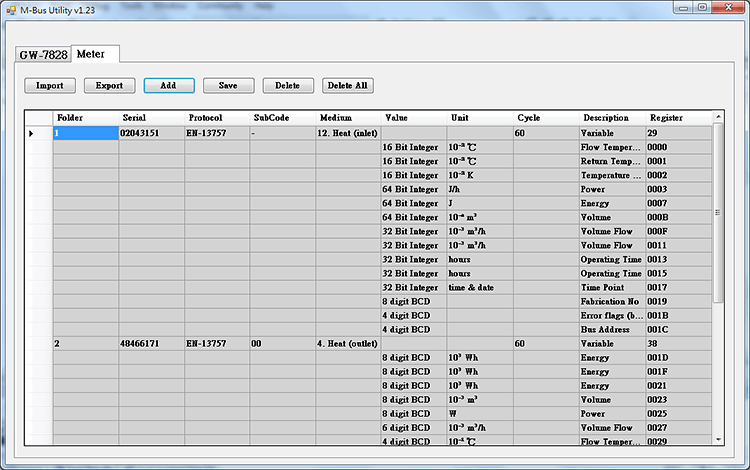
The GW-7828 operates as a slave device on the Modbus RTU side, receiving requests (function codes 0x03 and 0x04) from the master Modbus RTU controller. On the M-Bus side, it acts as a master, initiating polling of the connected meters. Configuration is performed using the M-Bus Utility software, which allows you to set up both the M-Bus and serial interfaces, as well as create a mapping table of data addresses that the gateway will request from the meters and store in its Modbus table.
The GM-7838-M gateway works in a similar way, with the exception that it has an Ethernet interface and supports the Modbus TCP protocol.
A brief summary of the ICP DAS solution:
- To extend the network – I-3591;
- To connect to a PC COM port – I-7590;
- If data is needed in a PLC via RS-485 – GW-7828;
- If data is needed in a SCADA/IT system via Ethernet – GW-7838-M.