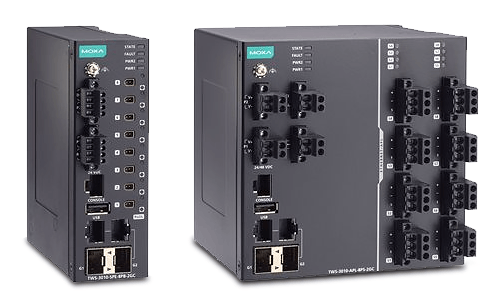
Moxa has launched two series of switches that support the modern 10BASE-T1L technology. This is an Ethernet physical layer standard developed specifically for industrial automation and field-level systems. It uses Single-pair Ethernet to transmit both data and power to remote devices over a single twisted pair. Thanks to its low data rate (10 Mbps), PAM3 modulation, and highly sensitive transceivers, the communication range can reach up to 1 kilometer — comparable to the RS-485 bus, but with significantly higher throughput. Before the introduction of the T1L standard, industrial systems had a clear separation between IT and OT layers: SCADA systems, modern PLCs, and operator panels relied on conventional Ethernet (typically 100 Mbps), while field devices, actuators, and sensors operated over industrial buses such as RS-485, HART, and Profibus. By introducing the TWS-3010 family of managed switches, Moxa proposed a solution that bridges the gap between the IT layer and field equipment.
The TWS-3010 product line is based on the IEEE 802.3cg (10BASE-T1L) standard and includes two specialized series: TWS-3010-SPE and TWS-3010-APL. Devices in both series feature eight T1L ports and two combo gigabit uplink ports (RJ45 and SFP). Their main purpose is to combine the high performance of gigabit backbone networks with the cost efficiency and simplicity of two-wire field connections. Although the TWS-3010-SPE and TWS-3010-APL switches belong to the same family of managed two-wire Ethernet devices, they are designed for different industrial automation ecosystems. The TWS-3010-SPE series is intended for general industrial applications of the technology, while the TWS-3010-APL series is specifically developed for process automation and for operation with Ethernet-APL (Advanced Physical Layer) field devices.
One of the key challenges in adopting Ethernet at the field level has always been integration with existing control systems. The TWS-3010 switches address this issue through native support for major industrial protocols, including PROFINET, EtherNet/IP, and Modbus TCP. This allows SCADA systems and PLCs to communicate directly with field devices and monitor the operational status of the switches themselves.
|
|
|
|
It is equipped with 8 × 10BASE-T1L ports with support for PoDL (Power over Data Line) Classes 10, 11, and 12, using compact IEC 63171-2 connectors. |
A version designed for process automation, offering 8 APL ports with support for Power Classes A and C. In these models, the connectors are implemented as 3-pin terminal blocks. The devices are fully compliant with the Ethernet-APL specification, which is critical for integrating field instruments into a unified IT/OT infrastructure. |
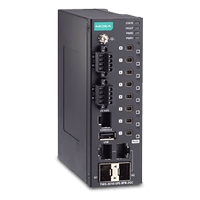
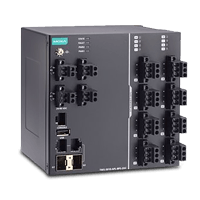
Both series are additionally equipped with two combo gigabit ports (SFP/RJ45) for integration into the enterprise backbone network.
Signal Quality Monitoring. Since T1L bus lines can span long distances and pass through areas with electromagnetic interference, the switches include signal quality monitoring features such as Signal-to-Noise Ratio (SNR) and Bit Error Rate (BER) analysis. These capabilities make it possible to detect cable degradation and other transmission issues in advance.
The PD Failure Check function monitors connected powered devices (PDs) via their IP addresses and automatically power-cycles the corresponding port if the device stops responding. Because T1L devices may be located up to a kilometer away from the switch, manually rebooting a frozen sensor can be labor-intensive. This feature allows the switch to independently “revive” a remote device by resetting power over the T1L line.
VLAN
In T1L networks, where a single cable may run hundreds of meters to a remote sensor, VLANs become a tool for logical isolation. They make it possible to separate control-system traffic, equipment condition monitoring data, and service/configuration channels. Given the limited bandwidth of T1L (10 Mbps), such segmentation prevents broadcast storms from affecting critical automation traffic.
Port Trunking
The TWS switches support port aggregation. For the switch uplink ports, link aggregation not only increases bandwidth to the central node but also creates a reliable redundant connection path. Since the TWS-3010 aggregates data from multiple low-speed T1L lines, a stable gigabit uplink ensures that information is not lost at the aggregation level.
Multicast and IGMP Snooping
Industrial protocols such as EtherNet/IP and PROFINET actively use multicast communication. At a speed of 10 Mbps, the risk of channel congestion caused by unnecessary traffic is extremely high. The IGMP Snooping function monitors device requests and forwards multicast packets only to those T1L ports where they are actually needed. This preserves bandwidth for the transmission of critical process data.
Network Redundancy (MRP, RSTP/STP, Turbo Ring/Chain)
In continuous-process industries such as petrochemical production and water treatment, where T1L technology may be deployed, communication reliability is critically important. Support for ring topologies and redundancy protocols ensures uninterrupted operation of field sensors even if one of the communication links is damaged.
Cybersecurity
Moxa places significant emphasis on the cybersecurity of its devices. With the transition to Ethernet at the field level, every field device becomes a potential entry point into the network. Security functions prevent unauthorized devices from connecting directly to field communication nodes. To implement this protection, the switches provide the following security mechanisms:
- Security management — administrators can enable or disable unused protocols and configure permitted ports.
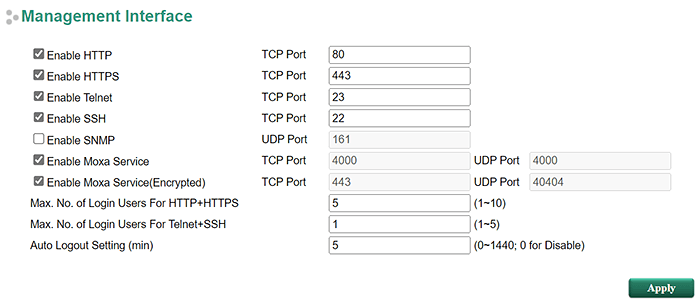
- Trusted access
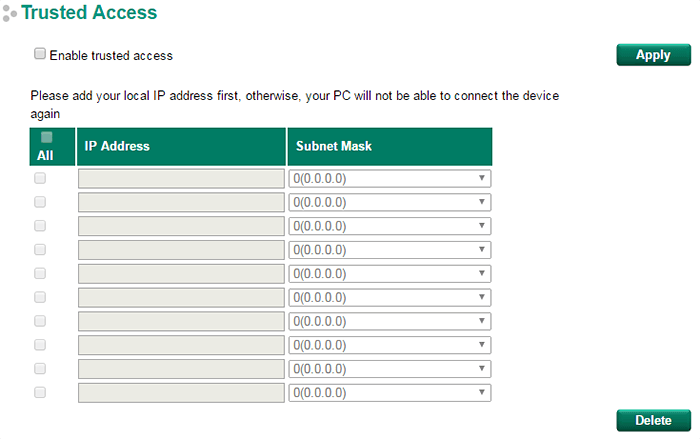
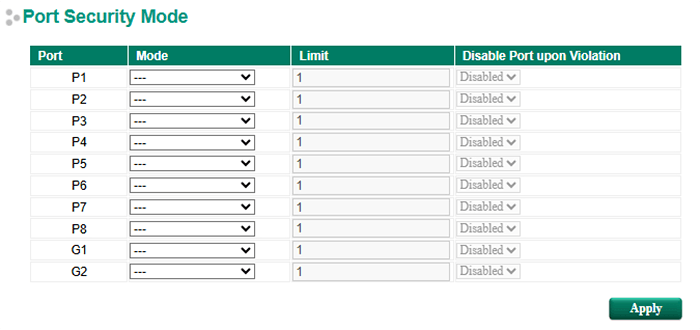
- Port security
- Authentication via RADIUS and TACACS+ enables centralized management of engineers’ access rights to switch configurations, eliminating the use of shared passwords and simplifying personnel activity auditing.
- Broadcast storm protection
- Secure management via HTTPS/SSL and SSH. All management traffic (whether through the web interface or command line) is encrypted, preventing password interception and configuration tampering within the enterprise network.
- Sticky MAC and Port Lock functions to prevent unauthorized access. Since T1L ports are located directly “in the field,” an attacker could attempt to disconnect a sensor and connect a laptop instead. The Sticky MAC function memorizes the address of the legitimate device and blocks the port if any unauthorized equipment is connected.
The TWS-3010 series provides a reliable foundation for digital transformation, enabling previously isolated automation segments to be integrated into a unified, manageable, and secure infrastructure.