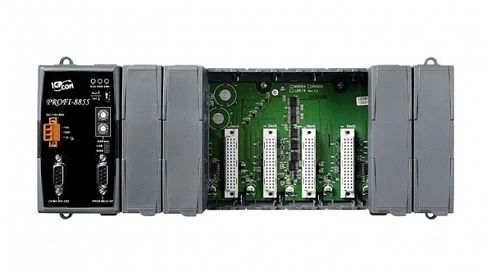
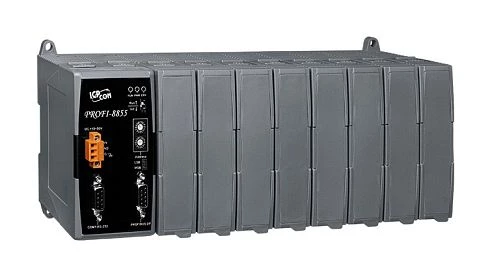
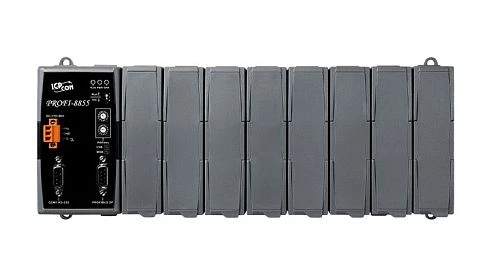
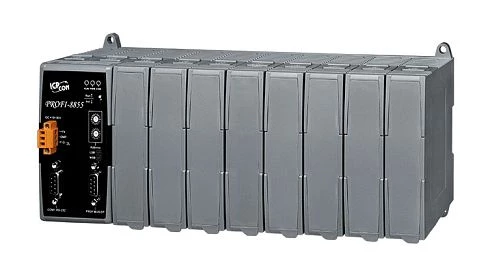
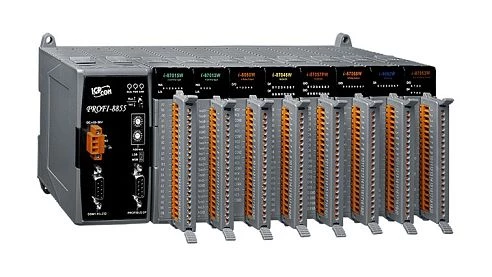
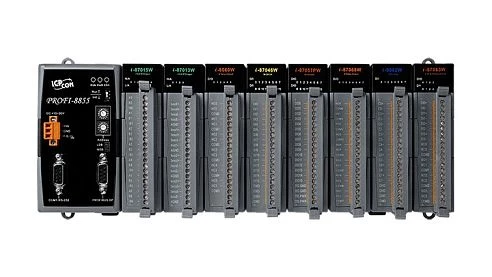
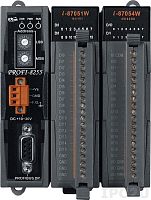
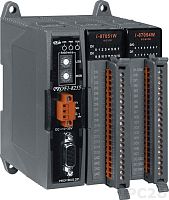
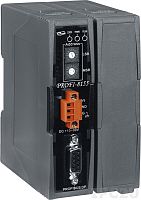
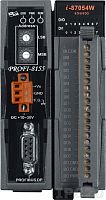
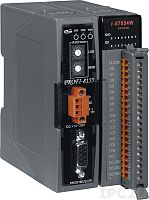
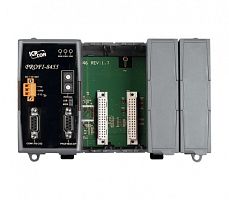
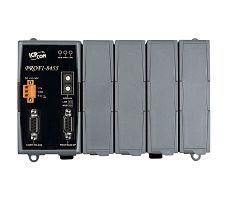
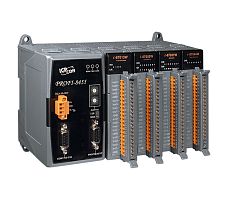
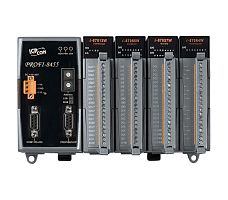
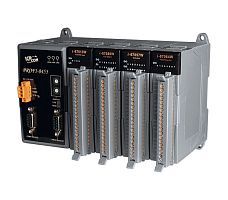
PROFI-8855
The PROFI-8855 is configured exclusively through the GSD file supplied by ICP DAS — the standard PROFIBUS device description file used by all compliant configuration environments including STEP 7, TIA Portal and Sycon.net. There are no proprietary configuration utilities or additional software licences required. The PROFIBUS interface provides 3000 VDC DC-to-DC isolation and 2500 Vrms bus-to-logic isolation, backed by 4 kV class A ESD protection on all terminals, making the PROFI-8855 suitable for installation in electrically noisy industrial environments where fieldbus isolation is a critical design requirement.
Key Features
- 8 Expansion Slots — Full I-8k and I-87k Module Compatibility: All eight slots accept ICP DAS I-8k parallel-bus I/O modules and both Low Profile and High Profile variants of the I-87k serial-bus I/O module family, covering the complete ICP DAS catalogue of digital input, digital output, analogue input, analogue output, counter/frequency measurement and motion control modules; each slot is independently configurable, allowing a single PROFI-8855 to serve as a mixed-signal remote I/O node without requiring separate digital and analogue slave units
- PROFIBUS DP-V0 Slave — Auto-Detect 9.6 kbps to 12 Mbps: The Profichip VPC3+C PROFIBUS controller and ADI ADM2486 transceiver implement DP-V0 slave operation with automatic baud rate detection across all standard PROFIBUS rates; the unit connects to a Siemens S7-300/400/1200/1500 PLC as a standard GSD-configured slave without hardware configuration changes; cable distance extends to 1200 m per segment at 9.6 kbps and 100 m at 12 Mbps per PROFIBUS EN 50170 cable length tables
- Hot-Swap with Automatic Reconfiguration for I-87k High Profile Modules: I-87k High Profile I/O modules can be inserted and removed from any slot whilst the PROFI-8855 remains on the PROFIBUS network; on module removal, a diagnostic message is reported to the DP master; on reinsertion, the PROFI-8855 automatically reconfigures the I/O object mapping for that slot without requiring a master reconfiguration cycle — enabling I/O module replacement and maintenance in running production lines without network shutdown
- GSD File Configuration — Compatible with All PROFIBUS Engineering Tools: Network integration requires only the ICP DAS GSD file loaded into the PROFIBUS configuration environment; the GSD file defines all available I/O module slot combinations, parameter options and diagnostic structures; no ICP DAS proprietary software, dongle or runtime licence is required — the PROFI-8855 integrates into existing Siemens STEP 7 and TIA Portal projects, Schneider Electric Unity Pro setups and any other IEC 61158-compliant PROFIBUS engineering tool
- 3000 VDC Isolation and 4 kV ESD Protection: The PROFIBUS interface provides 3000 VDC isolation on the DC-to-DC power converter and 2500 Vrms bus-to-logic isolation, breaking ground loops between fieldbus cabling and the local I/O power domain; 4 kV class A ESD protection on every terminal protects against electrostatic discharge events from field wiring and connector handling in industrial panel environments; reverse polarity protection and over-voltage brown-out protection are included on the power input
- Device-Related and Channel-Related PROFIBUS Diagnostics: The PROFI-8855 supports both Device-Related Diagnostics (reporting unit-level faults to the DP master) and Channel-Related Diagnostics (identifying the specific I/O module slot and channel that generated a fault condition); diagnostic data is transmitted in the PROFIBUS diagnostic telegram to the master on each occurrence, enabling fault localisation in SCADA and PLC alarm management systems without polling or additional diagnostic wiring
- Dual Watchdog and Address 0–126 via Rotary Switches or SSA-Telegram: An onboard hardware watchdog IC and a CPU-integrated watchdog provide two independent recovery mechanisms against firmware hangs or CPU lockup; PROFIBUS slave address is set via onboard rotary switches for fixed-address installations, or via SSA-Telegram (Set Slave Address) for software-assigned addressing in multi-master and flexible-topology networks; address range 0–126 covers the full PROFIBUS DP addressing space
- Wide Operating Range — −25°C to +75°C, DIN-Rail or Wall Mount: The PROFI-8855 operates from −25°C to +75°C on an unregulated +10 to +30 VDC supply at 5.5 W total consumption; the 312 × 91 × 132 mm chassis mounts on standard 35 mm DIN-rail or directly to a wall or panel surface; the RS-232 UART port supports firmware updates in the field without removing the unit from the installation
Application Use Cases
Siemens SIMATIC PROFIBUS Distributed I/O
The PROFI-8855 integrates directly into Siemens SIMATIC PROFIBUS DP networks as a standard GSD-configured slave alongside Siemens ET 200 and third-party remote I/O stations. Using STEP 7 or TIA Portal, the engineer loads the ICP DAS GSD file, selects I/O modules from the slot configuration window and assigns process addresses — the same workflow used for any PROFIBUS slave. This allows the PROFI-8855 to be added to existing Siemens S7-300, S7-400 or S7-1500 networks without commissioning overhead or PLC software changes outside the hardware configuration block, providing a cost-effective route to expanding I/O point count on established PROFIBUS installations.
Flexible Mixed-Signal Remote I/O for Machine Automation
Machine builders requiring custom combinations of digital and analogue I/O per machine zone configure each PROFI-8855 with a specific mix of I-8k and I-87k modules to match the signal types at that location — digital inputs from limit switches and proximity sensors in slots 1–4, analogue inputs from pressure and temperature transducers in slots 5–6, and digital outputs to solenoid valves and relay modules in slots 7–8, for example. A single PROFI-8855 replaces what would otherwise require multiple separate PROFIBUS slaves for digital and analogue channels, reducing node count on the PROFIBUS segment and simplifying GSD configuration management.
Process Industry Remote I/O over Long Cable Runs
In process plants where field instruments are located hundreds of metres from the control room, the PROFI-8855 operates at 9.6 kbps or 19.2 kbps to extend PROFIBUS cable segments up to 1200 m per segment using standard PROFIBUS Type A shielded twisted-pair cable. The 3000 VDC isolation on the PROFIBUS port breaks the ground potential difference that commonly exists between control room and field equipment earthing systems, preventing common-mode interference and ground loop currents from corrupting fieldbus communication in large plant environments.
Hot-Swap I/O Maintenance in 24/7 Production Lines
Manufacturing lines that cannot tolerate network shutdowns for I/O module replacement benefit from the PROFI-8855's hot-swap capability on I-87k High Profile modules. A maintenance technician replaces a faulty analogue input module in the field slot whilst the PROFI-8855 remains live on the PROFIBUS segment; the unit sends a diagnostic telegram to the DP master upon module removal and re-establishes I/O object mapping automatically when the replacement module is inserted. The DP master detects the reconfiguration event in the diagnostic data and resumes cyclic data exchange without operator intervention at the PLC or SCADA console.
Multi-Drop PROFIBUS Networks with Mixed I/O Architecture
Large automation systems with dozens of PROFIBUS nodes use the PROFI-8855 at locations where high I/O density per slave is required. With 8 slots accommodating up to 64 or more I/O points per module (depending on the selected I/O module type), a single PROFI-8855 can represent a high-channel-count node on the PROFIBUS segment, reducing total slave count and the corresponding address allocation, GSD management overhead and field wiring complexity compared to deploying multiple smaller remote I/O units at the same location.
Why Choose the PROFI-8855
GSD-Only Integration — No Proprietary Software, No Additional Licences
PROFIBUS networks in most industrial facilities are engineered and maintained in Siemens STEP 7 or TIA Portal. The PROFI-8855 slots into this workflow without friction: the GSD file is loaded once into the hardware catalogue, and from that point the PROFI-8855 is configured identically to any other PROFIBUS slave — module slot assignment, process address mapping and parameter setting all within the standard PROFIBUS configuration interface. There are no ICP DAS runtime licences, no vendor-specific programming environments and no additional commissioning steps beyond what the PROFIBUS standard already defines. For engineering teams maintaining large PROFIBUS projects, this means the PROFI-8855 adds no workflow overhead.
Hot-Swap Auto-Reconfiguration Reduces Planned Downtime to Zero
Conventional PROFIBUS remote I/O units require the DP master to be placed in STOP mode — halting all cyclic I/O exchange on the segment — before an I/O module can be replaced. The PROFI-8855 eliminates this requirement for I-87k High Profile modules: the unit manages the slot reconfiguration internally and notifies the master through standard diagnostic channels, allowing the master to remain in RUN mode throughout. For production environments where stopping a PROFIBUS segment means halting a conveyor, a press line or a filling machine, this capability directly translates to reduced planned maintenance windows and higher overall equipment effectiveness.
Wide I/O Module Ecosystem — One Platform for Every Signal Type
The ICP DAS I-8k and I-87k module families cover over 100 distinct I/O module types spanning 8-bit to 32-channel digital I/O, ±10 V and 4–20 mA analogue I/O, thermocouple and RTD temperature inputs, pulse/frequency counter inputs, PWM outputs and communication modules. The PROFI-8855 accepts all of these across its eight slots, making it a single hardware platform for remote I/O expansion regardless of the signal types required at the installation point. System integrators specifying automation systems across multiple machine types and process areas can standardise on one remote I/O chassis and vary only the inserted modules per application, reducing spare parts inventory and technician training requirements.
Frequently Asked Questions
Is the PROFI-8855 compatible with Siemens SIMATIC S7 PLCs?
Yes. The PROFI-8855 operates as a PROFIBUS DP-V0 slave and integrates into any PROFIBUS DP network with a compliant Class-1 DP master, including Siemens SIMATIC S7-300, S7-400, S7-1200 and S7-1500 PLCs. Configuration is performed in STEP 7 or TIA Portal using the ICP DAS GSD file, following the standard PROFIBUS slave integration procedure without any additional steps or proprietary software.
Which I/O modules are compatible with the PROFI-8855?
The PROFI-8855 supports ICP DAS I-8k series parallel-bus I/O modules, I-87k Low Profile series modules, and I-87k High Profile series modules across all eight expansion slots. All three module families cover digital input, digital output, analogue input, analogue output, counter/frequency and specialist communication module types. Hot-swap functionality applies to I-87k High Profile series modules only; I-8k and I-87k Low Profile modules require the unit to be powered off before insertion or removal.
What is the maximum PROFIBUS cable length supported by the PROFI-8855?
Cable length per PROFIBUS segment depends on baud rate. At 9.6 kbps, the maximum segment length is 1200 m using PROFIBUS Type A cable. At 1.5 Mbps the limit is 200 m, and at 12 Mbps it reduces to 100 m. If more than 32 nodes are connected or if cable distance exceeds the per-segment limit, a PROFIBUS repeater is required to extend the segment.
How does hot-swap work on the PROFI-8855 in a running PROFIBUS network?
When an I-87k High Profile module is removed from a slot, the PROFI-8855 sends a diagnostic message to the DP master reporting the module loss. When a replacement module is inserted, the PROFI-8855 automatically re-maps the I/O objects for that slot and resumes cyclic data exchange with the master. The DP master remains in RUN mode throughout — no network stop or master reconfiguration is required, making module replacement possible without interrupting other nodes on the PROFIBUS segment.
What is the difference between the PROFI-8855 and the PROFI-8855 CR?
The PROFI-8855 CR is the RoHS-compliant variant of the PROFI-8855. Both models are functionally and electrically identical — same hardware specifications, same PROFIBUS interface, same I/O module compatibility and same operating temperature range. The CR designation indicates that the PROFI-8855 CR is manufactured using RoHS-compliant materials, as required for CE marking and equipment supplied to the European market under the RoHS Directive.
Get a Quote