What is a PoE++ Industrial Media Converter?
A PoE++ industrial media converter is a high-performance device that converts Ethernet signals between copper and fiber while delivering high-power PoE++ (IEEE 802.3bt) up to 90W or 95W. The Leonton MBG2-0201-SFP-24-T is an example, designed to power demanding equipment like high-power PTZ cameras, industrial IoT sensors, or 5G access points, especially in remote locations like pipeline infrastructure.
Industrial environments require stable, long-distance, and intelligent Ethernet transmission solutions. Leonton’s MPT2-0201-M and MBG2-0201-SFP-24-T exemplify this philosophy — delivering fiber-optic connectivity, PoE power delivery, and remote management capabilities for demanding applications such as transportation systems, tunnel surveillance, oil and gas infrastructure, and smart manufacturing.
MPT2-0201-M — Industrial PoE+ Media Converter
Overview
The MPT2-0201-M is a rugged industrial PoE+ (IEEE 802.3at) media converter that transforms Ethernet signals between copper and fiber media. Designed for applications such as IP camera networks, traffic control systems, and long-distance fiber deployments, it combines PoE power delivery, Link Fault Pass-through (LFP), and redundant power input in a compact DIN-rail enclosure.
What Are the Key Advantages of Industrial PoE Media Converters?
The key advantages are their ability to deliver stable, long-distance Ethernet transmission while simultaneously providing Power over Ethernet (PoE) to remote devices. Converters like the Leonton MPT2-0201-M transform copper signals to fiber, enabling distances up to 20 km, and support redundant power input and Link Fault Pass-through (LFP) for superior reliability in harsh industrial and transportation systems.
Key Features
- PoE+ Output (30W) — Provides power directly over Ethernet for cameras, access points, or controllers.
- Fiber Connectivity — Supports single-mode fiber for up to 20 km transmission.
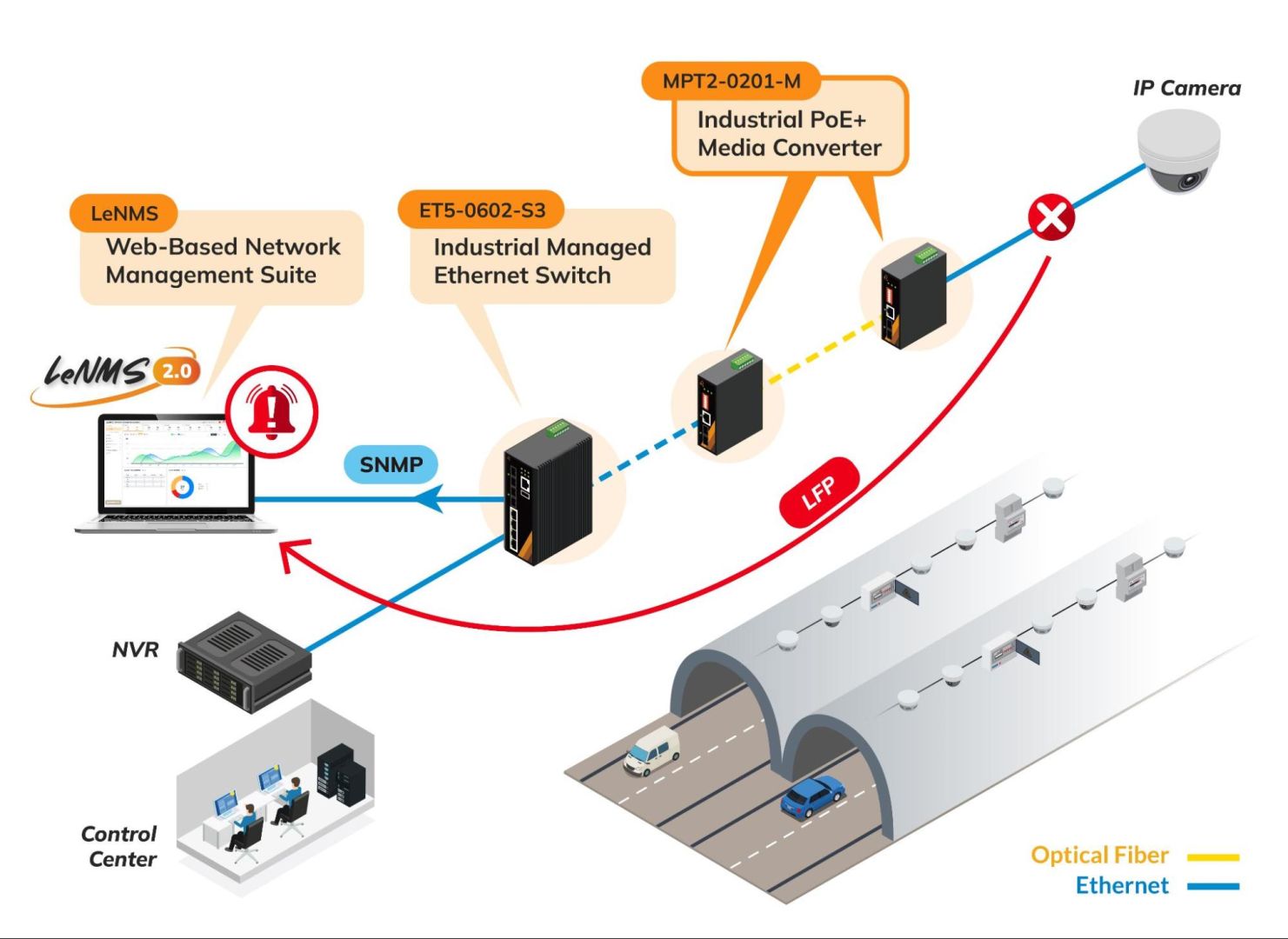
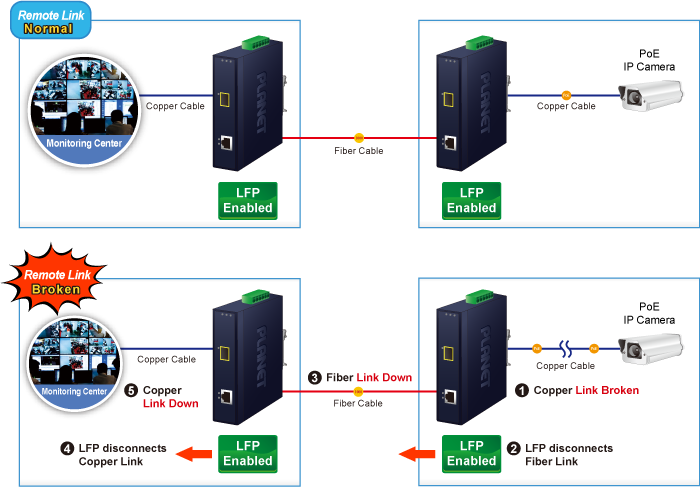
- LFP (Link Fault Pass-Through) — Ensures instant alarm signaling upon link failure, improving network reliability.
- Dual Power Input (12–57 V DC) — Guarantees redundancy and uninterrupted operation.
- Industrial Design — Withstands temperatures from -40 °C to 75 °C and vibration, ensuring long-term stability in harsh environments.
Use Case Example
If installed in a tunnel surveillance system, the MPT2-0201-M could enable long-distance IP camera connections through optical fiber, providing PoE power, real-time fault alerts, and uninterrupted operation via redundant power inputs. The device is able to minimize installation costs by eliminating the need for separate power infrastructure while improving reliability for 24/7 monitoring.
Advantages
- Long-distance connectivity via fiber
- Reduced maintenance through LFP fault signaling
- PoE+ simplifies installation and power delivery
- Dual power input ensures uptime
Limitations
- Single Ethernet port may limit scaling without an external switch
- Basic management functions compared to fully managed switches
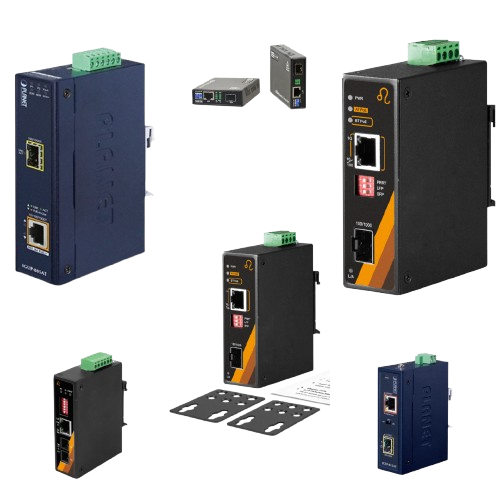
MBG2-0201-SFP-24-T — 802.3bt PoE++ Media Converter
Overview
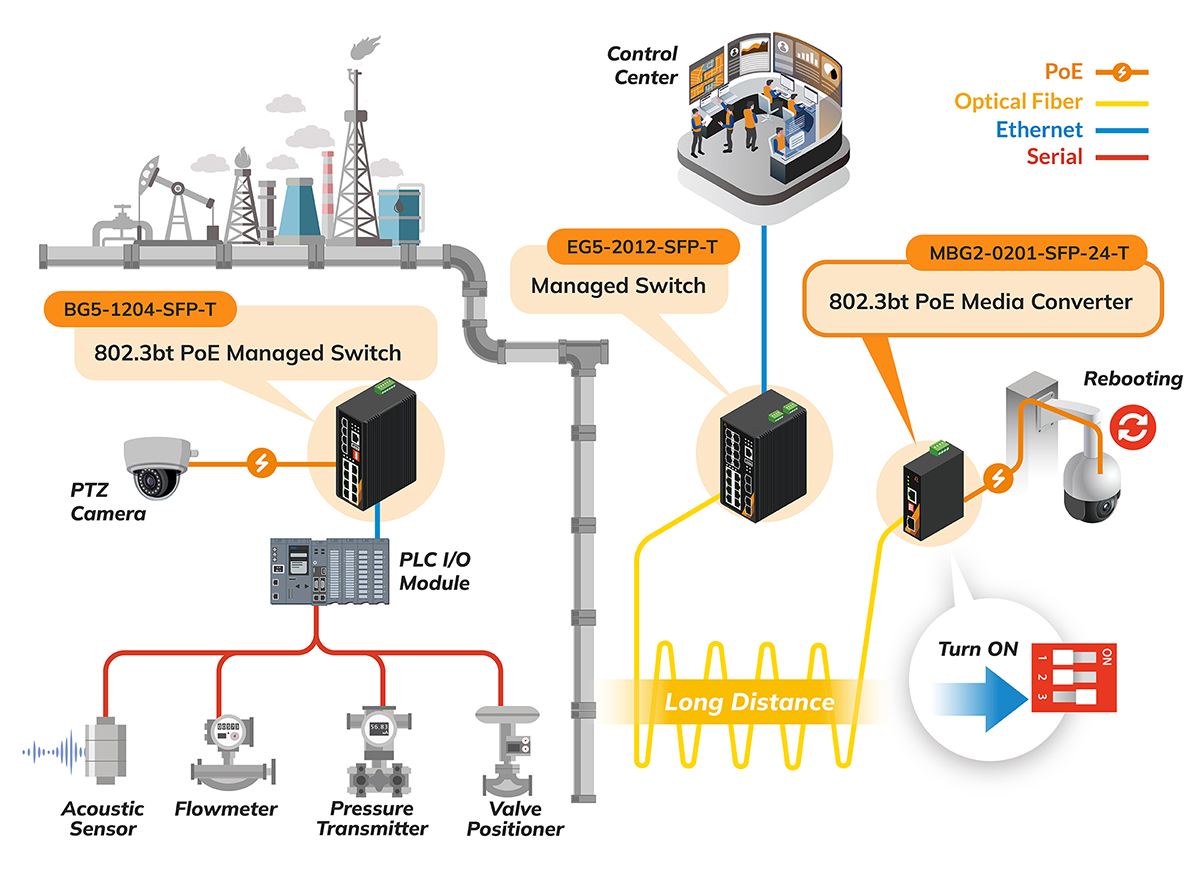
The MBG2-0201-SFP-24-T is Leonton’s high-performance 802.3bt PoE++ fiber media converter supporting up to 90 W output power — perfect for high-power PTZ cameras, wireless access points, and industrial IoT devices in remote locations. It also introduces PRRT (Patented Remote Reset Technology), enabling remote device rebooting and maintenance over long distances.
Key Features
- High-Power 802.3bt PoE++ (up to 90 W) — Sufficient to power advanced PTZ cameras or industrial sensors.
- SFP Fiber Uplink — Extends Ethernet connectivity beyond 10 km for long-distance installations.
- PRRT (Remote Reset Technology) — Allows remote device reboot without physical intervention, reducing downtime.
- G.8032 ERPS Redundancy — Provides sub-50 ms failover for ring-network resilience.
- Wide Temperature Range — Operational stability between -40 °C and 75 °C.
- DIN-rail, IP30 Housing — Robust mechanical construction for industrial deployment.
Use Case Example
If utilized in a pipeline process instrumentation project, MBG2-0201-SFP-24-T converters could supply power to PTZ cameras and PLC I/O modules via 90 W PoE while transmitting data over SFP fiber. The remote reset feature aimed to eliminate costly field maintenance, and ERPS redundancy helps maintain continuous operation even during link interruptions.
Advantages
- 90 W PoE++ supports high-power industrial and security equipment
- PRRT enables fast remote troubleshooting
- ERPS ring topology ensures network redundancy
- Rugged and temperature-resistant for extreme environments
Limitations
- Slightly higher cost compared to standard PoE converters
- Requires proper configuration of PRRT for reliable operation in mixed-vendor environments
Leonton’s Competitive Edge
According to performance evaluations, Leonton’s products consistently demonstrate:
- RMA rate < 0.25%, proving exceptional reliability
- 100% burn-in testing and full international certifications
- 5-year warranty for long-term assurance
- Fast customization options and short lead times
- Patented PoE technologies enabling energy efficiency and smart power management
These characteristics distinguish Leonton from many general-purpose manufacturers, making their converters ideal for integrators and system designers seeking industrial-grade reliability and scalable network solutions.
Conclusion
Both the MPT2-0201-M and MBG2-0201-SFP-24-T stand out as high-reliability PoE media converters designed to handle the challenges of modern industrial networks.
The MPT2-0201-M is ideal for compact, long-distance deployments requiring basic management and redundancy.
The MBG2-0201-SFP-24-T suits advanced surveillance and automation environments that demand remote maintenance, redundancy, and high-power PoE++ output.
Together, they reflect Leonton’s commitment to innovation, quality, and operational resilience in industrial networking.
MEG2-0201-SFP — Industrial Gigabit Media Converter
Overview
The MEG2-0201-SFP is a high-performance industrial media converter designed to bridge copper Ethernet and fiber networks in harsh environments. It offers 1 × 10/100/1000Base-T(X) copper port and 1 × 100/1000Base-X SFP slot, supporting full Gigabit speeds, redundant power inputs, Link Fault Pass-Through (LFP), and robust, wide-temperature operation. Source: Leonton product details page
Key Specifications & Features
Ports:
- 1 × RJ45 copper (10/100/1000Base-TX, auto negotiation, full/half duplex)
- 1 × SFP slot (100/1000Base-X) for fiber uplink, modular fiber modules supported
Link Fault Pass-Through (LFP)
- Supports LFP — when one side’s link fails, the fault is echoed/propagated to the other side, aiding diagnostics and network resiliency
Redundant Power Input
- Dual 12–48 V DC power inputs with reverse polarity protection, overload protection (slow-blow fuse)
Power Consumption
- Approximately 1.8 W in idle operation (without heavy load)
Operating Temperature
- Standard: –10 °C to +70 °C
- Extended Option (“-T” version): –40 °C to +80 °C
Jumbo Frame, MAC Table, Switching Fabric
- Switching fabric: 4 Gbps
- Memory buffer: 1 Mbit
- Jumbo frame support: up to 10 KB
- MAC table size: 8K entries
Mechanical & Environmental
- Metal housing with IP30 rating, DIN-rail and wall mounting options
- Dimensions: 26 × 95 × 75 mm
- Storage: –40 °C to +85 °C, humidity 5–95% non-condensing
Certifications & Reliability
- Compliant with EMC, ESD, surge, EFT, etc. standards.
- MTBF specification, 5-year warranty from Leonton
Use Cases
- Gigabit fiber backbone to remote devices in industrial settings
- Extending network segments across fiber for control rooms or substations
- Connecting network cabinets via fiber while preserving copper interface at endpoints
- Environments needing dependable fiber links with fault detection + redundant powering
Pros & Strengths
- Full Gigabit throughput on both copper and fiber sides
- Low power consumption (1.8 W) — highly efficient
- Robust redundancy with dual power inputs, reverse polarity protection
- LFP support helps early detection and network fault management
- Extended temperature support (–40 to +80 °C for -T model) for outdoor/industrial use
- Compact industrial package, IP30, DIN-rail/wall mountable
Cons & Limitations
- No PoE — cannot supply power to downstream devices; purely a data converter
- Unmanaged — lacks VLAN, QoS, SNMP, or advanced switching features
- Single-conversion device — only one copper and one fiber port
- In standard model, temperature range limited to –10 to +70 °C unless using the “-T” variant
- For high-traffic sites, buffer or MAC table may be limiting
Summary
The MEG2-0201-SFP is a versatile, efficient, and resilient industrial media converter aimed at bridging Gigabit copper and fiber networks in harsh environments. Its standout features are low power draw, redundancy, and diagnostic support (LFP), all packaged in a compact industrial housing.
For scenarios requiring PoE power delivery, you’d want a different model (e.g. Leonton’s PoE or PoE++ converters). But where data conversion, fiber reach, and reliability matter above all else, MEG2-0201-SFP is an excellent choice.
Planet IGTP-815AT, IGUP-805AT and IGT-805AT: Industrial PoE Media Converters for High-Demand Networks
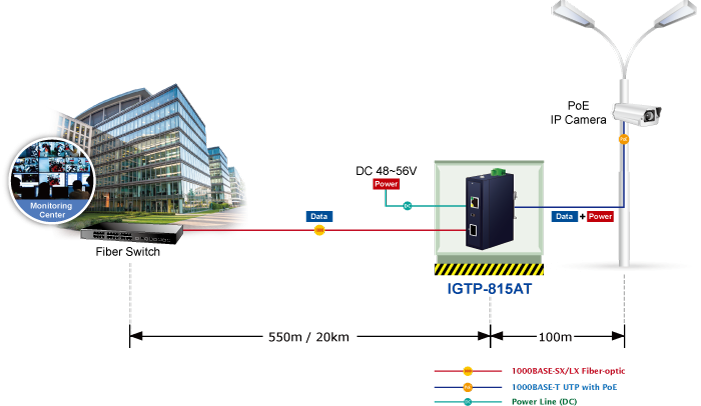
In modern industrial networking, media converters that provide power (PoE) over Ethernet lines, while supporting fiber-optic uplinks, become crucial building blocks. Planet’s IGTP-815AT and IGUP-805AT are two standout models engineered for exactly this role—offering dependable data transmission, power delivery, and resilience under harsh environments.
Planet IGTP-815AT — Industrial PoE+ Fiber Media Converter
Overview
The Planet IGTP-815AT is a rugged media converter that connects fiber to copper Ethernet while delivering PoE+ (IEEE 802.3at) power to downstream devices such as IP cameras, access points, or sensors. It is built for industrial settings—capable of operating in extreme temperatures between -40 °C and +75 °C.
Key Specifications & Features
- Fiber ↔ copper conversion: 1 × SFP port (100/1000Base-X) to 1 × RJ45 (10/100/1000Base-T)
- PoE+ (IEEE 802.3at) support: power output up to 36 W to the powered device
- Power input: 48–56 V DC, with protection against reverse polarity
- Operating temperature: -40 °C to +75 °C
- Link Fault Pass-Through (LFP) support, configurable via DIP switches
- Enhanced EMC/ESD protection: e.g. 6 kV contact discharge, 8 kV air
- Industrial housing (IP30), DIN-rail mountable
Use Case
Deploy IGTP-815AT when you need to power an IP camera or PoE endpoint over fiber distance, eliminating the requirement for local power sources. Ideal in surveillance systems, transit installations, or remote site automation.
Advantages
- Combines fiber media conversion and PoE+ in one device
- Wide operational temperature range for outdoor and industrial environments
- LFP ensures prompt detection of fiber link failures
- Robust protection from ESD and power surges
- Compact, DIN-rail friendly form factor
Disadvantages
- PoE+ output (36 W) may not suffice for devices requiring PoE++ (60–90 W)
- Single data and power path—no built-in redundancy or multiple PoE ports
- Lacks advanced switching features (VLAN, QoS) — focuses solely on conversion
Planet IGUP-805AT — Industrial PoE++ Media Converter
Overview
The Planet IGUP-805AT elevates the concept with PoE++ (IEEE 802.3bt) support—delivering high power over Ethernet to demanding devices like PTZ cameras, high-end wireless radios, or IoT gateways. It combines fiber uplink, strong power delivery, and robust industrial design.
Key Specifications & Features
- 1 × SFP (100/1000Base-X) ↔ 1 × RJ45 (10/100/1000Base-T) conversion
- PoE++ (802.3bt) output capacity: up to 95 W (in “bt” mode)
- Alternate “Legacy / Force” mode for compatibility or 60 W fallback
- Power input: 12–54 V DC, with dual/backup input for redundancy
- Operating temperature: -40 °C to +75 °C
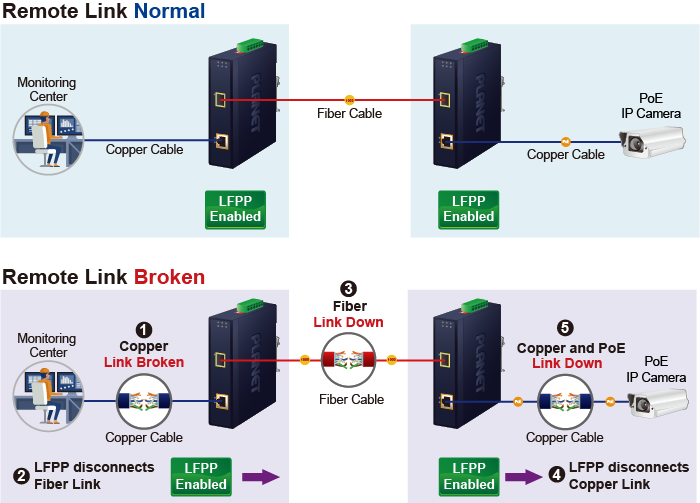
- LFPP (Link Fault Pass-through PoE) — disables PoE when fiber link is down
- Industrial design suited for DIN-rail mounting
Use Case
Use IGUP-805AT where you need to power high-demand devices (like PTZ cameras, large wireless access points) at remote locations via fiber. The remote reset ability and power capacity make it ideal for distributed surveillance or critical infrastructure.
Advantages
- High-power PoE++ capability (up to 95 W)
- Wide DC input range and redundancy support
- LFPP function keeps PoE off when fiber link fails, protecting devices
- Industrial-graded temperature range and enclosure
- Fits seamlessly into fiber-powered network designs
Disadvantages
- In “Force” mode the power is limited (often ~60 W)
- Higher internal power consumption under full load
- Again, lacks advanced switching or layer-2 features — purely media conversion
Comparison & Deployment Guidance
| Model | PoE Standard / Power | Role | Strengths | Limitations |
|---|---|---|---|---|
| IGTP-815AT | PoE+ (36 W) | Standard PoE media converter | Balanced for many devices, robust | Not suitable for PoE++ demands |
| IGUP-805AT | PoE++ (up to 95 W) | High-power PoE media converter | Drives heavy-load devices, LFPP | More expensive, higher energy draw |
Conclusion
Planet’s IGTP-815AT and IGUP-805AT are excellent choices for bridging fiber connectivity and powering devices via Ethernet in industrial settings. IGTP-815AT is ideal when 30–36 W PoE power suffices, offering a robust and compact solution. IGUP-805AT steps up to power-hungry devices, bringing PoE++ capability and redundant power handling while maintaining industrial durability.
Planet IGT-805AT — Industrial Gigabit Ethernet Converter
Overview
The Planet IGT-805AT is an industrial-grade Gigabit media converter designed to extend Ethernet connectivity over long distances through fiber-optic links. It features one 10/100/1000BASE-T RJ45 copper port and one 100/1000BASE-X SFP fiber interface, housed in a rugged IP30-rated metal case with redundant power inputs. Operating flawlessly from –40 °C to +75 °C, it is built for mission-critical applications like surveillance, automation, and industrial networking.
Key Features
- Interface: 1 × RJ45 10/100/1000BASE-T (auto-negotiation, auto MDI/MDI-X) & 1 × SFP slot (supports 100BASE-FX or 1000BASE-SX/LX modules)
- Data Performance: Non-blocking wire-speed throughput with 9 K jumbo frame support; Switching capacity: 2 Gbps
- Fiber Flexibility: Extend connections up to 120 km (with single-mode fiber or WDM SFP)
- Power Input: Dual 12–48 V DC redundant inputs with reverse polarity protection
- Power Consumption: < 3 W typical
- Enclosure: Compact DIN-rail/wall-mountable IP30 metal case
- Environmental Specs: –40 °C to +75 °C operation, 5–95 % humidity (non-condensing)
- Protection: ESD 6 kV (contact), 8 kV (air); surge and EFT protection
Use Cases
- Industrial and utility fiber backbones
- Outdoor surveillance system interconnects
- Control and monitoring systems in factories or energy facilities
- Remote cabinet-to-core fiber extensions
Advantages
- High Flexibility: supports both 100 Mbps and 1 Gbps fiber modules (dual-speed SFP).
- Excellent Reliability: redundant power design ensures continuous operation.
- Rugged Performance: wide temperature range and vibration-resistant DIN-rail housing.
- Efficient Data Handling: 9 K jumbo frames for large data packets.
- Low Power Draw: under 3 W even in harsh environments.
Disadvantages
- No PoE support — the converter cannot power connected devices.
- Unmanaged design — lacks VLAN or QoS features.
- Single link pair — one copper and one fiber port only.
- No remote monitoring — purely hardware-level operation.
Summary
The IGT-805AT provides a robust, energy-efficient, and flexible Gigabit media conversion solution for industrial networks. Its dual-speed fiber support, redundant power inputs, and extended-temperature tolerance make it ideal for field applications where downtime is not an option. For users requiring PoE capabilities, Planet offers the related IGTP-815AT model; otherwise, IGT-805AT is an optimal choice for pure data bridging over fiber.
CTC Union Industrial Media Converters: PMC-1000S, IMC-1000S-PB , and IMC-1000MS
Introduction
CTC Union, a well-established Taiwanese manufacturer of industrial and telecom networking equipment, provides a wide range of Ethernet media converters designed for reliability, safety, and high performance in harsh environments. The models PMC-1000S , IMC-1000S-PB , and IMC-1000MS are key representatives of this lineup, each addressing different needs in industrial Ethernet and fiber networking applications.
CTC Union PMC-1000S — Managed Gigabit PoE+ Media Converter
The PMC-1000S is a managed Gigabit media converter that bridges 10/100/1000Base-T Ethernet with 100/1000Base-X optical SFP. Designed as a PSE (Power Sourcing Equipment), it provides up to 30 W of PoE+ power per IEEE 802.3at/af standards, allowing direct power delivery to cameras, access points, or industrial controllers.
Key Features
- Conversion between 10/100/1000Base-T and 100/1000Base-X
- Dual-rate SFP for flexible fiber selection (Fast/Gigabit)
- PoE+ 30 W output with voltage up to 55 V DC
- Link Fault Pass Through (LFPT) and DIP switch for mode selection
- 16 K jumbo frames supported
- In-band SNMP management via FMC-1800 rack
- Compact and wall-mountable housing
Advantages
- Supports both Fast and Gigabit fiber speeds
- Enables centralized monitoring through SNMP
- Integrated PoE+ simplifies deployment of powered devices
- Wide compatibility with 100/1000 SFP modules
Disadvantages
- Requires FMC-1800 chassis for advanced management
- Limited to 30 W PoE+ power (no 90 W support)
- Not suitable for extreme temperature industrial conditions
Applications
Ideal for telecom cabinets, enterprise PoE backbones, IP surveillance systems, and FTTx infrastructure where fiber and copper integration with remote device power is needed.

CTC Union IMC-1000S-PB — Industrial PoE++ Gigabit Media Converter
The IMC-1000S-PB is a rugged, industrial-grade media converter that supports both Gigabit Ethernet and high-power PoE++ (IEEE 802.3bt) output up to 90 W.
It’s tailored for industrial automation, surveillance, and energy applications requiring high reliability in harsh environments.
Key Features
- 10/100/1000Base-T to 100/1000Base-X (SFP) conversion
- IEEE 802.3bt PoE++ up to 90 W output
- Dual DC power inputs (46–57 V DC) with redundancy
- Wide operating temperature: −40 °C to +75 °C
- Compact DIN-rail/wall mount design
- Supports LFPT and hardware DIP configuration
- Fanless operation for noise-free environments
Advantages
- Industrial-grade design with extended temperature range
- High-power PoE++ (90 W) for PTZ cameras or access points
- Dual redundant power ensures reliability
- Compact and energy-efficient
Disadvantages
- Unmanaged device (no SNMP or VLAN configuration)
- Slightly higher power draw due to PoE++ module
- Single-pair connectivity (one copper, one fiber port)
Applications
Perfect for industrial PoE camera systems, remote outdoor enclosures, factory automation networks, and energy sector monitoring, where power delivery and data bridging are needed across long distances.
CTC Union IMC-1000MS — Industrial Gigabit Media Converter (Non-PoE)
The IMC-1000MS is a non-PoE version of the industrial converter series, combining simplicity, durability, and high performance.
Who needs this Industrial Media Converter?
Industrial media converters are needed by system integrators and engineers in transportation systems, tunnel surveillance, oil and gas, and smart manufacturing. Specifically, users needing to power high-demand devices over long-distance fiber should choose PoE++ models like the CTC Union IMC-1000S-PB. For simpler data conversion without power, unmanaged, non-PoE options like the Leonton MEG2-0201-SFP are ideal.
It converts 10/100/1000Base-T Ethernet to 100/1000Base-X SFP, designed for harsh industrial conditions where only data (no power) needs to be transmitted over fiber.
Key Features
- Dual-speed fiber: 100 Mbps or 1 Gbps (auto-detect)
- 1× RJ45 copper + 1× SFP slot
- −40 °C to +75 °C temperature range
- Fanless, IP30 metal enclosure for DIN-rail or wall mounting
- LFPT support for link integrity
- Low power consumption (< 3 W typical)
Advantages
- Compact, cost-effective industrial converter
- Wide-temperature operation and high EMC protection
- Plug-and-play functionality
- Ideal for installations where PoE is not required
Disadvantages
- No management or SNMP interface
- Lacks PoE for powered devices
- One-to-one link only (no redundancy ports)
Applications
Used in factory automation, transportation systems, renewable energy sites, and process control networks, ensuring stable fiber communication between field devices and control centers.
Conclusion: CTC Union Lineup Summary
The three CTC Union converters form a scalable lineup for different deployment needs:
| Model | PoE Support | Temperature Range | Management | Use Case |
|---|---|---|---|---|
| PMC-1000S | PoE+ (30 W) | 0 °C – 50 °C | Managed (SNMP) | Telecom, enterprise edge |
| IMC-1000S-PB | PoE++ (90 W) | −40 °C – 75 °C | Unmanaged | Industrial outdoor, automation |
| IMC-1000MS | None | −40 °C – 75 °C | Unmanaged | Fiber backbone, control systems |
Each converter provides a tailored solution—from managed telecom applications to rugged industrial installations—offering users flexibility, reliability, and optimal connectivity in fiber-to-Ethernet conversion.
Comparative Overview
| Feature | Leonton MPT2-0201-M | Planet IGTP-815AT | CTC Union PMC-1000S |
|---|---|---|---|
| Device Type | Industrial Fast Ethernet Media Converter with PoE+ | Industrial Gigabit Media Converter with PoE+ | Managed Gigabit PoE+ Media Converter |
| Ports | 1 × 10/100Base-TX (RJ45, PoE+) + 1 × 100Base-FX (SC Fiber) | 1 × RJ45 10/100/1000Base-T (PoE+) + 1 × SFP (100/1000Base-X) | 1 × RJ45 10/100/1000Base-T (PoE+) + 1 × SFP (100/1000Base-X) |
| PoE Standard / Output | IEEE 802.3at (PoE+) up to 30 W | IEEE 802.3at (PoE+) up to 36 W | IEEE 802.3at (PoE+) up to 30 W |
| Speed | 100 Mbps (Fast Ethernet) | 1 Gbps (Gigabit Ethernet) | 1 Gbps (Gigabit Ethernet) |
| Power Input | 48–55 V DC (dual input with alarm relay) | 48–56 V DC | 48–55 V DC |
| Temperature Range | −10 °C … +70 °C (standard), −40 °C … +80 °C (-T) | −40 °C … +75 °C | 0 °C … +50 °C |
| Housing / Mounting | IP30 metal case, DIN-rail / wall mount | IP30 industrial case, DIN-rail / wall mount | Compact housing, desktop or rack with FMC-1800 chassis |
| Management | Unmanaged | Unmanaged | Managed (SNMP, in-band control) |
| LFP Support | Yes (Link Fault Pass-Through, alarm output) | Yes (LLCF / LLR selectable via DIP) | Yes (LFPT configurable) |
| Primary Application | Industrial automation with 100 M fiber links | Harsh-environment Gigabit PoE applications | Enterprise / telecom cabinets with centralized management |
Individual Characteristics
1. Leonton MPT2-0201-M
A robust Fast Ethernet PoE+ converter aimed at legacy or cost-sensitive industrial systems where 100 Mbps fiber connectivity suffices. It includes dual redundant power inputs with alarm relay — a feature valuable for SCADA or factory networks requiring fault notification.
Advantages:
- Power redundancy and alarm relay improve reliability
- Optional “-T” variant for wide temperature range
- Stable PoE+ (30 W) performance
Disadvantages:
- Limited to 100 Mbps — unsuitable for high-bandwidth applications
- Lacks advanced diagnostics or management
- Slightly dated compared to Gigabit models
Best for: small automation systems, field control units, and IP camera installations where data throughput is modest but ruggedness is key.
2. Planet IGTP-815AT
An industrial Gigabit PoE+ media converter bridging copper and fiber networks with higher bandwidth and environmental durability. It supports Gigabit SFP modules up to 120 km, operates at −40 °C to +75 °C, and provides PoE+ 36 W output.
Advantages:
- Full Gigabit speed and dual-rate SFP compatibility
- Wide-temperature industrial design
- LFP and link-recovery features
- Higher PoE power (36 W) than Leonton and CTC models
Disadvantages:
- Still unmanaged — no SNMP or VLAN features
- Single fiber/copper pair only
- Slightly higher power draw
Best for: outdoor surveillance, transportation, and energy systems where bandwidth and environmental resilience matter.
3. CTC Union PMC-1000S
A managed PoE+ media converter intended for enterprise and telecom deployments rather than extreme industrial use. It offers SNMP and in-band management via the FMC-1800 rack chassis, enabling centralized control across multiple converters.
Advantages:
- SNMP management allows remote monitoring
- PoE+ for power delivery (30 W)
- Supports both Fast and Gigabit SFPs
- Ideal for rack-mounted or datacenter integration
Disadvantages:
- Narrow temperature range (0 °C … +50 °C)
- Requires FMC-1800 chassis for full management
- Not suitable for harsh or outdoor environments
Best for: telecom access networks, enterprise IT rooms, or central hubs where reliability and remote configuration are prioritized over environmental toughness.
Comparative Insights
Performance
Planet IGTP-815AT and CTC PMC-1000S both provide Gigabit performance, whereas Leonton remains Fast Ethernet only. Planet’s design emphasizes ruggedness and field flexibility, while CTC’s focus is on managed telecom installations.
Power & PoE
All three deliver PoE+ (30–36 W), but Planet slightly leads with 36 W capacity. CTC offers SNMP-based monitoring for PoE status — absent in the other two.
Temperature Tolerance
Planet and Leonton-T operate down to −40 °C, ideal for outdoor/industrial use. CTC PMC-1000S is limited to moderate indoor conditions (0 °C to +50 °C).
Management Capability
Only CTC PMC-1000S supports in-band SNMP management. Leonton and Planet are plug-and-play unmanaged devices with DIP-switch-based LFP controls.
Conclusion
- Leonton MPT2-0201-M → Best for budget-friendly, rugged Fast Ethernet networks where power redundancy and reliability matter more than speed.
- Planet IGTP-815AT → Best for industrial Gigabit PoE+ applications, combining performance and extreme environmental tolerance.
- CTC Union PMC-1000S → Best for enterprise or telecom environments requiring centralized SNMP management and rack integration.
In short:
- Choose Leonton for simple field PoE conversion.
- Choose Planet for Gigabit performance in outdoor or heavy-duty installations.
- Choose CTC Union for managed, centralized PoE fiber networks.
Comparative Overview
| Feature | Leonton MBG2-0201-SFP-24 | Planet IGUP-805AT | CTC Union IMC-1000S-PB |
|---|---|---|---|
| Device Type | Industrial Gigabit Media Converter with PoE++ (95 W) | Industrial Gigabit PoE+ Media Converter | Industrial Gigabit PoE++ Media Converter |
| Ports | 1×10/100/1000Base-T (PSE) + 1×100/1000Base-X SFP | 1×RJ45 10/100/1000Base-T (PSE) + 1×SFP (100/1000Base-X) | 1×RJ45 10/100/1000Base-T (PSE) + 1×SFP (100/1000Base-X) |
| PoE Standard / Output | IEEE 802.3bt (PoE++) up to 95 W | IEEE 802.3at (PoE+) up to 30 W | IEEE 802.3bt (PoE++) up to 90 W |
| Speed | Gigabit (1000 Mbps) | Gigabit (1000 Mbps) | Gigabit (1000 Mbps) |
| Power Input | 50 – 57 V DC redundant inputs + relay alarm | 46 – 57 V DC | 46 – 57 V DC dual redundant |
| Temperature Range | −40 °C … +75 °C | −40 °C … +75 °C | −40 °C … +75 °C |
| Housing / Mounting | IP30 metal case, DIN-rail / wall | IP30 metal case, DIN-rail / wall | IP30 metal case, DIN-rail / wall |
| Management | Unmanaged | Unmanaged | Unmanaged |
| LFP Support | Yes (LFP / LLCF / LLR) | Yes (Link Fault Pass-Through) | Yes (Link Pass-Through mode) |
| Primary Application | High-power PoE devices (PTZ cameras, 5G APs, PoE lighting) | Mid-range PoE+ industrial applications | High-power PoE++ industrial installations |
Individual Characteristics
1. Leonton MBG2-0201-SFP-24
The MBG2-0201-SFP-24 from Leonton is a PoE++ industrial Gigabit media converter designed for demanding, high-power applications. It delivers up to 95 W of PoE per IEEE 802.3bt standard and supports redundant power inputs with a relay output for alarm signaling. This unit is built for mission-critical tasks such as smart lighting control, 5G base stations, and pan-tilt-zoom security cameras.
Advantages:
- Highest power capacity (95 W PoE++) among the three models
- Dual power inputs with alarm relay for system redundancy
- Supports both 100 Mbps and 1 Gbps SFP modules
- Wide temperature range and robust industrial design
Disadvantages:
- Unmanaged — no remote diagnostics or SNMP
- Slightly larger and heavier chassis due to high-power components
- Higher cost than standard PoE+ models
Best for: applications that require very high PoE budgets — such as smart cities, PoE lighting, and multi-sensor outdoor systems.
2. Planet IGUP-805AT
The IGUP-805AT is a compact industrial Gigabit PoE+ converter from Planet, supporting 30 W IEEE 802.3at output and designed for stable data and power delivery in harsh conditions. It features auto MDI/MDIX RJ45, dual-rate SFP compatibility, and a rugged IP30 housing.
Advantages:
- Proven industrial reliability and brand support from Planet
- Affordable and compact PoE+ solution
- Wide temperature range (−40 °C … +75 °C)
- Excellent electromagnetic resilience and vibration protection
Disadvantages:
- Limited to PoE+ (30 W), not PoE++
- Unmanaged — no remote configuration
- No redundant power alarm or relay output
Best for: standard PoE+ devices like IP cameras, wireless access points, and VoIP phones in industrial or transport infrastructure.
3. CTC Union IMC-1000S-PB
The IMC-1000S-PB is a rugged industrial converter offering PoE++ (90 W) power output over Gigabit Ethernet. It supports redundant DC inputs, fanless cooling, and a DIN-rail mount design. Its focus is high-power delivery for PTZ cameras and wireless equipment in extreme conditions.
Advantages:
- High PoE++ output (90 W) close to Leonton’s performance
- Dual redundant power inputs for uninterrupted operation
- Wide temperature range (−40 °C … +75 °C)
- Low noise fanless design
Disadvantages:
- Unmanaged — no VLAN or QoS features
- Slightly higher power consumption than PoE+ models
- Single copper and fiber port only
Best for: outdoor or industrial PoE++ deployments needing high-power PSE with extreme environmental tolerance — for example, smart transport or energy sector applications.
Comparative Insights
PoE Power and Standards
Leonton MBG2-0201-SFP-24 leads with 95 W PoE++, the highest available among industrial media converters. CTC IMC-1000S-PB is close with 90 W PoE++. Planet IGUP-805AT is limited to 30 W PoE+, better for low-power devices.
Industrial Design and Temperature
All three models support wide temperature operation (−40 °C to +75 °C) and DIN-rail mounting. However, Leonton and CTC Union include redundant power inputs and alarm relays, while Planet focuses on compactness and simplicity.
Speed and Connectivity
All offer Gigabit Ethernet conversion with dual-rate SFP support, ensuring compatibility with existing fiber infrastructure. Leonton and CTC Union emphasize link-fault protection (LFP / LLCF / LLR) for network stability.
Management and Integration
None of these devices offer SNMP management; they are unmanaged plug-and-play solutions geared toward field installation simplicity.
Conclusion
- Leonton MBG2-0201-SFP-24 → Top choice for maximum PoE power (95 W) and system redundancy in smart city or energy projects.
- CTC Union IMC-1000S-PB → Excellent balance of ruggedness and 90 W PoE++ performance for industrial automation and transport networks.
- Planet IGUP-805AT → Best for cost-efficient PoE+ deployments where extreme environmental protection and compact size are more important than power budget.
In summary:
- Leonton wins on power and redundancy
- CTC Union wins on industrial robustness and thermal endurance
- Planet wins on simplicity and affordability
Comparative Overview
| Feature | Leonton MEG2-0201-SFP | Planet IGT-805AT | CTC Union IMC-1000MS |
|---|---|---|---|
| Device Type | Industrial Gigabit Media Converter | Industrial Gigabit Ethernet Media Converter | Managed Gigabit Ethernet Media Converter |
| Ports | 1×10/100/1000Base-T (RJ45) + 1×100/1000Base-X (SFP) | 1×10/100/1000Base-T (RJ45) + 1×100/1000Base-X (SFP) | 1×10/100/1000Base-T (RJ45) + 1×100/1000Base-X (SFP) |
| PoE Support | No PoE | No PoE | No PoE |
| Speed | 1 Gbps (Gigabit Ethernet) | 1 Gbps (Gigabit Ethernet) | 1 Gbps (Gigabit Ethernet) |
| Power Input | Dual 12–48 V DC (redundant) | 12–48 V DC (redundant) | 12/24/48 V DC (redundant) |
| Temperature Range | −10 °C … +70 °C (standard), −40 °C … +80 °C (-T model) | −40 °C … +75 °C | −40 °C … +75 °C (-E model) |
| Housing / Mounting | IP30 metal case, DIN-rail / wall mount | IP30 rugged industrial case, DIN-rail / wall mount | IP30 metal case, DIN-rail / wall mount |
| Management | Unmanaged | Unmanaged | Managed (SNMP, EMS software) |
| LFP / LFPT Support | Yes (configurable via DIP switch) | Yes (LLCF / LLR) | Yes (LFPT via management) |
| Primary Application | Simple copper-to-fiber conversion in harsh environments | Rugged Gigabit conversion for outdoor or industrial use | Intelligent, managed conversion for monitored industrial networks |
Individual Characteristics
1. Leonton MEG2-0201-SFP
A reliable industrial Gigabit media converter designed for cost-efficient network expansion across fiber links. It supports dual-rate SFPs (100/1000Base-X) and redundant DC inputs, providing dependable operation even in unstable power conditions. The optional “-T” model extends the temperature range to −40 °C … +80 °C, making it suitable for both indoor and outdoor deployments.
Advantages:
- Wide input voltage range and dual power redundancy
- DIP-switch control for LFP and fiber speed selection
- Very low power consumption (~1.8 W)
- Optional “-T” version for extreme climates
Disadvantages:
- No PoE capability
- Unmanaged — lacks SNMP or diagnostics
- Limited monitoring and configuration functions
Best for: industrial automation, traffic control systems, or factory floor connectivity where simplicity, reliability, and fiber distance matter more than management functions.
2. Planet IGT-805AT
The Planet IGT-805AT provides rugged, high-performance copper-to-fiber conversion for industrial networks. It supports dual-rate SFPs, LLCF/LLR link-fault handling, and a −40 °C … +75 °C operating range. Its metal IP30 enclosure and redundant 12–48 V DC power inputs make it ideal for environments exposed to temperature fluctuations and electrical noise.
Advantages:
- Full Gigabit throughput with jumbo-frame support
- Industrial-grade design with extended temperature range
- LFP mechanisms ensure quick fault recovery
- Compact size and low installation complexity
Disadvantages:
- No management or SNMP capability
- No PoE output support
- One-to-one media conversion (no advanced redundancy options)
Best for: transportation systems, power substations, or outdoor cabinets where rugged performance and plug-and-play reliability are essential.
3. CTC Union IMC-1000MS
The CTC Union IMC-1000MS is a fully managed Gigabit media converter engineered for mission-critical networks. Supporting SNMP and EMS control, it allows administrators to remotely configure, monitor, and diagnose link status. Its redundant DC power, LFPT function, and industrial temperature tolerance make it a professional-grade option for system integrators requiring visibility and control.
Advantages:
- SNMP/EMS management and diagnostics
- Industrial-grade build and dual DC inputs
- LFP/LFPT functionality for proactive maintenance
- Reliable fiber-copper conversion with redundant operation
Disadvantages:
- More complex setup due to management features
- Higher cost compared to unmanaged devices
- Slightly higher power draw
Best for: centralized industrial networks, smart manufacturing plants, and infrastructure hubs where remote monitoring and link redundancy are critical.
Comparative Insights
Performance
All three models deliver Gigabit throughput and support 100/1000Base-X SFP modules, ensuring flexibility in both single-mode and multi-mode fiber connections. Planet and Leonton prioritize hardware simplicity, while CTC Union adds management intelligence suited for supervisory control networks.
Power & Reliability
Each device provides redundant DC power inputs, but Leonton’s design stands out for its wide 12–48 V voltage tolerance, while CTC Union ensures stable operation under industrial EMC conditions.
Temperature Endurance
Leonton-T and Planet IGT-805AT operate down to −40 °C, ensuring outdoor resilience. CTC Union IMC-1000MS also offers a wide-temperature “E” version, maintaining full industrial capability.
Management Capability
Only CTC Union IMC-1000MS supports SNMP, web, and EMS management, providing remote diagnostics — a major advantage in larger network infrastructures.
Conclusion
- Leonton MEG2-0201-SFP → Ideal for basic, cost-effective fiber expansion with redundancy and wide temperature tolerance.
- Planet IGT-805AT → Best for rugged, unmanaged Gigabit connectivity in industrial and outdoor environments.
- CTC Union IMC-1000MS → The most advanced of the three, suited for managed and monitored network infrastructures requiring visibility and diagnostics.
How helps this Industrial Converter to reduce maintenance costs?
An industrial converter helps reduce maintenance costs through rugged design and remote diagnostic features. High-end models, such as the Leonton MBG2-0201-SFP-24-T , incorporate Patented Remote Reset Technology (PRRT), which allows administrators to remotely reboot devices over long distances without physical intervention. Additionally, Link Fault Pass-through (LFP) on models like the Planet IGTP-815AT provides instant fault signaling, allowing for faster troubleshooting and reduced downtime.