The clock is ticking for traditional mechanical engineering. While mechanical perfection was the guarantee for market leadership for decades, digital sovereignty now dictates success. Those who sleep on the integration of Edge Computing and Edge AI will lose touch with the smart factory of the future.
In Industry 4.0, data processing is no longer a "nice-to-have"—it is the nervous system of every modern plant. Yet, the reality on many shop floors looks different: cloud latencies block real-time decisions, and rigid PLC controls stifle AI innovation in its tracks. Our brand-new whitepaper shows you how to overcome these hurdles.
Why is Industrial Edge Computing vital for survival in mechanical engineering?
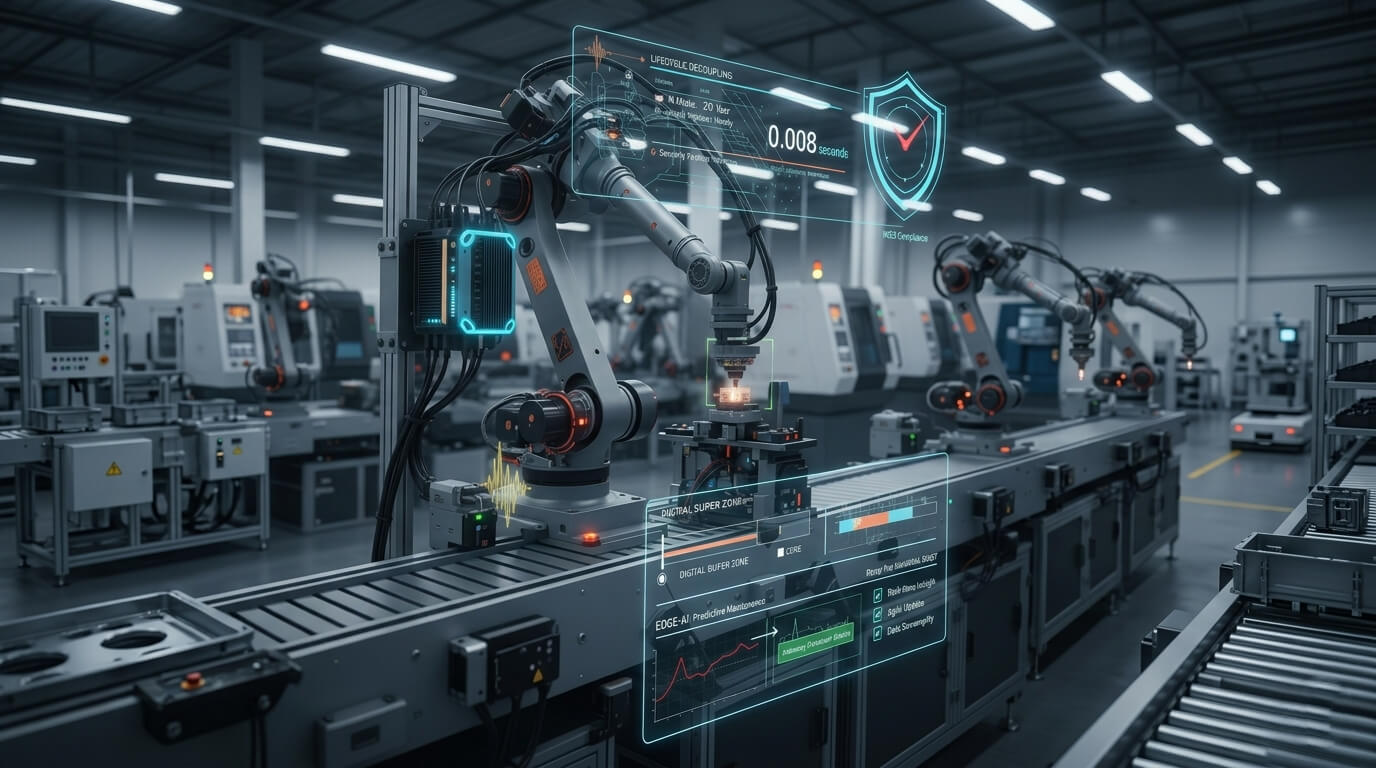
The decisive advantage lies in lifecycle decoupling. While a machine may be in use for 20 years, AI models often become obsolete after 12 months, and security patches must be applied weekly. A modern Edge architecture acts as a "digital buffer zone." It allows you to update software and AI inference at lightning speed without ever touching the machine’s certified OT core. Without this buffer, every digital update risks expensive downtime and laborious re-certification.
What role does Edge AI play in preventing production outages?
AI at the Edge means inference instead of training. This means the decision is made directly at the machine—in under 10 milliseconds. Whether it’s visual quality control at over 500 fps or predictive maintenance through high-frequency vibration analysis, Edge AI detects anomalies before damage occurs. The whitepaper provides the exact performance requirements for these use cases, ensuring you don’t invest in underpowered hardware.
How do you secure your systems against new regulatory requirements like NIS2?
The margin for insecure systems is shrinking. Since October 2024, the NIS2 Directive has been mandatory, holding mechanical engineering accountable as part of critical supply chains. Those who cannot demonstrate documented update processes and hardware security features like Secure Boot or a TPM 2.0 chip will soon find themselves unable to deliver. The whitepaper explains IT security at the Edge not as an add-on, but as an integral component of a production-ready architecture.
Which manufacturer strategy leads to long-term success?
The choice of manufacturer is not a mere purchasing decision; it is a fundamental architectural choice. Maximum processing power is rarely the primary criterion; instead, long-term availability (> 7 years) and a stable software stack determine the Total Cost of Ownership (TCO). We compare IPC specialists, AI champions, and embedded providers for you in a detailed matrix.
⚡️ Stop the digital risk – Start scaling!
The competition never sleeps. Those who hesitate now will cement outdated structures that will no longer be competitive in two years. Use our field-tested decision-making guide to turn Edge Computing from a "project" into a stable "series platform."
What to expect in the document:
- Structured Evaluation Framework: Hardware evaluation that goes beyond simple data sheets.
- Detailed Use-Case Analyses: From Computer Vision to retrofit scenarios.
- Decision-Maker Checklist: Are you ready for Industrial Edge?