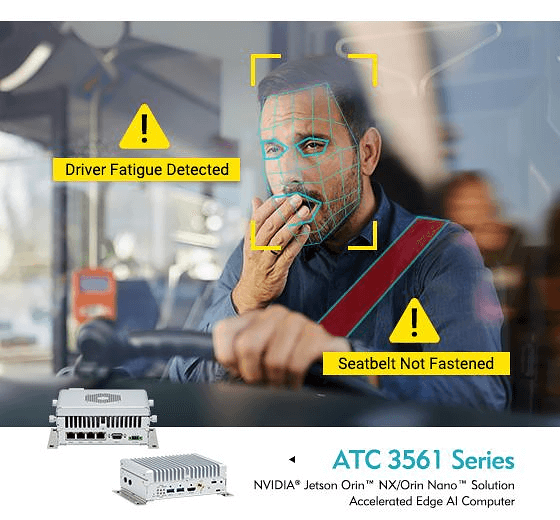
NEXCOM has introduced a new ATC 3561 series of embedded computers designed to enhance passenger safety and reduce road accidents in commercial transportation.
Modern buses are subject to heavy workloads and are often operated on long routes and in harsh weather conditions. This creates a high level of risk for drivers and passengers due to fatigue and lack of concentration. To minimize these risks, a Driver Monitoring System (DMS) has been introduced.
Driver Monitoring System (DMS):
DMS (Driver Monitoring System) is a driver condition monitoring system that uses a camera and artificial intelligence to detect signs of fatigue, distraction, or drowsiness. When a dangerous situation is detected, the system alerts the driver with an audible warning and sends a notification to the dispatcher. In this way, DMS enhances driving safety and helps prevent accidents by analyzing factors such as yawning, eye closure, looking away from the road, smoking, or mobile phone usage.
To implement a DMS solution, operators require modern GPUs capable of handling AI and video analytics workloads, high-speed connectivity to cameras and sensors, and reliable storage for collecting and processing large volumes of data.
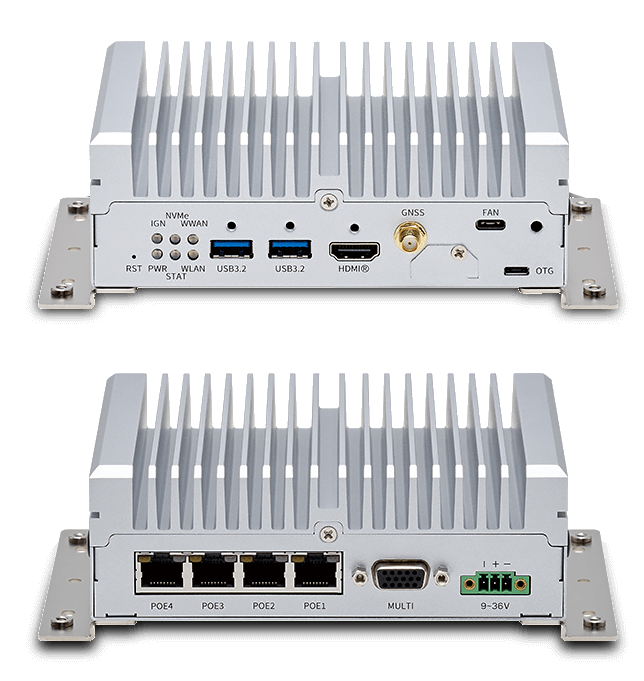
The ATC 3561 series meets all of these requirements, as it is built on powerful NVIDIA Jetson Orin processors that deliver high computing performance for processing large amounts of data from surveillance cameras and sensors. All models in the series support high-resolution cameras and are capable of simultaneously processing up to 18 HD video streams in real time. In addition, support for 5G networks and GNSS technology enables more accurate vehicle positioning on satellite maps.
SUPER MODE
One of the key features of the ATC 3561 series is the SUPER MODE function, which is designed to temporarily boost performance by utilizing greater GPU computing power. Here is how it works:
What does Super Mode do?
Performance boost. Under normal operating conditions, the devices are limited to a certain performance level due to thermal output and power consumption constraints. Super Mode lifts these limits, temporarily increasing performance by overclocking the GPU.
Enhanced AI computing capabilities. As a result, the performance of artificial intelligence (AI) algorithms improves, enabling more efficient image processing, video stream analysis, and decision-making in monitoring and security systems.
When is Super Mode recommended?
- Intensive workloads. When a short-term performance boost is required to process large data sets or handle tasks that demand significant computing resources.
- Real-time monitoring and diagnostics. Improved performance allows more effective tracking of vehicle activity, detection of potentially dangerous situations, and instant delivery of recommendations to the operator.
- Optimized graphics and image processing. With increased computing power, the quality and refresh rate of video streams are improved, leading to better decision-making accuracy.
Important considerations
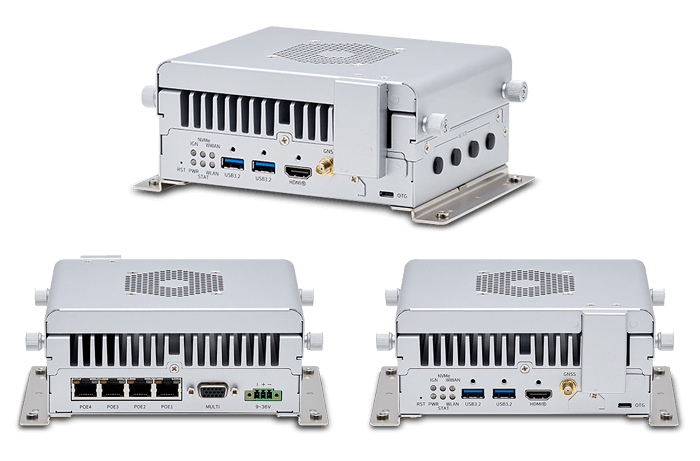
Using Super Mode involves increased heat generation and power consumption, so its operation is limited by continuous runtime and cooling conditions. To stabilize temperature in SUPER MODE, NEXCOM has equipped the entire series with an additional removable cooling fan, and the enclosure design is engineered to withstand harsh operating conditions, including vibration and shock in compliance with MIL-STD-810H standards. The rugged enclosure reliably protects the equipment from environmental impact and ensures stable operation within a temperature range from –25 °C to +60 °C.
Application Scenarios
The series includes three models: ATC 3561-NA4C, ATC 3561-NX4CF, and ATC 3561-NX4CF-16.
Each model differs in performance level and intended application scenario:
- ATC 3561-NA4C: Designed for energy-efficient use cases with support for Super Mode to boost computing power when needed.
Example: Urban public transportation systems, where low power consumption and modest computing workloads are critical. - ATC 3561-NX4CF: Optimized for resource-intensive tasks thanks to a high-performance processor and increased RAM capacity.
Example: Medium-sized transportation operators that require processing multiple video streams and enhanced connectivity (5G networks, GNSS). - ATC 3561-NX4CF-16: The highest-performance version with the maximum amount of RAM, capable of handling even the most demanding AI applications.
Example: Long-haul truck fleets, corporate transportation departments, and specialized delivery services where large data volumes and high processing speed are required.
Key Features:
|
Model name |
|||
|
CPU |
NVIDIA Jetson Orin Nano |
NVIDIA Jetson Orin NX |
NVIDIA Jetson Orin NX |
|
CPU cores |
6 cores |
6 cores (8 GB) / 8 cores (16 GB) |
|
|
Architecture |
ARM Cortex-A78AE |
||
|
Cache |
1.5 MB L2 + 4 MB L3 |
2 MB L2 + 4 MB L3 |
|
|
GPU |
1024-core Ampere with 32 TC |
1024-core Ampere with 32 TC |
|
|
AI performance |
67 TOPS (Super Mode) |
117 TOPS (Super Mode) |
157 TOPS (Super Mode) |
|
API support |
OpenGL 4.6, OpenGL ES 3.2, CUDA 11.4, Vulkan 1.1 |
||
|
OS |
NEXCOM Acceleration Linux (NAL) with JetPack 6.2 |
||
|
RAM |
8 GB LPDDR5 |
16 GB LPDDR5 |
|
|
Storage |
M.2 key M format 2242 PCIe 3.0 x4 NVMe |
||
|
Expansion |
M.2 Key E format 2230 (PCIe 4.0 + USB 2.0) M.2 Key B format 3042/3052 (USB 3.2/2.0) with two nano-SIM slots |
||
|
I/O interfaces |
2xUSB 3.2 Gen1, Micro USB OTG, 4xGbit/s Ethernet PoE+, CAN FD (compatible with CAN 2.0A/B) |
||
|
Display |
HDMI 2.0a/b (max 3840 × 2160, 60 Hz) |
||
|
Acceleration sensor |
3D accelerometer and gyroscope ST LSM6DSLTR |
||
|
Power requirements |
DC 9V ~ 36V |
||
|
Operational temperature |
-25°C ~ 65°C |
-25°C ~ 55°C |
|
|
Dimensions |
179.4 mm × 119 mm × 55.6 mm (without fan) 179.4 mm × 119 mm × 70.1 mm (with fan) |
||
|
Standards and certification |
CE, FCC Class A, UKCA, E-mark |
||
In conclusion, the new ATC 3561 device series from NEXCOM opens up broad opportunities for innovation in the field of transportation safety and monitoring process optimization. Thanks to a combination of advanced technical specifications, robust design solutions, and a wide range of interfaces, these devices become an indispensable tool for commercial vehicle operators seeking to enhance comfort, safety, and fleet durability. The use of modern artificial intelligence technologies and data acquisition systems helps reduce costs, improve transportation efficiency, and ensure the protection of valuable assets and passengers.