NVIDIA introduced the Jetson Orin Nano Developer Kit at GTC 2023 as the definitive entry-level platform for edge AI development. With up to 40 TOPS of AI inference performance, an NVIDIA Ampere GPU, a 6-core Arm CPU, and a reference carrier board compatible with all Orin Nano and Orin NX modules, it removes the cost and complexity barrier that previously limited access to production-grade edge AI hardware. The kit is also now upgradeable to the "Super" software configuration, which unlocks up to 67 TOPS from the same hardware via a firmware update.
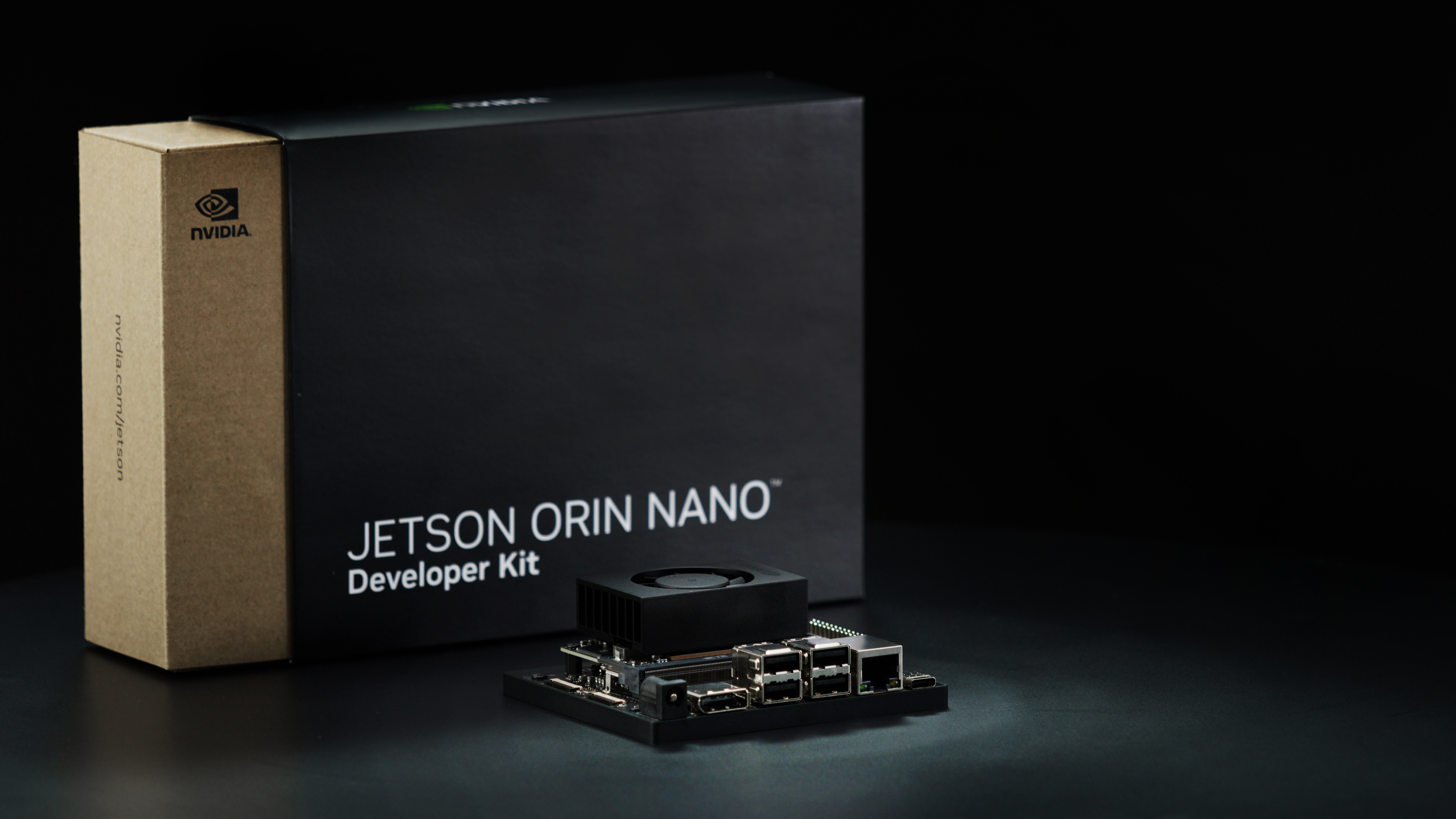
NVIDIA Jetson Orin Nano Developer Kit — Jetson Orin Nano 8GB module with reference carrier board, heatsink, and 19V DC power supply
80× the Performance of the Original Jetson Nano
The original Jetson Nano Developer Kit made AI accessible to a generation of developers, students, and makers. The Jetson Orin Nano Developer Kit raises the bar dramatically — not as a modest refresh, but as a generational platform leap. Compared to the previous Jetson Nano:
Perhaps the most striking figure is 50× performance per watt — the Jetson Orin Nano delivers its massively increased AI throughput within a 7–15W power envelope, making it genuinely viable for battery-powered, solar-powered, and thermally constrained edge deployments where the previous generation would have struggled.
Critically, the Orin Nano is capable of running modern AI model architectures — including transformer models and advanced robotics models — that the previous Jetson Nano simply could not execute at acceptable latency. This is the difference between a platform for AI experiments and a platform for production AI deployment.
Hardware Architecture: What's Inside the Module
The developer kit is built around the Jetson Orin Nano 8GB module, a production-grade System-on-Module that can be purchased separately and integrated into custom carrier board designs for volume product deployment. Understanding the module architecture helps clarify why its AI performance is so much higher than the previous generation.
NVIDIA Ampere GPU — 1024 CUDA Cores + 32 Tensor Cores
The Ampere GPU architecture at the heart of the Orin Nano delivers hardware-accelerated inference via 1024 CUDA cores for parallel compute and 32 third-generation Tensor Cores for matrix multiply operations — the fundamental building block of neural network inference. Tensor Cores accelerate both INT8 and FP16 precision inference, which is the operating precision used by virtually all deployed edge AI models. This combination enables the module to run multiple concurrent AI application pipelines simultaneously — for example, running object detection on a camera feed while simultaneously executing a pose estimation model on the same hardware.
6-Core Arm Cortex-A78AE CPU
The six Arm Cortex-A78AE cores provide the control layer for AI application logic, pre- and post-processing pipelines, system management, and peripheral communication. The A78AE is designed specifically for safety-relevant embedded applications, with Arm's Automotive Enhanced (AE) features enabling split-lock mode — pairing two cores to execute identical instructions in lockstep for error detection — a feature relevant for safety-critical robotics and autonomous vehicle deployments.
8GB LPDDR5 — 68 GB/s Bandwidth
The 8GB of 128-bit LPDDR5 unified memory provides 68 GB/s of memory bandwidth shared between the CPU and GPU, using a unified memory architecture that eliminates the overhead of CPU-to-GPU data transfers that constrain discrete GPU systems. All AI processing — data input, inference, and output — occurs within this shared memory space, enabling faster and more efficient pipeline execution.
What's in the Box
The carrier board is also compatible with separately sold Jetson Orin NX modules (8GB and 16GB), giving developers a single carrier board platform that can scale from entry-level Orin Nano prototyping to higher-performance Orin NX production deployments. Storage is provided externally via microSD card or, for higher performance and endurance, NVMe SSD via the M.2 Key M slots on the underside of the carrier board.
Carrier Board Connectivity
The reference carrier board is designed to expose the full I/O capability of the Orin Nano and Orin NX module families, providing a comprehensive prototyping platform for AI-powered product development:
| Interface | Specification |
|---|---|
| Camera | 2× MIPI CSI-2 22-pin connectors (supports 2-lane and 4-lane cameras, up to 4 lanes per connector) |
| Storage — M.2 Key M (×2) | PCIe Gen 3 x4 (primary) + PCIe Gen 3 x2 (secondary) — NVMe SSD, located on carrier board underside |
| Wireless — M.2 Key E (×1) | PCIe (x1), USB 2.0, UART, I2S, I2C — pre-populated with 802.11ac Wi-Fi + Bluetooth module |
| USB | 4× USB 3.2 Gen2 Type-A + 1× USB Type-C (UFP) |
| Networking | 1× Gigabit Ethernet (RJ45) |
| Display | 1× DisplayPort 1.2 (+ MST support) |
| Storage — microSD | 1× microSD slot (UHS-1, up to SDR104 mode) — bootable |
| Expansion Header | 40-pin (UART, SPI, I2S, I2C, GPIO) — Raspberry Pi GPIO-compatible layout |
| Other Headers | 12-pin button header, 4-pin fan header |
| Power | DC power jack (19V input from included supply) |
| Module Power Draw | 7W – 15W (configurable power modes) |
| Dimensions | 100 × 79 × 21 mm (height includes feet, carrier board, module, and thermal solution) |