Axiomtek has announced the release of a new compact single-board computer, the PICO570, in the Pico-ITX form factor, built on modern Intel Core Ultra processors.
Let’s take a closer look at what this new product offers, going beyond the dry specification lines, and discuss where it can be effectively applied.
In the world of embedded systems, the Pico-ITX format has long established itself as a kind of “golden mean,” where every millimeter of space is critical, yet sacrificing x86 compatibility and full-fledged performance is not an option.
Architecture and performance:
At the heart of the system are Intel Core Ultra (Series 1) processors. Configurations based on the Ultra 7 155U (PICO570-U7) and Ultra 5 125U (PICO570-U5) are available for ordering. The choice of the U-series is entirely logical: in such a small form factor, thermal design power (TDP) is the primary limiting factor, and the use of energy-efficient chips helps maintain a balance between performance and heat dissipation.
One particularly interesting aspect is the graphics subsystem. The board integrates Intel Arc Xe-LPG graphics. For professionals, this means a significant performance boost in tasks related to video transcoding or light GPU computing compared to previous generations of Intel integrated graphics. As is typical for solutions of this class, video memory is allocated from system memory, which brings us to an important point—RAM.
Here, Axiomtek relies on the modern DDR5 standard. The board is equipped with a single SO-DIMM slot supporting DDR5-5600 modules. Officially, support for up to 48 GB of memory is stated in the specifications (although the features description mentions 64 GB, likely depending on the availability of high-density modules). The move to DDR5-5600 is not merely a nod to current trends but a necessity to fully unlock the potential of the integrated Arc graphics.
Connectivity and peripherals:
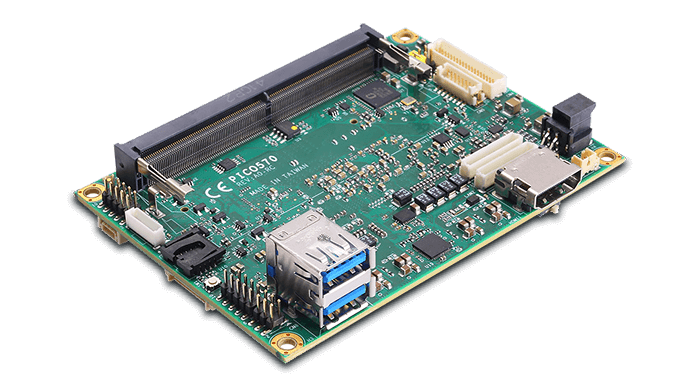
Fitting a rich set of interfaces onto a PCB measuring just 100 × 72 mm is a non-trivial task that requires careful layout design. Axiomtek’s engineers have used the available board space as follows:
Networking:
We see a configuration with two Ethernet ports. One is a classic Gigabit Ethernet port based on the Intel I219-LM controller, while the second is a faster 2.5GbE port using the Intel I226-V. Both support Wake-on-LAN and PXE, which is critical for remote administration and diskless boot scenarios. The presence of two physically different controllers makes it possible, for example, to separate management and data-streaming networks.
Displays:
For video output, the board features a modern HDMI port and—importantly for integrators who need to maintain legacy support—an LVDS interface (18/24-bit). Dual-View mode is supported, enabling the use of two independent displays, a typical scenario for self-service kiosks or medical consoles.
USB and I/O:
On the rear panel (if that term can be applied to an SBC), there is a pair of USB 3.2 ports. For internal connectivity, headers are provided for two additional USB 2.0 ports. A single RS-232/422/485 serial port is also present, which remains indispensable in industrial automation.
Expansion and storage options:
Given the board’s compact dimensions, it is not possible to accommodate traditional PCIe slots, so functional expansion is handled via M.2 slots located on the underside of the board:
M.2 Key M, 2280 form factor: a full-sized slot with PCIe x4 support, designed for installing high-speed NVMe SSDs.
M.2 Key E, 2230 form factor: a slot for installing wireless modules (Wi-Fi/Bluetooth), utilizing PCIe x1 and USB 2.0 lanes.
Operating characteristics:
The board is designed for demanding operating conditions. The specified operating temperature range is from -20°C to +60°C. While not exactly a “military” standard, this is more than sufficient for use in unheated warehouses, outdoor terminals (with an enclosure), or hot industrial workshops.
Power is supplied via a 12V DC source, with support for AT auto power on—automatic startup when power is applied—eliminating the need to place a power button in hard-to-reach locations. For data security, TPM 2.0 is supported via Intel PTT.
The Axiomtek PICO570 appears to be a timely update to the product lineup. The transition to the Intel Core Ultra architecture and DDR5 memory delivers a significant improvement in performance per watt, which is critically important for fanless or space-constrained systems.
This solution is unlikely to appeal to home DIY enthusiasts due to its industrial focus and cost, but for engineers designing medical equipment, compact edge servers, advanced digital signage systems, or industrial controllers, the PICO570 offers an excellent balance between physical size and computing power.