In the segment of industrial automation and embedded systems, the COM Express form factor has long been the "gold standard," providing the necessary balance between compactness and scalability. However, with the growing demands for local computing and neural network processing, classic architectures have become insufficient.
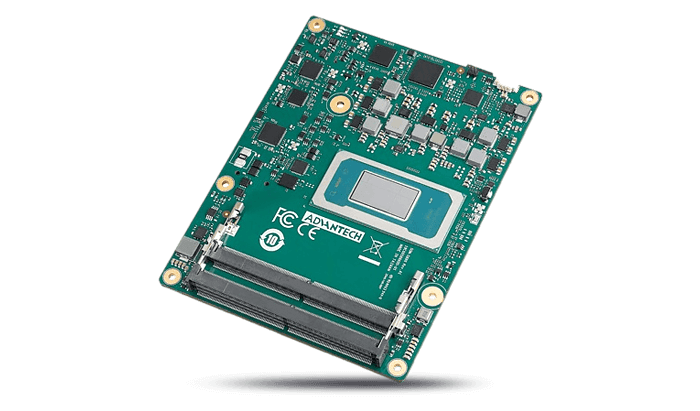
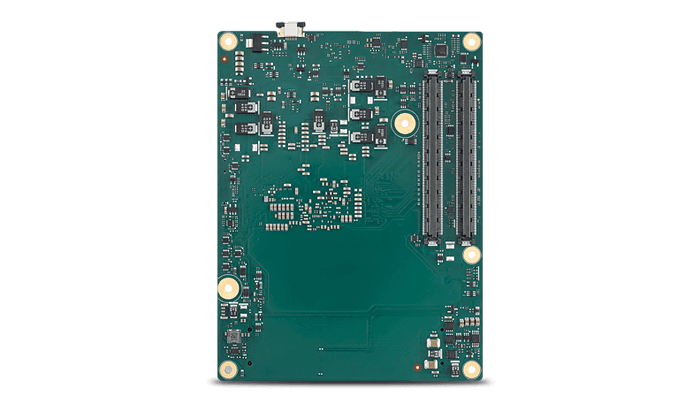
Advantech’s engineers have unveiled their vision for a solution to this problem: the new SOM-5886 module, which brings the power of the Intel Core Ultra Series 3 (Panther Lake) architecture to the proven Basic Type 6 format.
This announcement is not just an update to the CPU lineup, but a comprehensive approach to creating a high-performance unit where the graphics subsystem, neural network accelerator, and high-speed interfaces operate as a single, fine-tuned mechanism.
Computing power
At the heart of the SOM-5886 are Intel Core Ultra Series 3 processors. For developers, this means access to a hybrid architecture that, in top configurations (e.g., the Core Ultra X9 388H), offers up to 16 cores and 20 threads. Importantly, resource allocation is optimized: a combination of performance (P), efficiency (E), and power-saving (LPE) cores allows for flexible power management within a TDP range of 15 to 65 W.
|
Configuration |
Intel Core Ultra |
Turbo boost (GHz) |
Cores/ Threads |
TDP (W) |
Operational temperature |
|
388H |
5.0 |
16 / 20 |
15-65 |
0…60 |
|
|
386H |
4.8 |
||||
|
358H |
4.7 |
||||
|
356H |
4.6 |
||||
|
325 |
4.4 |
8 / 12 |
12-45 |
||
|
368HR |
TBD |
16 / 20 |
15-65
|
-40..+85 |
|
|
336HRE |
TBD |
12 / 16 |
Memory and bandwidth
To realize the potential of the Panther Lake computing architecture, Advantech engineers integrated support for dual-channel DDR5 7200MT/c CSO-DIMM memory, with a maximum capacity of 128GB.
One of the key features of CSO-DIMM modules is the integrated clock generator, known as a Clock Driver (CKD). This component solves the problem of signal degradation during high-speed data transfer, which is often observed in traditional memory modules.
Graphics and AI:
One of the module's most prominent features is the integration of a specialized AI accelerator: a 5th-generation NPU.
The integrated NPU delivers up to 50 TOPS of dedicated performance for machine vision and analytics tasks.
The new Intel ARC GPU architecture (up to 12 Xe cores) not only delivers high rendering speeds but also supports up to four independent 4K displays via HDMI 2.1 and DisplayPort 2.1 interfaces.
For automation systems, this means the elimination of discrete graphics cards or external accelerators.
Interfaces and expandability:
The SOM-5886 emphasizes modern data transmission standards, which is critical for integration into complex ecosystems.
- Network capabilities: the Intel i226 controller is responsible for wired communication, providing speeds up to 2.5 GbE.
- PCI Express bus: the CPU module supports PCIe Gen4 (up to 8 lanes), allowing you to connect high-speed NVMe drives or custom expansion cards without losing performance..
- Next generation USB: The SOM-5886 module supports USB4 integration, which is available as an optional expansion. This standard enables the use of ultra-fast peripherals and universal docking stations, delivering maximum throughput for the most demanding applications.
- This option seamlessly complements the standard interface stack, which includes proven 4xUSB 3.2 Gen2 and 8xUSB 2.0 ports.
It is also worth mentioning is the support for traditional interfaces such as SATA 3.0, UART, GPIO, and even optional CAN bus support via a COM port, which is crucial for the medical and transportation sectors.
Conclusion
SOM-5886 isn't just another iteration in the Advantech lineup. It's a powerful tool that blurs the line between a "simple computer-on-module" and a full-fledged AI workstation. The transition to the Panther Lake architecture with a powerful NPU and ultra-fast DDR5 memory makes this module an excellent choice for those designing expert-class medical equipment, autonomous driving systems, or high-tech digital signage.