 Market Situation SSD | NAND Flash Shortage | AI Impact | Enterprise vs. Consumer | Industrial Solutions | Purchasing Checklist
SSD Market Overview 2026
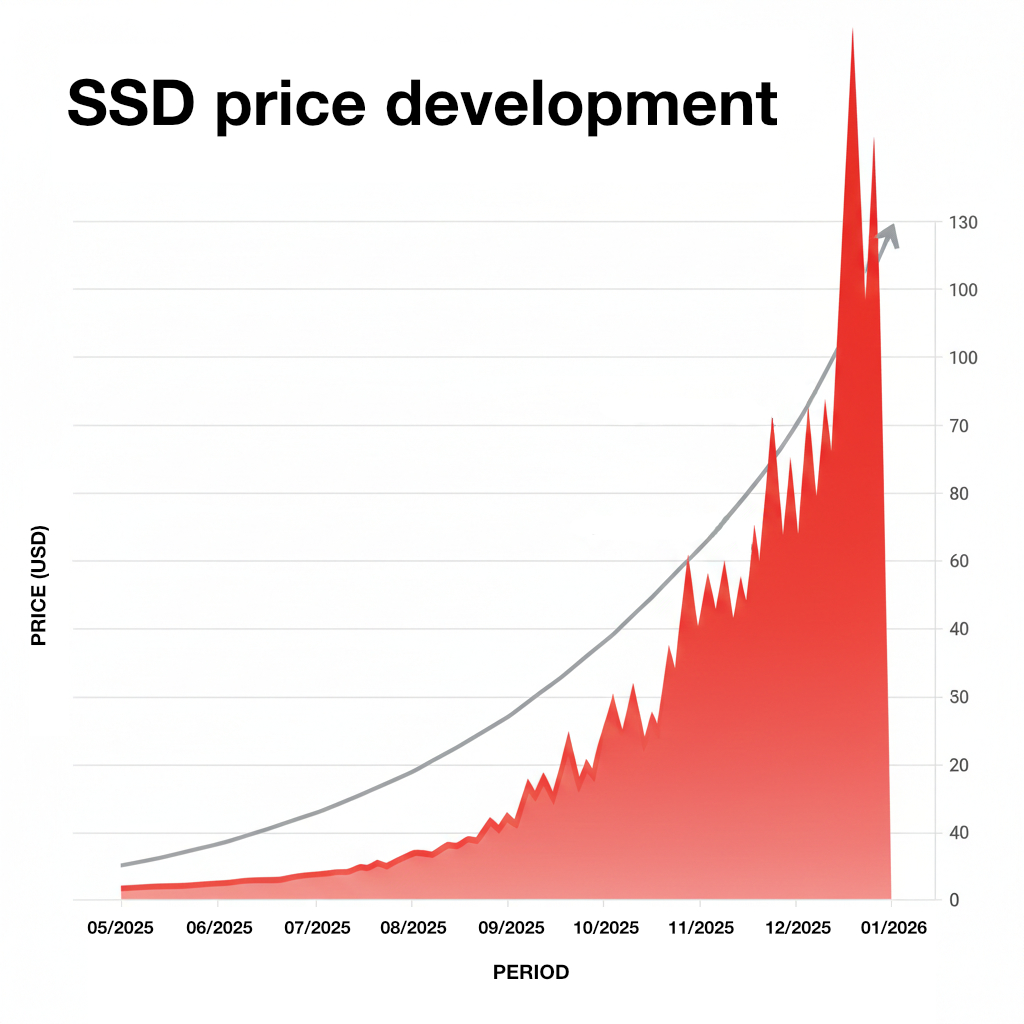
- Trend: Massive price increases for enterprise and industrial SSDs (up to 60%).
- Cause: Global NAND flash shortage due to prioritization of high-end AI servers.
- Forecast: Tight availability at least until the end of 2026; increasing lead times.
- Strategy: Stockpiling and framework agreements to secure prices are essential for B2B projects.
Why are SSD prices rising so sharply in 2026?
The era of cheap storage solutions is over. In 2026, we are facing a price surge that even experts find surprising: Analysts from TrendForce report price jumps of up to 60% for enterprise SSDs.
The main cause is the enormous demand for AI infrastructure, which displaces global production capacity for standard memory chips. NAND flash manufacturers (the base material of every SSD) are currently prioritizing the production of high-margin memory for AI servers. Since factory capacities are limited, bottlenecks arise for conventional industrial SSDs. In addition, higher raw material costs and the complex transition to new chip generations with over 300 layers further increase production costs.
⚠️ Urgent Action Needed: Market availability for Q3 and Q4 2026 is already severely limited. Lead times for specialized modules are already exceeding 16 weeks.
Key Terms Driving SSD Price Development in 2026
To understand the market situation, IT decision-makers need to know the central keywords:
- NAND Flash Shortage: The fundamental component of every SSD is in global shortage.
- AI Displacement: Production capacity is almost entirely diverted to AI infrastructure.
- Allocation: Manufacturers only supply prioritized major customers; smaller quotas are rationed.
- Fixed BOM (Bill of Materials): “Freezing” components – in 2026 the only insurance against unplanned re-certification costs when components change.
- TCO (Total Cost of Ownership): Why the cheapest SSD in 2026 can become the most expensive decision for your project due to high failure rates.
What role does Artificial Intelligence play in the price increase?
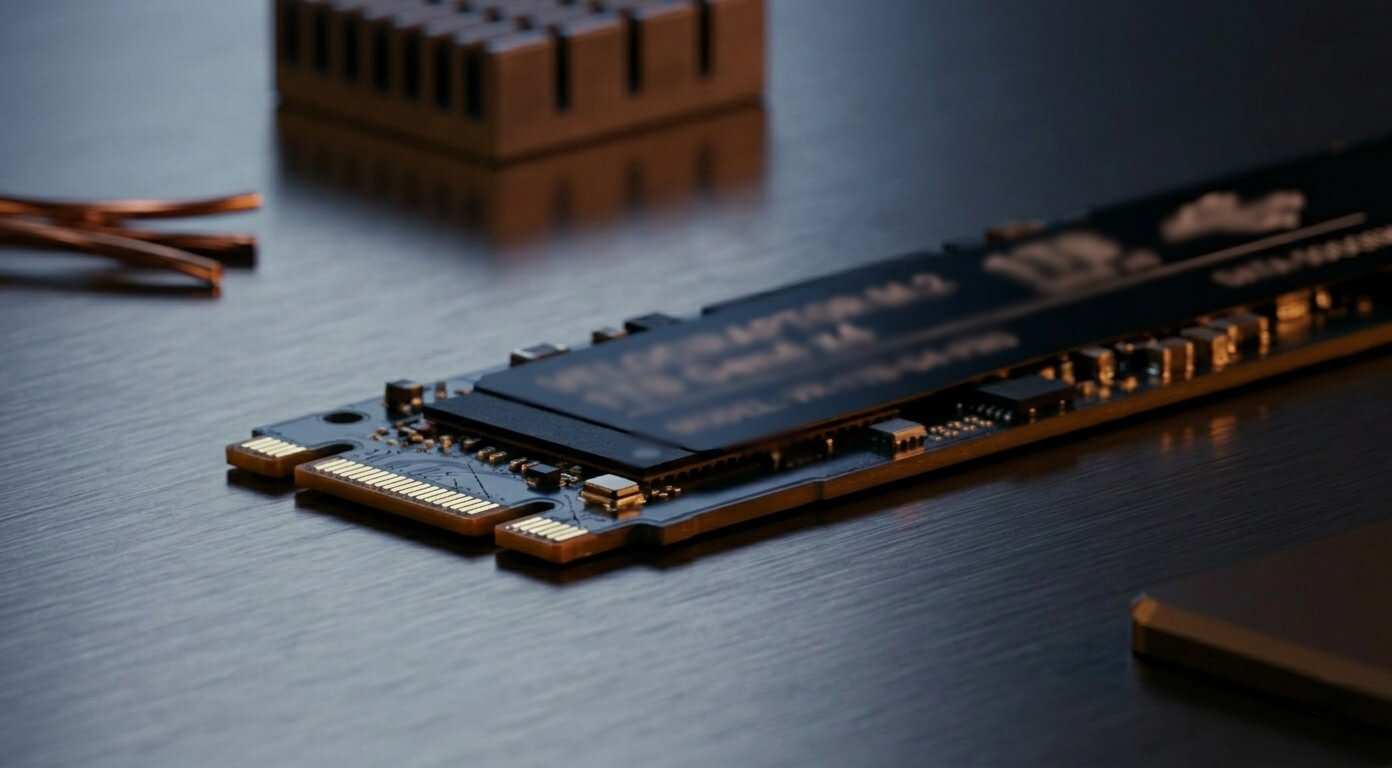
AI systems require specialized high-performance memory produced on the same factories as regular SSDs. These so-called HBM (High Bandwidth Memory) chips occupy valuable wafer space in the factories. Since chip giants earn significantly higher profits from AI components, capacities for standard products are reduced. This means “regular” SSDs for industrial PCs are no longer available in usual quantities, and prices on the open market rise.
Why are industrial solutions more affected than consumer products?
Industrial SSDs rely on long-lasting, stable chip technologies, the production of which is reduced in favor of modern mass-market products. While consumer devices often use cheaper memory (such as QLC), industry requires robust cells (TLC or pSLC). Manufacturers are increasingly shutting down older, stable production lines to make room for new technologies. This makes the reliable modules so important to engineers a rare commodity, with lead times sometimes exceeding 20 weeks.
Three Ways Out of the Crisis: Our SSD Portfolio for Stable Projects
To respond to current market shortages, IPC2U has strategically aligned its portfolio for reliability, performance, and longevity. For your projects, we offer selected series from leading industrial SSD manufacturers:
1. InnoDisk – iCAP Monitoring
- Key Feature: Comprehensive real-time monitoring of SSD health
- Strategic Advantage: Reduces failure risks and lowers Total Cost of Ownership (TCO)
- Use Case: Ideal for critical 24/7 industrial applications where stability and continuous monitoring are essential
2. Apacer – Industrial Grade Durability
- Key Feature: High resistance to shock, vibration, and extreme temperatures
- Strategic Advantage: Ensures reliable performance in harsh industrial environments
- Use Case: Optimal for mechanical engineering, automotive, or any environment with challenging operating conditions
3. ADATA – High-Speed NVMe
- Key Feature: Extremely fast NVMe performance for data-intensive applications
- Strategic Advantage: Ensures fast processing and short response times, even for large data volumes
- Use Case: Perfect for AI, edge computing, and projects with high throughput requirements
With this selection, IPC2U ensures you receive SSDs that precisely match your requirements, regardless of market volatility.
Quality as Cost Insurance: Why It Matters in 2026
Using cheap consumer SSDs in industrial systems often leads to system crashes and costly re-certifications. Consumer products frequently change internal components (controller or firmware) without notice. In industrial control, such a “silent change” can suddenly destabilize the system. Additionally, inexpensive models usually lack physical protection against power loss (Power Loss Protection), which can result in catastrophic data loss during voltage drops.
An industrial SSD provides:
- Fixed BOM: Guaranteed hardware identity throughout the project lifecycle.
- Power Loss Protection (PLP): Protects against data loss via hardware capacitors.
- Wear Monitoring: Allows proactive replacement before defects stop production.
How can companies secure their production for 2026?
Daily fluctuating SSD prices make classic Fixed BOM agreements nearly impossible. Waiting or relying on spot prices risks budget overruns, delivery bottlenecks, and project delays.
IPC2U offers a proven alternative:
Secure your entire annual SSD requirement early. We purchase the quantity in bulk, store it in our warehouse, and deliver just-in-time according to your actual needs.
This means for you:
- Protection against short-term price spikes and market volatility
- Guaranteed availability over the entire project duration
- Identical SSDs in every delivery – no re-qualification or retesting required
- Predictable costs, stable production processes, and reduced project risk
Your advantage:
You benefit from the security of a Fixed BOM without being constrained by unrealistic price fixes from SSD manufacturers. Quality, availability, and cost-efficiency remain under control, even in an unpredictable market environment.
Secure your SSD availability for 2026 now – before the next price increase.
SSD Purchasing Checklist 2026
- Demand Planning: Have you calculated the SSD requirement for the next 12–18 months?
- Second Sourcing: Has an alternative SSD been qualified for the project?
- Durability: Is the TBW rating sufficient for 24/7 operation?
- Supply Security: Is the annual requirement pre-allocated and secured via a warehouse & pull model?
FAQ: The 2026 SSD Price Crisis – Background & Strategies
1. Will SSD prices decrease again in 2026?
Noticeable relief is not expected until late 2026 at the earliest. The main reason is the massive shift in production capacity: major NAND manufacturers are currently prioritizing highly efficient memory for AI data centers. As long as global demand for AI infrastructure exceeds supply, capacities for standard components remain tight and prices stay elevated.
2. Does the increase affect only NVMe SSDs or also SATA?
Price increases affect the entire portfolio, including modern NVMe and traditional SATA solutions. Since both form factors are based on the same NAND flash wafers, the general raw material shortage drives broad price increases. Even if the controller technology differs, flash memory remains the price-determining element.
3. Why are industrial SSDs more expensive than consumer models?
Industrial SSDs are specialized components for demanding environments. The higher price reflects their robust construction, longer lifespan (TBW), and resistance to temperature, vibration, and 24/7 operation.
Supply security is also crucial: classic Fixed BOM models are often hard to implement for SSDs. IPC2U provides a practical alternative: your annual requirement is pre-allocated, purchased in bulk, stored with us, and delivered on demand. Components, prices, and availability remain stable over the entire project cycle – without costly retesting or re-certifications.
4. Should I buy in advance now?
For companies with ongoing or planned projects, strategic stockpiling is strongly recommended. This is not only about price, but primarily about planning reliability. The current crisis threatens both price increases and sudden supply stops (allocation). Covering your 6–12 month requirement now shields you from spot market volatility.
5. What is the difference between SLC and TLC in 2026?
While TLC (Triple-Level Cell) is sufficient for standard applications, pSLC (Pseudo-SLC) remains the gold standard in 2026 for write-intensive tasks. Despite overall price increases, pSLC is often more economical long-term: higher endurance reduces replacement cycles and Total Cost of Ownership (TCO) as well as costly on-site technician interventions.
6. How does the price increase affect industrial PCs?
SSDs have evolved from a low-cost accessory to a central cost driver for entire systems. Industrial PC procurement requires a shift in planning, as memory now significantly drives total system cost. This necessitates more precise demand planning in the design-in phase.
7. Are there alternatives to SSDs?
Currently, there is no technically equivalent alternative to flash storage in the industrial sector. Mechanical hard drives (HDDs) are unsuitable for modern edge computing due to shock vulnerability and low performance. The industry remains dependent on NAND flash availability.
8. How does IPC2U support me in this situation?
IPC2U acts as a strategic partner for stable supply and predictable costs. We offer a tailored pull-model: your annual SSD requirement is purchased in bulk, stored with us, and delivered according to your actual demand.
This ensures:
- Price and supply stability despite volatile markets
- Continuity of your projects without interruptions
- Consistent component quality throughout the project lifecycle
This model replaces classic Fixed BOMs for SSDs, ensuring reliable production – without costly retesting or re-certification.