EDS-408A Series by Moxa
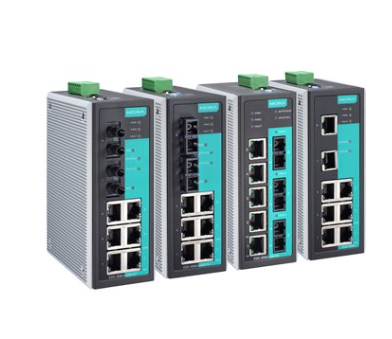
The EDS-408A Series is a range of industrial managed Ethernet switches developed for reliable Layer 2 networking in automation, transportation, energy, and infrastructure projects.
In industrial installations, equipment such as PLCs, HMIs, IP cameras, RTUs, and sensors must exchange data over networks exposed to vibration, extreme temperatures, electrical interference, and aggressive environments. Conventional office-grade switches are not designed for such conditions and often become a weak point in system reliability.
As part of Moxa’s industrial EDS portfolio, the EDS-408A Series combines rugged hardware design, industrial protection standards, and fast redundancy mechanisms to ensure stable communication in demanding applications.
What Is the EDS-408A Series?
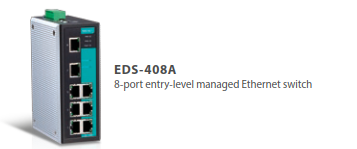
The EDS-408A Series consists of managed industrial Ethernet switches equipped with 8 Fast Ethernet ports. They support advanced Layer 2 features including VLAN, QoS, IGMP Snooping, and multiple redundancy protocols, enabling predictable and secure data exchange between industrial devices.
These switches are well suited for medium-scale industrial networks that require fault tolerance, deterministic performance, and centralized monitoring.
What Is an Industrial Ethernet Switch?
An industrial Ethernet switch is a hardened networking device designed to interconnect Ethernet-enabled field equipment and forward data using hardware-based switching.
Compared to commercial office switches, industrial switches are engineered to withstand:
- Wide operating temperature ranges
- Vibration and mechanical shock
- Electromagnetic interference (EMI)
- Redundant power supply requirements
- Long product availability and firmware maintenance
They form the backbone of communication between PLCs, RTUs, SCADA systems, and field devices in critical environments.
Key Features of the EDS-408A Series
- 8 × 10/100Base-TX Ethernet ports
- IEEE 802.3 / 802.3u Layer 2 switching
- Redundancy protocols: Turbo Ring, Turbo Chain, and RSTP
- VLAN, QoS, and IGMP Snooping for traffic control
- Web-based and SNMP management
- DIN-rail and wall-mount installation
- Dual DC power inputs for redundancy
- Operating temperature up to –40…+75 °C
- Industrial surge, EFT, and EMI protection
Typical Applications
- Factory automation networks
- Railway and metro communication systems
- Traffic control and Intelligent Transportation Systems (ITS)
- Substation automation and power distribution
- CCTV and video surveillance
- Water and wastewater treatment plants
- Machine-to-machine (M2M) and smart building networks
How Industrial Ethernet Switching Works
- Ethernet-enabled devices such as PLCs, HMIs, IP cameras, and sensors connect to the EDS-408A ports.
- The switch forwards Ethernet frames between devices at line speed.
- Managed functions such as VLAN and QoS organize and prioritize traffic.
- Redundancy protocols (Turbo Ring, Turbo Chain, RSTP) automatically reroute traffic when a link failure occurs.
- SCADA and control systems access all connected equipment through a resilient Ethernet infrastructure.
Configuration and Management
The EDS-408A Series can be configured using:
- Web browser interface
- SNMP-based management tools
- Moxa MXview network management software
Configurable parameters include:
- IP addressing and subnet configuration
- VLAN segmentation
- Redundancy topology and protocol selection
- Port speed and duplex settings
- QoS policies
- Alarm events and diagnostic monitoring
Industrial and Transportation Use Cases
Intelligent Transportation Systems (ITS)
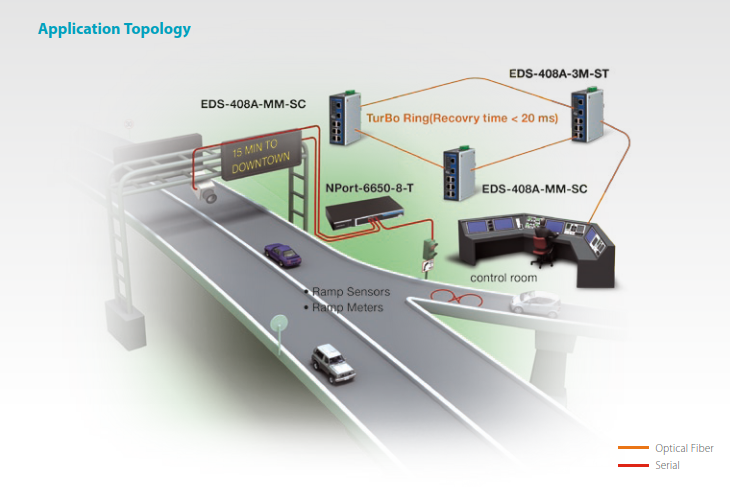
In urban and highway traffic management projects in the USA and China, EDS-408A switches are deployed in roadside cabinets to interconnect traffic controllers, message signs, and video cameras with central traffic servers. VLAN and QoS ensure separated and stable data streams.
Energy and Utilities
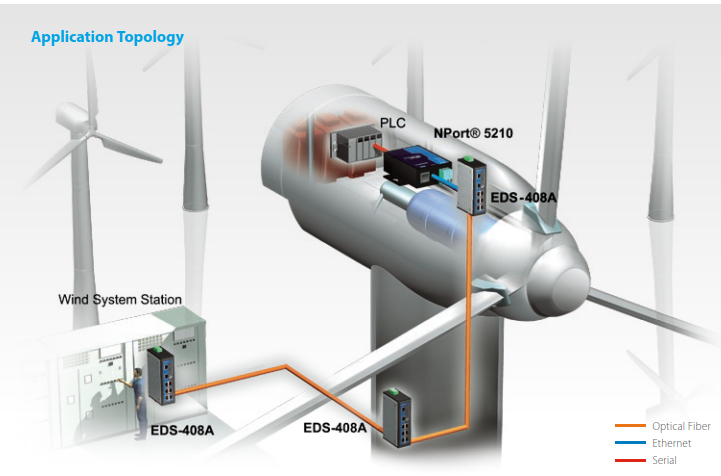
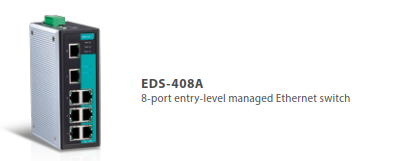
In renewable energy facilities and substation automation systems, EDS-408A switches connect RTUs, protection relays, and SCADA servers into redundant Ethernet topologies for uninterrupted monitoring and control.
Typical deployment scenarios include:
- Medium-scale industrial backbone networks
- Redundant factory Ethernet segments
- Trackside and station automation networks
- ITS field communication nodes
Comparison with Alternative Industrial Ethernet Switches
Moxa EDS-408A Series
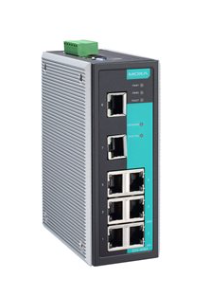
Advantages: Rugged design, wide temp options, fast recovery (Turbo Ring), and support for protocols like Modbus/TCP and EtherNet/IP.
Limitations: Fast Ethernet only (10/100 Mbps) and lower switching capacity compared to modern Gigabit products.
Summary: Reliable choice for traditional networks where ruggedness is prioritized over speed.
Antaira LMX-0800 Series
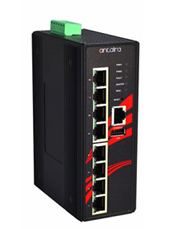
Advantages: IP30 design, strong ESD protection, ERPS ring support, and dual DC inputs.
Limitations: 10/100 Mbps ports on base models and less comprehensive security controls.
Summary: Economical and rugged, ideal for essential managed features without Gigabit needs.
Kyland SICOM3000A-8T-L5-L5
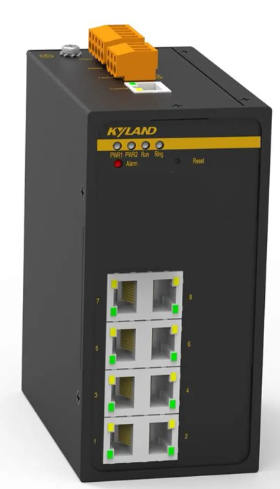
Advantages: Suited for harsh environments and diverse DC supply voltages.
Limitations: Management depth and benchmarks are less transparent compared to peers.
Summary: Focused on hardware durability and plant floor applications.
PLANET IGS-801M
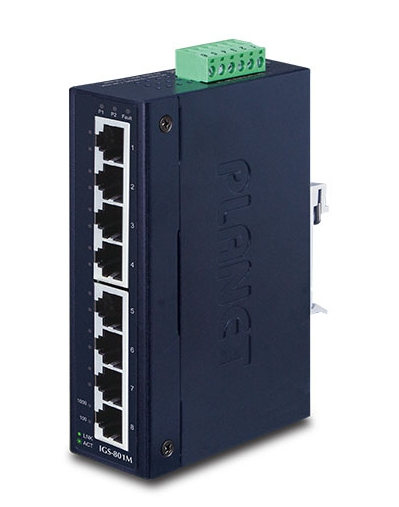
Advantages: Full Gigabit performance (8x10/100/1000 Mbps), advanced security (802.1X, ACLs), and secure management (TLS/HTTPS).
Limitations: Potentially over-engineered for simple needs and higher price point.
Summary: Ideal for demanding environments requiring both speed and advanced control.
Network Integration and Security
Industrial Ethernet switches such as the EDS-408A integrate easily into PLC, SCADA, RTU, and IP camera networks. They can be combined with industrial firewalls, routers, and VPN gateways to create segmented and secure industrial networks with controlled remote access.
The Moxa EDS-408A Series remains a reliable solution for building industrial Ethernet infrastructures in automation, transportation, and energy sectors. Its rugged construction, mature management functions, and proven redundancy mechanisms make it suitable for mission-critical communication networks.
Although alternatives from PLANET, Antaira, and Kyland address specific project requirements, the EDS-408A Series continues to stand out due to its long-term stability, comprehensive Layer 2 feature set, and industrial-grade performance.