ICP DAS has introduced a new series of multifunctional power meters: PM-4324AP and PM-4324AP-MTCP. These devices are designed to monitor power consumption in distribution cabinets, metering boards and energy management centers, where several input circuits must be accounted for at once. These meters are ideal for buildings with a large number of tenants: residential complexes, shopping centers, business centers, as well as industrial facilities.
Universal metering of up to 24 single-phase or 8 three-phase circuits
The PM-4324AP series meters are capable of monitoring up to 24 single-phase lines or up to 8 three-phase circuits. This is achieved by using external current transformers (CT) with an output of 333 mV. Thus, PM-4324AP and PM-4324AP-MTCP allow you to organize centralized and detailed electricity metering at the facility without the need to install a large number of individual meters. It is important to note that current transformers are not included in the delivery set and are purchased separately. The following transformer models are recommended for use:
|
Model name |
Max current (A) |
Diameter (mm) |
|
|
CA-SCT10P-005A-L040-3P |
5 |
10 |

|
|
CA-SCT10P-60A-L040-3P |
60 |
10 |
|
|
CA-SCT16P-100A-L040-3P |
100 |
16 |
|
|
CA-SCT24P-200A-L040-3P |
200 |
24 |
|
|
CA-SCT36P-300A-L040-3P |
300 |
36 |
|
|
CA-SCT36P-400A-L040-3P |
400 |
36 |
Models that have numeric designations before the letter “P” in their names already include current transformers, the dimensions and current calculation of which depend on the designation; for example, the designation “160” in the model name PM-4324-160P-MTCP means that the packing list includes transformers with a diameter of 16 mm (0.1 A ~ 100 A).
Differences between PM-4324P and PM-4324AP
ThePM-4324Pmodel is a basic version, designed to work with one main circuit. It supports connection of up to 24 current channels and is compatible with various electrical network configurations: 3P4W, 3P3W, 1P3W, 1P2W.

The newPM-4324APmodel is an advanced version which has two independent voltage inputs (V1 and V2), allowing monitoring of two separate power systems simultaneously. This is especially useful in situations where monitoring of both the common power input and the backup line or parallel networks is required. If necessary, both inputs can be combined, and then the device will function identically to the PM-4324P model.
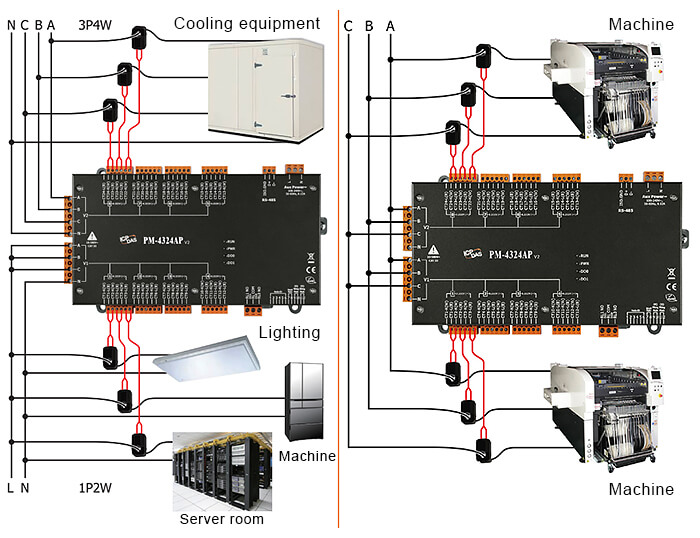
Note: when using two circuits V1 and V2, it is important to make sure that the transformation ratios and connection configurations are identical; only under this condition the correct data display is guaranteed.
Key interfaces and protocols support
Models with different interfaces are available for integration into SCADA systems and energy monitoring:
- RS-485 (Modbus RTU): PM-4324P / PM-4324AP;
- Ethernet (Modbus TCP): PM-4324P-MTCP / PM-4324AP-MTCP;
- EtherNet/IP: PM-4324AP-EIP (under development);
- CANopen: PM-4324AP-CPS (under development).
This variety of choice allows the solution to be adapted to any existing infrastructure without the cost of protocol gateways or network redesign.
Model name meaning
- "A" in the model name means two independent voltage inputs (dual voltage input);
- "P" means support for current transformers with 333 mV output, standard for measurement tasks. Rogowski coils are not supported;
- "MTCP", "EIP", "CPS" indicate network protocols: Modbus TCP, EtherNet/IP and CANopen, respectively.
Technical features and advantages
- True RMS voltage and current measurements;
- Monitoring of active, reactive and apparent power and energy (kW, kVA, kvar, kWh, kvarh, kVAh);
- Support for bidirectional metering (import/export), including for solar power plants and generators;
- Data updates every second, which ensures high relevance of monitoring;
- Support for harmonics measurements;
- 2 relay outputs for alarms and automatic response to threshold exceeding;
- Interface isolation up to 3000 Vdc;
- Compact dimensions; can be flush mounted in existing panels;
- Operational temperature range from -20 to +70 °C;
- Compliance with IEC 61010-1 / EN 61010-1 standards.
Application examples
- Accounting for electricity consumption by tenants (office buildings, shopping centers);
- Control of distribution lines and production units;
- Integration into dispatching and SCADA systems
- Accounting for input/output of electricity at facilities with alternative power sources